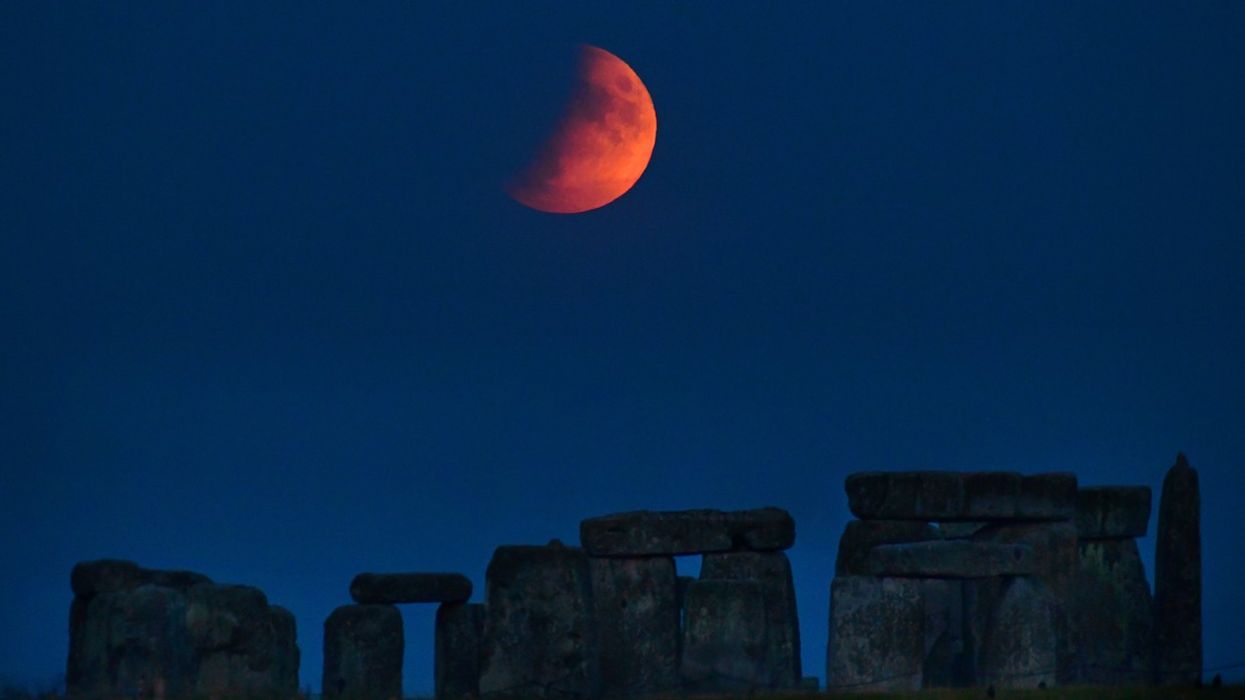

In the early hours of Friday morning, stargazers across the UK were treated to a partial lunar eclipse, with many enthusiasts rising before dawn to catch a glimpse. The celestial event, which saw the Earth's shadow partially covering the Moon, began at 05:09 GMT. Although only partial for most UK observers, it still presented a spectacular sight, with western parts of the country and regions further afield, such as the Americas and some Pacific islands, witnessing the eclipse.
For some, like Kathleen Maitland, the experience was magical. Stargazing from Pagham Harbour in West Sussex, she described the beauty of watching the Moon gradually darken and transform into a reddish hue, with the sunrise unfolding behind her. The eclipse gave rise to the so-called "blood Moon," a phenomenon that occurs when the Moon moves into the Earth’s shadow, turning a dusky red as sunlight is refracted through the Earth's atmosphere.
Jake Foster, an astronomer from the Royal Observatory in Greenwich, provided insight into the science behind this stunning transformation. As sunlight passes through the Earth’s atmosphere, shorter blue light wavelengths are scattered by small particles, leaving the longer red wavelengths to reach the Moon, giving it that characteristic red glow. This process, known as "Rayleigh scattering," is the same effect that makes the sky appear blue and gives sunsets their reddish tones.
A lunar eclipse occurs when the Earth moves directly between the Sun and the Moon, blocking sunlight and casting a shadow on the lunar surface. For a total lunar eclipse to occur, the Earth, Sun, and Moon must be in perfect alignment. During this time, the Moon is fully submerged in the Earth’s shadow, making it appear blood red. While Friday's event was a partial eclipse for most of the UK, it was a captivating experience for many stargazers and a precursor to the next total lunar eclipse.
This upcoming total lunar eclipse is scheduled for early September and will be most visible over central and eastern Asia. Some parts of the UK may catch glimpses of it, but the full effect will only be seen in certain regions. The last total lunar eclipse occurred in May 2022, when the Moon turned completely red, and this event provided a reminder of nature’s awe-inspiring celestial displays.
The lunar eclipse of Friday may not have been as dramatic as the total eclipses seen in other parts of the world, but it still offered a moment of wonder for those who woke early to catch a view. Observatories, such as LA’s Griffith Observatory, provided livestreams for those unable to see it in person, allowing people worldwide to join in the experience.
For those lucky enough to witness the event in person, the eclipse served as a reminder of the beauty of the natural world, and for astronomers, it was another opportunity to explain the science behind these awe-inspiring events. As the next lunar eclipse approaches, it promises to bring yet another opportunity for people worldwide to marvel at the wonders of the cosmos. Whether observing from the comfort of their homes or gathering at observatories, stargazers will once again have the chance to witness the Moon bathed in the red light of Earth’s shadow.