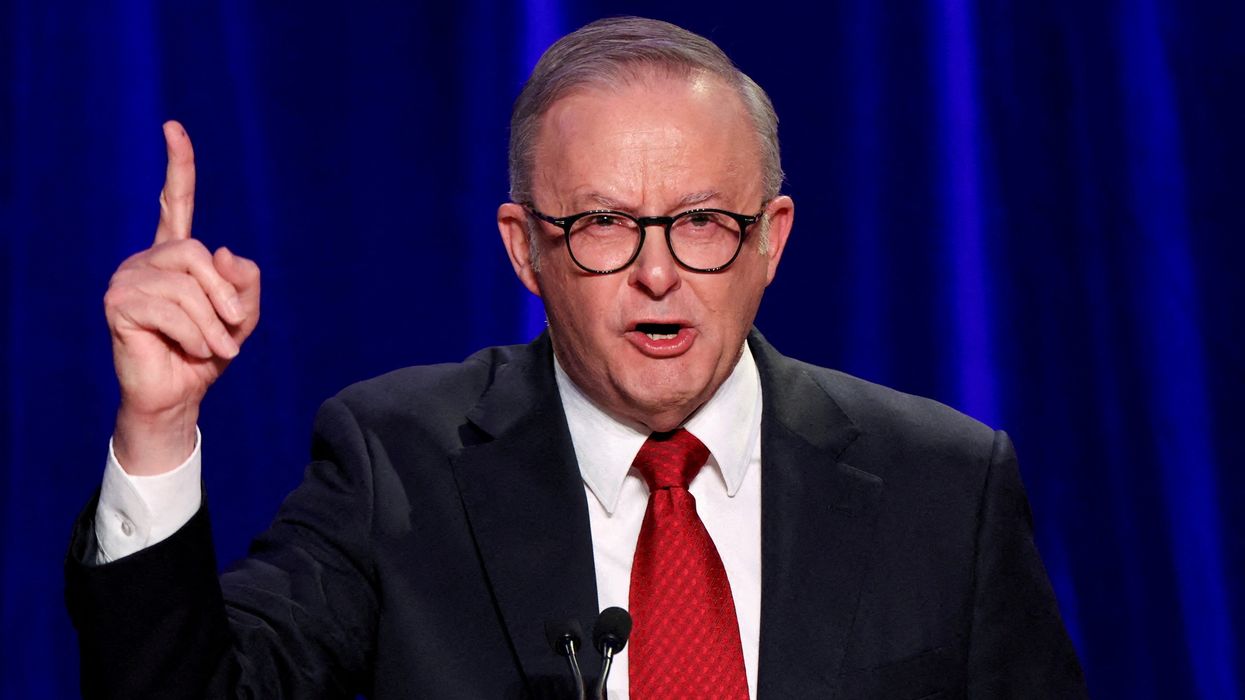

AUSTRALIA’s prime minister Anthony Albanese won the national election on Saturday, with his Labor Party on course for a strong majority. His opponent, opposition leader Peter Dutton, lost his seat.
According to national broadcaster ABC, Labor had secured 85 seats in the 150-member parliament. Dutton’s coalition held 41, other parties had nine, and 15 seats were undecided.
“Today the Australian people have voted for Australian values. For fairness, aspiration and opportunity for all,” Albanese said in his victory speech.
“In this time of global uncertainty, Australians have chosen optimism and determination.”
Albanese’s win came after a campaign focused on economic concerns. He has pledged to invest in renewable energy, address the housing crisis, and improve healthcare. Dutton had proposed cutting immigration, lifting the ban on nuclear energy, and reducing the public service.
Supporters of the Labor Party gathered in Sydney, celebrating with drinks and chanting Albanese’s nickname, “Albo,” as results were announced on television.
Former US president Donald Trump was a point of discussion during the six-week campaign. Albanese criticised Trump’s tariffs, calling them “economic self-harm” and “not the act of a friend.” Dutton said he would “in a heartbeat” challenge any world leader, including Trump, to protect Australia’s interests.
Some analysts said Albanese’s leadership style appealed to voters during a time of instability. “In times of instability, we expect people to go back to a kind of steady incumbent,” Sydney politics lecturer Henry Maher told AFP.
Before results were announced, there was speculation about Dutton’s future. “We didn’t do well enough during this campaign. That much is obvious tonight and I accept full responsibility,” he told supporters in his concession speech.
Voters across Australia cast their ballots in large numbers. Voting is compulsory in the country, with fines of Aus$20 for non-participation, leading to turnout above 90 per cent. Many voters took part in the traditional polling day activity of eating barbecued sausages, while others arrived in swimwear after early morning swims.
Some voters cited concerns over Dutton’s praise of Trump. “I mean, Donald Trump is as mad as a cut snake, and we all know that,” said voter Alan Whitman, 59. “And we’ve got to tiptoe around that.”
Rising prices for essentials such as milk, bread, power and fuel were also major concerns. “The cost of living – it’s extremely high at the moment… Petrol prices, all the basic stuff,” said Robyn Knox, a human resources manager in Brisbane.
The campaign lasted 36 days and included some unscripted moments. Albanese fell backwards off the stage at a campaign rally, while Dutton accidentally hit a cameraman with a football.
Albanese said on Saturday, “Our government will choose the Australian way. We do not need to beg, or borrow, or copy from anywhere else. We do not seek our inspiration from overseas.”
US Secretary of State Marco Rubio congratulated Albanese, calling Australia a “valued ally, partner, and friend of the United States.” He added that Washington looked forward to working with the new government to “advance our common interests and promote freedom and stability in the Indo-Pacific and globally.”
European Commission president Ursula von der Leyen and Indian prime minister Narendra Modi also congratulated Albanese. A Chinese foreign ministry spokesperson, quoted by state agency Xinhua, said Beijing was ready to work with Australia’s new government for a “more mature, stable and productive” partnership.
Ukrainian president Volodymyr Zelensky said Kyiv “sincerely values Australia’s unwavering support and its principled stance on ending Russia’s war.”
(With inputs from agencies)