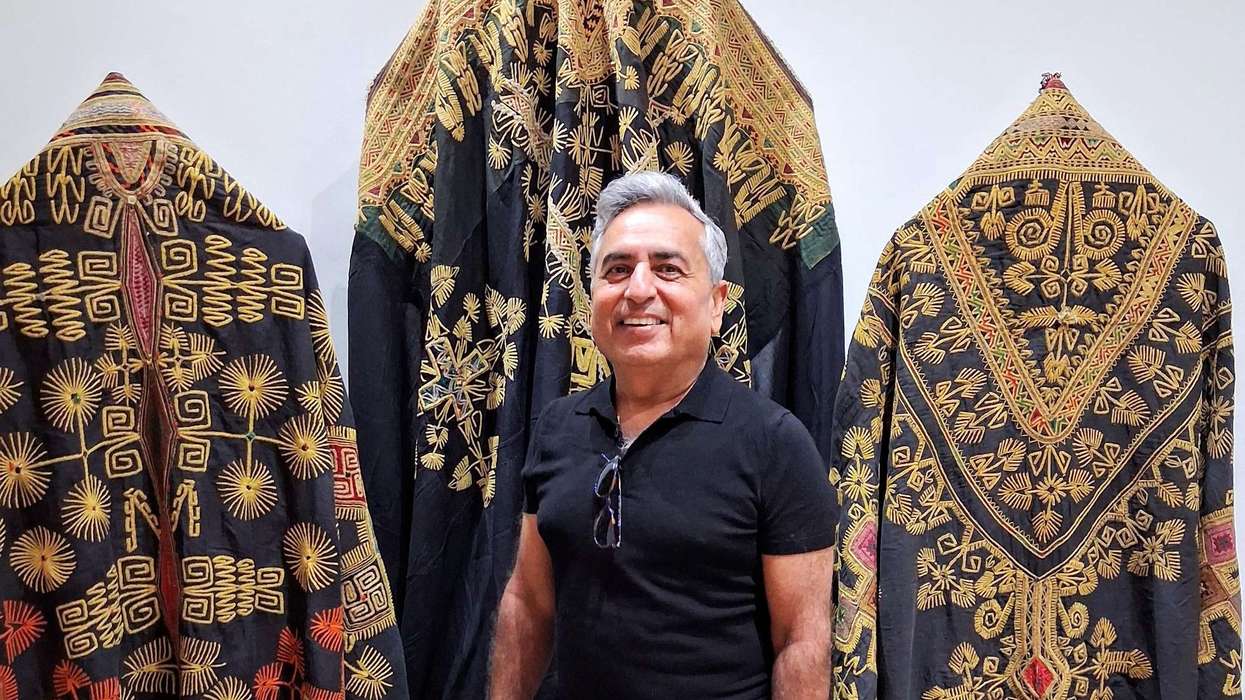

AFGHAN men clearly love their rifles, judging by the embroidered textile cases in which they carry them on their hunting trips.
A couple of these cases can currently be seen in Karun Thakar’s exhibition, Embroidery Traditions of Afghanistan, at the School of Oriental and African Studies’ art gallery in Russell Square, London.
Thakar, who has one of the finest and largest textile collections in the world, told Eastern Eye, “The beautiful embroidery in Afghanistan is done by women and girls, but the tradition is now disappearing”.
When the Soviets invaded Afghanistan in December 1979, between four million and five million refugees fled across the border into North-West Pakistan.
Many traders among the refugees carried textiles with them, but began cutting out the embroidery in order to get some money for survival, Thakar said.
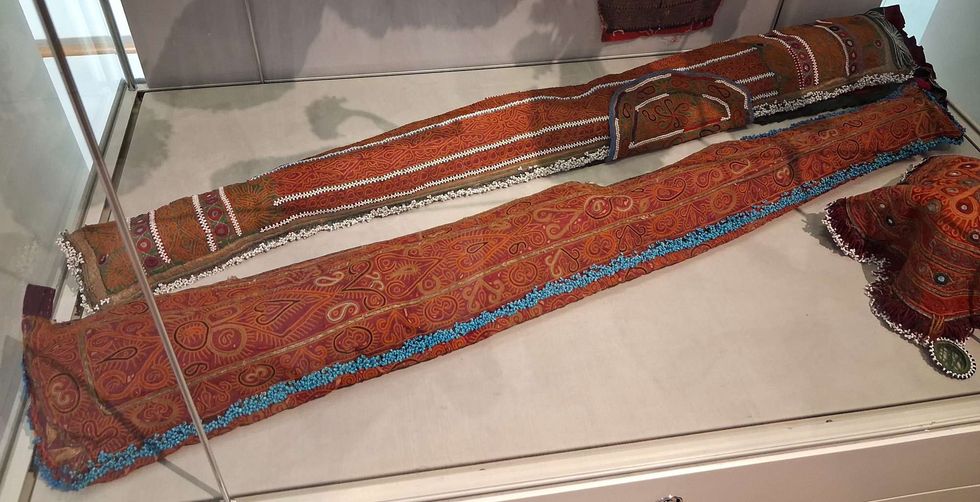 Embroidered rifle casesAmit Roy
He travelled to Pakistan in 1980 and began buying the textiles directly from the traders. He bought the men’s and women’s garments intact with the embroidery.
The exhibition at the SOAS Gallery is a collaboration between Thakar and the V&A, and was inaugurated last week by the V&A director, Sir Tristram Hunt.
There are about 100 items on display, mostly from Thakar’s collection, though the V&A has added some items.
On display is a map of Afghanistan, showing its 34 provinces. Some such as Kabul, Helmand, Kandahar, and Herat have become familiar to people in Britain because of the deployment of British and US troops in Afghanistan. Osama bin Laden is believed to have hidden in the Tora Bora caves situated in the Pachir Wa Agam District of Nangarhar province, ap proximately 50 kilometres west of the Khyber Pass.
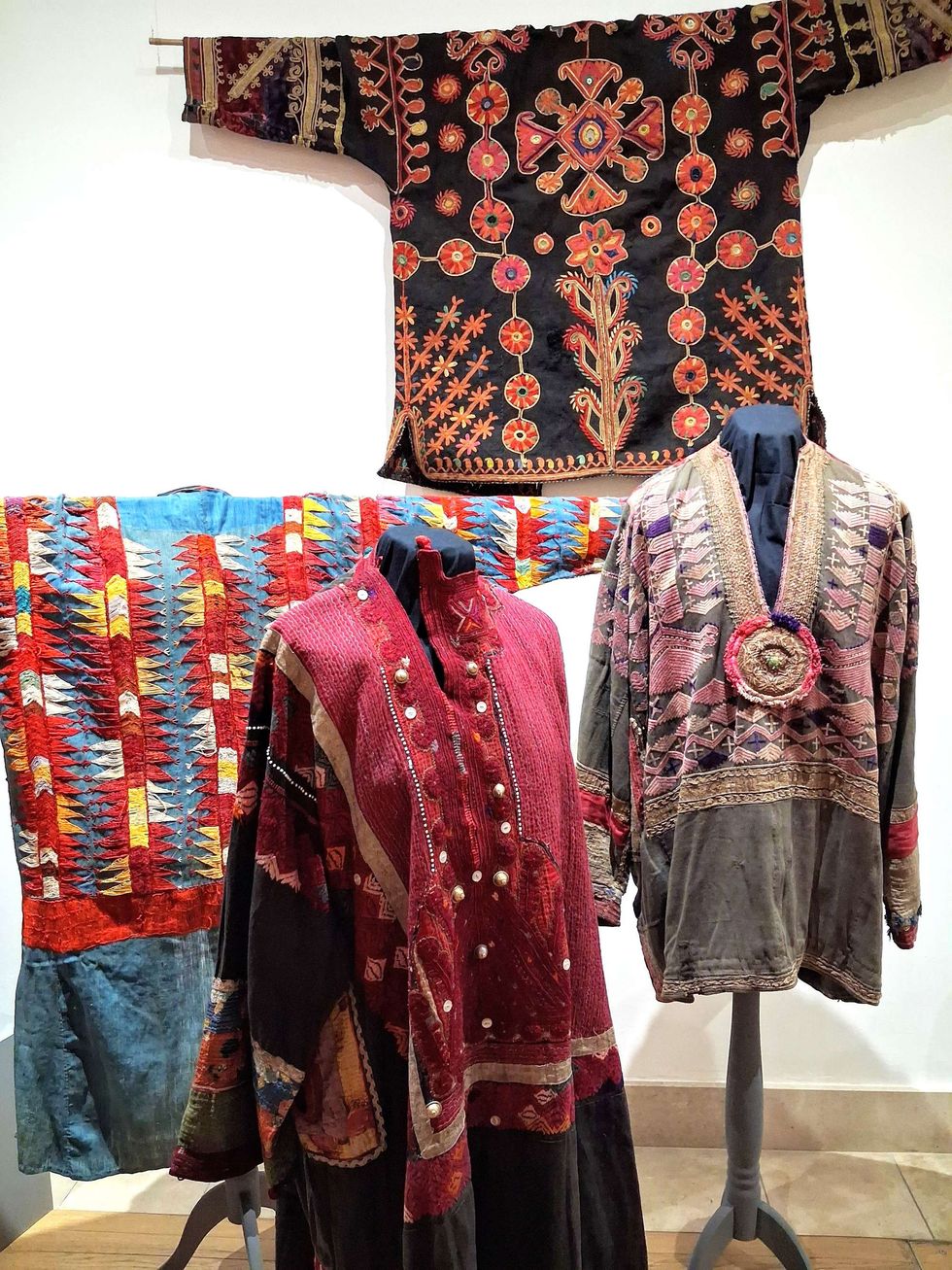 Men’s shirtsAmit Roy
For the Brits, Afghanistan provided the backdrop for “the Great Game”.
In A Study in Scarlet, Sherlock Holmes cordially greets Dr Watson at their first meeting with: “How are you?” He then immediately deduces: “You have been in Afghanistan, I perceive.”
Indians have a more nuanced view of Afghanistan. Afghan traders have long worked in the major cities of India. This is reflected in the nostalgic 1957 Bengali movie, Kabuliwala, which sympathetically tells the tale of Rahmat, an Afghan fruit seller in Calcutta (now Kolkata).
Thakar, too, hopes his exhibition will make people understand that Afghani stan is a country with rich traditions, and should not be viewed just as a war-torn land. The exhibition includes a wide variety of clothes woven with cotton, silk and metal thread.
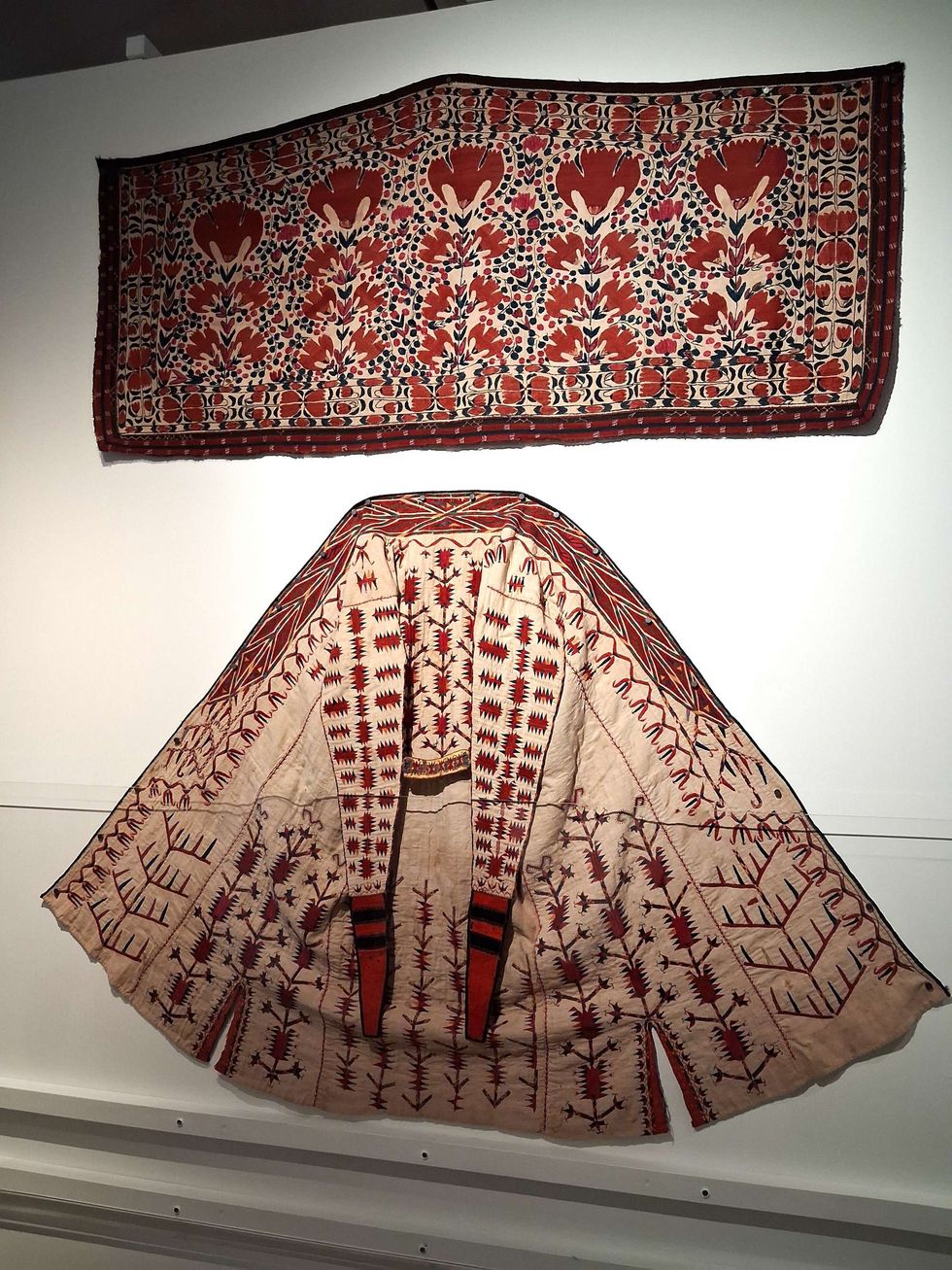 A camel or horse trapping and a woman’s cloakAmit Roy
Along with their rifles, the men love their camels and horses. There are horse and camel trappings made from cotton and silk thread.
“Often referred to as an asmalyk (hanging), these five-sided textiles are generally thought to have decorated camels. Recent research has suggested they should more correctly be referred to as a halyk and were made for horses. What is certain is they were used to adorn the animals of a Turkmen wedding caravan, taking a bride to her new home.”
There are embroidered covers, often used as cushion covers, from Katawaz Pashtun, Paktika or Ghazni regions. “Katawaz embroideries are colourful and often dominated by threads in oranges, reds, and yellows. The embroidery is commonly embellished with beads, often turquoise, and small mirrors.”
While a man’s shirt was more likely to be made from white fabric, women’s dresses were made of fabrics with darker or bolder colours. When they decorated their dresses, women incorporated embroidery styles and motifs which expressed their identities, sometimes further embellished with beads, coins or mirrors. In addition to this intricate embroidery, women would have further adorned themselves with jewellery, such as earrings, necklaces, and bracelets.
A note explains: “This exhibition explores the richness and diversity of textile, dress and embroidery traditions from Afghanistan. Drawing on the many excel lent examples in the collection of Karun Thakar, supplemented by objects from the V&A’s collection, the exhibition reveals the remarkable range of what can be done with a needle and thread.
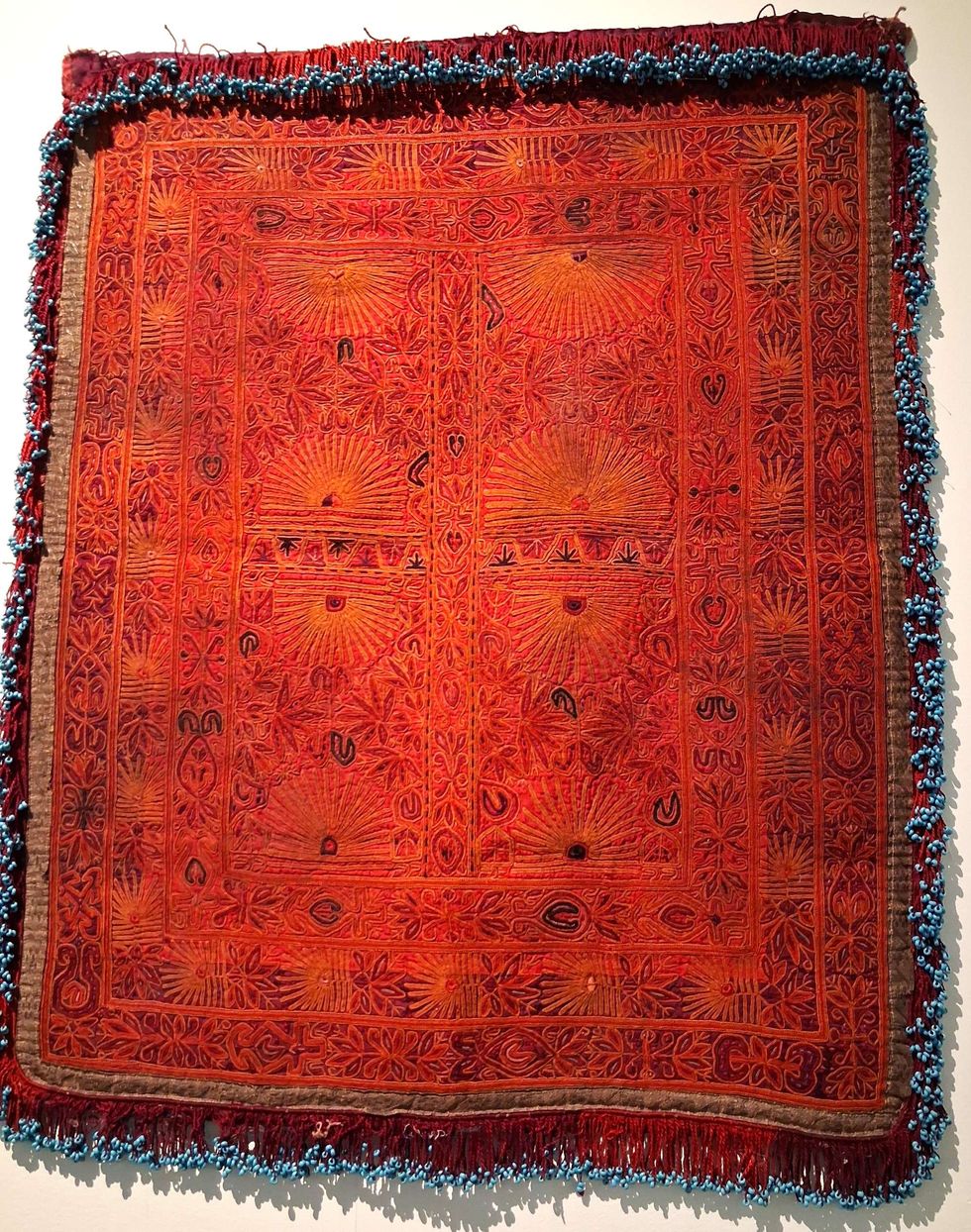 A cushion coverAmit Roy
“Afghanistan has always been a place of many peoples, languages, and cultures. Its diverse geography and mountainous are as mean that numerous distinctive and varied styles of embroidery are found across the country. Largely created by women and girls within the home, elaborately embroidered garments were created to mark special moments in life, such as marriage, but also to be worn every day.
“Embroiderers used a vast array of materials, ranging from silk and wool to beads and coins to decorate both dress and other items.
“Their designs and skilled stitchwork reflect the pattern of their lives, encoding identity and indicating their home region, status, and even their age. However, attributing these objects to particular groups of people can sometimes be challenging, especially where shared geographies meant that techniques and motifs could be exchanged among neighbours. Historically, a lack of borders also meant that people, such as Uzbeks and Turk men, moved about, carrying their embroideries with them.
“Embroidery Traditions of Afghanistan celebrates the makers and users of these textiles, through the colourful variety and skilled artistry on display. In particular, the aim is to make visible less frequently published or displayed objects, to encourage wider conversation about and study of these beautiful and important embroidery traditions.”
The SOAS Gallery adds: “Afghanistan has always been a territory of numerous peoples and cultures. The Hazara people, the Pashai, Pashtuns of many tribes, Tajiks, Turkmens, Uzbeks and many more have lived in and around the geographically varied regions of Afghanistan. As well as having their own languages, cultures, and customs, all these groups have vibrant and distinctive textile traditions.
“Displaying items of dress for women and men, bags, other accessories and more surprising objects, such as bicycle seat covers, this exhibition reveals the embroidered world of Afghanistan.
“While traditional and local dress is still worn across the country today, the exhibition represents many styles and techniques, which are now lost or disappearing. Highlights include remarkable nine teenth-century Arabatchi coats embroidered in red on blue; rarely displayed Mangal and Pashai shirts; a collection of bold women’s capes with yellow stitches on a black ground; and an uncommon ex ample of a green Kandahari woman’s face veil, embellished with distinctive khamak (satin stitch) decoration. These are displayed alongside head coverings for men and women, furnishings for the home, such as the Uzbek suzani, and Lakai deco rations, as well as covers for weapons, food wraps, and lengthy turban cloths.
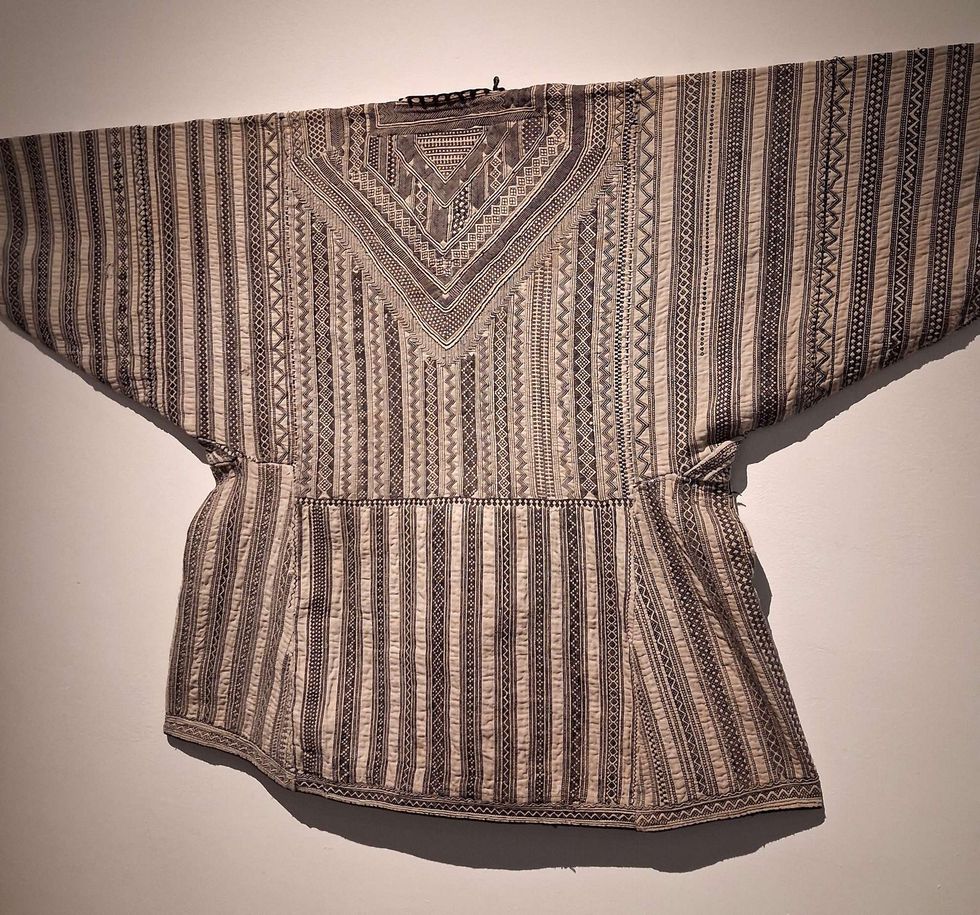 A man’s shirtAmit Roy
“Through silk, beads, coins, blanket stitch, and couching, these embroidered objects invite us into the lives of their makers and wearers. Symbols, materials, and colours are important markers of identity, geographies, status and religion, and can also provide protection through amulets and talismans. Embroidery Traditions of Afghanistan celebrates these makers and wearers, through the colourful variety and skilled artistry of their textiles.”
SOAS said while Thakar “initially collected these objects for their beauty, he now wants to emphasise the stories they can tell. Having lived with them for over 40 years, he feels ‘a sense of duty to share these increasingly important traditions which have totally disappeared, so audiences can focus on the creativity which has existed, rather than just seeing Afghanistan as a place in constant turmoil’.”
Embroidery Traditions of Afghanistan: Karun Thakar Collection, developed in collaboration with V&A, runs until September 19 at SOAS Gallery, Thornhaugh Street, Russell Square, London WC1H 0XG. Admission is free.




 Kate Varah Adama Jalloh
 Hiran Abeysekera (Hamlet) in Hamlet at the National Theatre. Sam Taylor
  Ncuti Gatwa as Algernon in The Importance of Being Earnest at the National Theatre Marc Brenner
 Sharon D Clarke as Lady Bracknell in The Importance of Being Earnest at the National Theatre Marc Brenner
  Indhu Rubasingham left and Kate Varah Amit Roy
 The company of Bacchae at the National Theatre Marc Brenner
  Ballet Shoes poster National Theatre
  Rosamund Pike (Jessica) in Inter Alia at the National Theatre resize Manuel Harlan