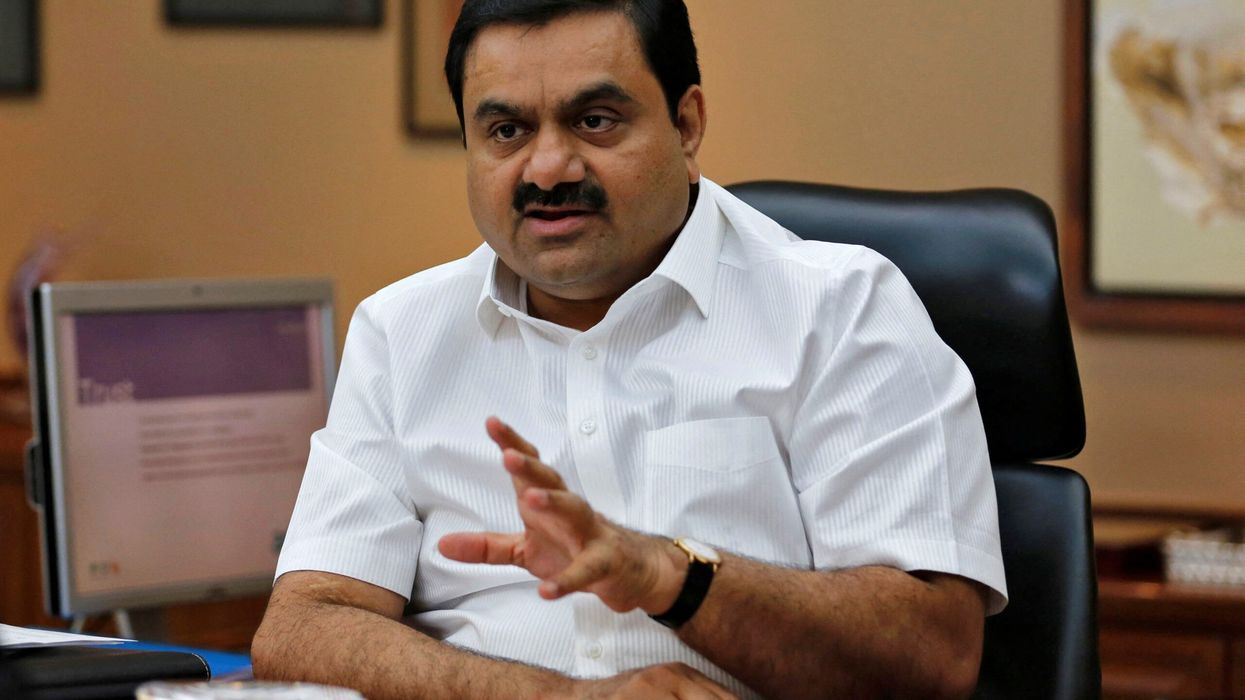

THE US Justice Department said last Saturday (4) it wants to drop charges against Indian billionaire Gautam Adani because the case is primarily foreign, hard to prove and inconsistent with the agency’s current priorities.
District judge Nicholas Garaufis last month ordered prosecutors to justify their decision to drop their case against Adani, whom Biden-era prosecutors charged with securities fraud and wire fraud related to an alleged bribery scheme. The Justice Department last week responded with a 10-page filing outlining why it sought to dismiss all charges with prejudice against Adani and other defendants.
Prosecutors under the administration of former president Joe Biden started a baseless case against Adani with little chance of success, the new filing says.
“The indictment was unsealed in the final days of the prior Administration, apparently as a ‘name and shame’ designed to levy accusations without any realistic prospect of a trial ever occurring,” the court filing says.
US government attorneys should not prosecute a “foreign case” of alleged conduct that involves no criminal organisations and no US companies, and does not affect national security, the Justice Department said.
“The alleged ‘payments’ in this case were made by Indian nationals, working for Indian companies, to the Indian government, with no US interests implicated in any way,” the filing says.
Adani was charged in 2024 with agreeing to bribe Indian government officials so a subsidiary of his Adani Group could win approval to develop a solar energy plant, then misleading US investors by providing reassuring information about his company’s anti-corruption practices.
Adani Group, Adani’s company, has consistently denied wrongdoing. Adani himself has not appeared in US court to respond to the charges.
The decision to drop US charges marked the latest instance in which the Justice Department has sought to end a high-profile white-collar criminal prosecution during president Donald Trump’s second term.
Legal experts say US judges have little discretion to compel prosecutors to continue with criminal cases they no longer wish to pursue, but the charges remain officially pending until Garaufis orders them dismissed. Days earlier, Adani Group announced that Europe’s MSC, the world’s largest container shipping company, would acquire a 49 per cent stake in its deep-water transshipment port in southern India for $1.4 billion (around £1.05bn). Adani described the deal as the single largest foreign private investment in Indian port infrastructure.
The transaction, to be carried out through MSC’s investment arm, Terminal Investment Limited, involves Adani Vizhinjam Port Private Limited, which operates the Vizhinjam International Seaport in Kerala, southern India. The agreement is subject to regulatory approvals and comes as India seeks to reduce its dependence on regional transshipment hubs such as Singapore and Colombo. Adani Ports chief executive Ashwani Gupta said Vizhinjam had “emerged as a premier transshipment hub and ramped up at an unprecedented pace.”
Meanwhile, in a separate announcement last Thursday (2), the Adani Group and Abu Dhabi’s International Holding Company (IHC) signed a memorandum of understanding with the Odisha state government to invest around £8.62bn in an aluminium project in the eastern Indian state. A 50/50 joint venture between Adani Enterprises Limited and an IHC subsidiary will be formed, in what Adani described as India’s largest foreign direct investment in the metallurgy sector.
The project will comprise a refinery capable of producing four million metric tonnes of aluminium annually, a smaller-capacity smelter, and a 4,000-megawatt captive power plant, and is expected to create 53,500 jobs.
IHC chief executive Syed Basar Shueb said: “This partnership with Adani Enterprises reflects that strategy and our shared ambition to develop a world-class integrated aluminium project that creates lasting economic value.”
India remains the world’s second-largest producer of aluminium but continues to depend on imports to meet rising demand from domestic industries. Indian policymakers last year unveiled a strategic plan to scale up domestic production sixfold by 2047 and double the country’s aluminium recycling rate.