
Skip to content
Search

Latest Stories

Submit Guest Post

Senior Swaminarayan saint meets diplomats and scholars during UK visit

During the visit, Madhavpriyadasji Swami offered prayers at the family's home shrine and blessed members of the Devani family and other devotees in attendance.

Senior Swaminarayan saint meets diplomats and scholars during UK visit
Kishan Dewani
xxxx

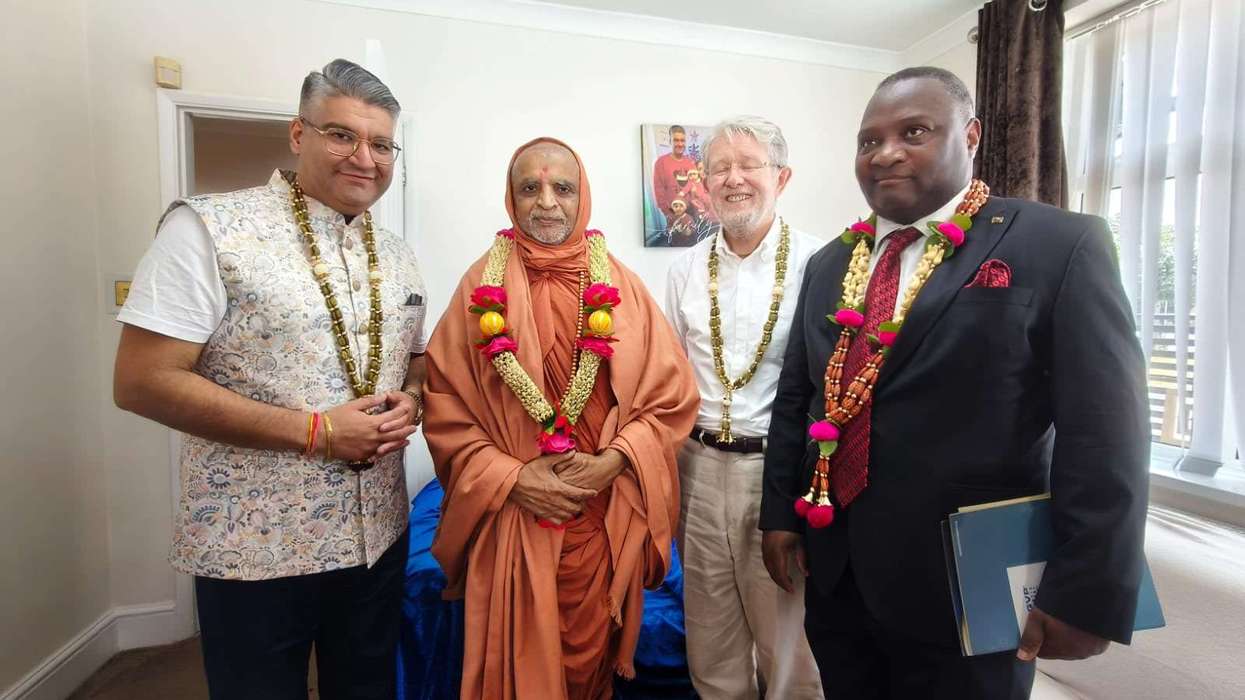
Param Pujya Sadguru Shastri Shri Madhavpriyadasji Swami of the Vadtal Gadi, part of the original Swaminarayan Sampraday, visited the residence of Professor Kishan Devani BEM, where a Thal Utsav, a ceremonial offering of food to deities, and a devotional assembly were held.

The event drew several distinguished guests, including Malawi's High Commissioner to the United Kingdom, Dr Thomas Bisika, and Shaunaka Rishi Das, founder-director of the Oxford Centre for Hindu Studies.


During the visit, Madhavpriyadasji Swami offered prayers at the family's home shrine and blessed members of the Devani family and other devotees in attendance.

The gathering also provided a platform for discussions on global peace, education and the role of spiritual values in contemporary society, according to organisers. The conversations involved the Swami, High Commissioner Bisika and Shaunaka Rishi Das.

Professor Devani, a long-standing devotee of the Vadtal Gadi within the Swaminarayan Sampraday and a well-known figure in Britain's public and community life, described the occasion as a significant moment for his family.

"It is an absolute privilege and a moment of supreme fortune for my family and me that Pujya Swamiji sanctified our home with his holy steps, and that eminent British and international dignitaries gathered together to take part in the Lord's Thal," he said.

Organisers said the event highlighted the growing visibility of Hindu traditions in Britain and reflected the continuing engagement between faith communities, academic institutions and diplomatic representatives.

The Swaminarayan Sampraday, one of the major Hindu traditions with roots in Gujarat, has a substantial presence in the United Kingdom, where its temples and community organisations play an active role in religious, cultural and charitable activities.


Add EasternEye As Your Trusted Source
preferred source on google news

More For You

Ganesh Chaturthi 2026: How British Hindus found a workaround for an 'illegal ritual'

Ganesh Chaturthi

iStock

Ganesh Chaturthi 2026: How British Hindus found a workaround for an 'illegal ritual'

Highlights:

  • Ganesh Chaturthi 2026 begins on 14 September and runs for ten days, ending with Anant Chaturdashi on 23 September.
  • The festival's closing ritual, immersing a clay idol of Lord Ganesha in water, is restricted in UK rivers and lakes under the Environmental Protection Act 1990 and the Water Resources Act 1991.
  • British Hindu communities have spent two decades building workarounds, from Environment Agency-permitted river sites to eco-friendly idols designed to dissolve safely at home.

Every Ganesh Chaturthi ends the same way. Ten days after Lord Ganesha's clay idol is welcomed into a home or temple, it's carried out in procession and lowered into water, so that he can begin his journey back. In Maharashtra, that means the Arabian Sea. In Britain, it means the Thames isn't legally yours to use that way, and the diaspora has been quietly solving that exact problem for twenty years.

Why can't you just do it in the river?

Because British law doesn't make an exception for it. The Environmental Protection Act 1990 and the Water Resources Act 1991 both restrict depositing solid material into protected waterways, and that applies to clay idols and religious offerings just as much as anything else, regardless of intent. The Thames, in particular, is treated as a protected waterway, meaning any activity that could affect water quality or wildlife needs formal authorisation from the Environment Agency and, in London specifically, the Port of London Authority as well.

Keep ReadingShow less