
Highlights
- Murty said the idea came after she noticed students wanting to know more about the murals, but finding little information available
- The launch was attended by Murty’s family, including her husband Narayana Murthy, daughter Akshata Murty and former British prime minister Rishi Sunak
- Kumaran said the murals preserve history through images, symbols and public spaces
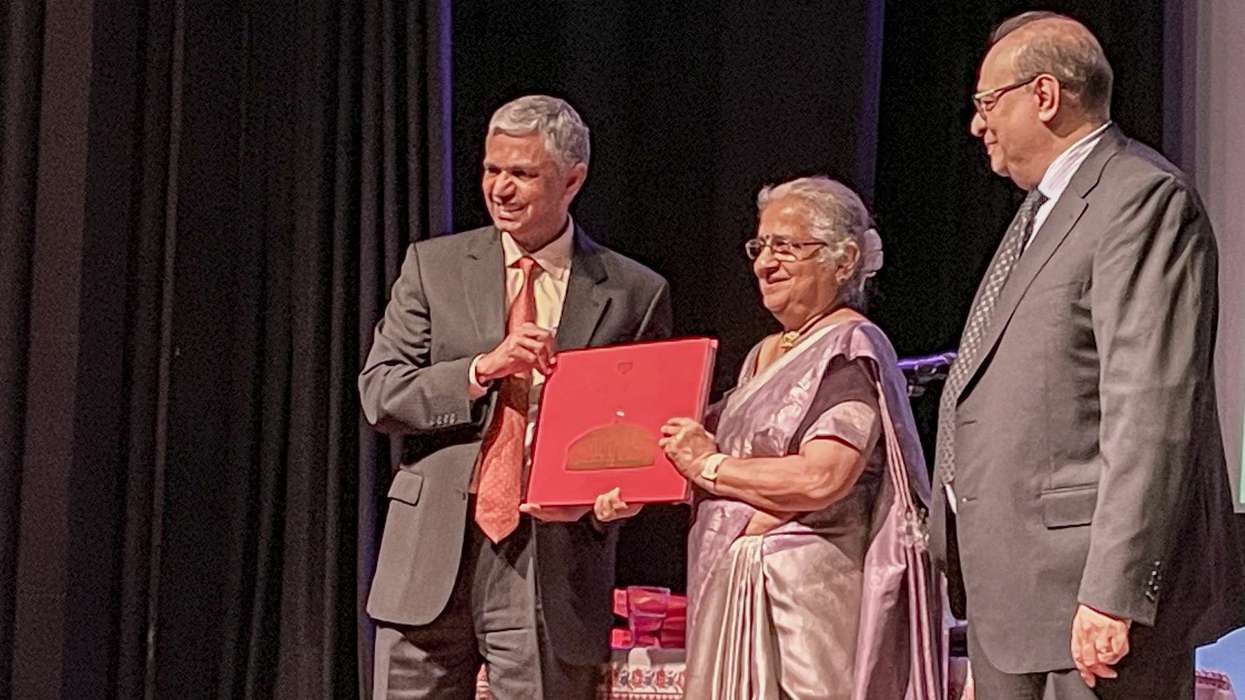
INDIAN parliament member Sudha Murty’s new book, which explores the history behind some of the murals in Parliament, was launched in the UK at the Bharatiya Vidya Bhavan in London.
Tides of Time: Bharat’s History Through Murals in Parliament, published by the Lok Sabha secretariat, was released by Indian high commissioner to the UK, P Kumaran on Friday (12) evening.
Murty was joined at the ceremony by her husband Narayana Murthy, daughter Akshata Murty, son-in-law and former British prime minister Rishi Sunak, and granddaughters Krishna and Anoushka.
“This book has been a labour of love,” Murty said in her address. “If you do not know the history of your country, then you do not know the future of your country... As long as I love to learn and follow my passion in history, I remain young. It helps me learn about my country’s different stages."
The idea for the book came after Murty noticed students pausing before the murals at Samvidhan Sadan. She found that while they were curious to learn more about the stories behind the artwork, there was little information available beyond brief descriptions on copper plates below the murals.
“I have dedicated the book to the people of Bharat – from Mohenjo-daro to the present day, and to all the soldiers who have protected and continue to protect our borders, so that Bharat remains a safe, sovereign and democratic nation,” Murty said.
The book was earlier released in April in Delhi by vice president C P Radhakrishnan and Lok Sabha (lower house of Indian parliament) speaker Om Birla at the Princes’ Chambers of the Old Parliament Building.
“It’s a remarkable book because it reminds us that history is not only written in texts, but is also preserved in images, symbols and public spaces in India,” Kumaran said.
“They are not merely decorative works of art; they are also visual stories of Bharat’s identity and aspirations. What makes this book meaningful is the spirit in which it was written — a work that makes history accessible, engaging and memorable for a wider readership."
Bharatiya Vidya Bhavan UK executive director Dr M N Nandakumara opened the event with a prayer, while Subhanu Saxena, chairman of the cultural organisation in west London, recited shlokas as the book was formally launched.
(PTI)




 Curator Emma Slocombe with ikat robes and arabachi coats in the Peter the Great Room in Blickling Hall Amit Roy
 View of the entrance to Blickling Hall on a rainy autumn dayAmit Roy
 Kente cloth from Ghana in the Long Gallery in Blickling Hall
 Decoration in the Great Hall at Blickling Hall Amit Roy
 Palampore fragment made in coastal south-east India in the Brown Room in Blickling Hall Amit Roy
 Bed valance dating from early 1700s in the Italian Print Room at Blickling Hall Amit Roy
 Indian inspired fabric draped on sofas in the South Drawing Room in Blickling Hall Amit Roy
 Indian inspired fabric draped on sofas in the South Drawing Room with Indian carpet in Blickling Hall Amit Roy
 Karun Thakar has picked out the geometric patterns in the bookcase and the Kente cloth in the Long Gallery in Blickling Hall Amit Roy
 Large tapestry depicting Peter the Great defeating the Swedish army at the Battle of Poltava in 1709 Amit Roy
 ikat robes and arabachi coats in the Peter the Great Room in Blickling Hall Amit Roy
 Baghs and kanthas made by women provide contrast to the men only portraits in the Great Hall at Blickling Hall Amit Roy
 Baghs and kanthas in the entrance Great Hall at Blickling Hall Amit Roy
 Baghs and Kanthas in the Great Hall in harmony with stained glass window at Blickling Hall Amit Roy
 Kimonos reflect Japanese influence in Upper Ante Room in Blickling Hall Amit Roy
 Kimono in Upper Ante Room in Blickling Hall
 A view of the Palace and fort at Agra shows romantic side of India Amit Roy
 Blickling Hall Amit Roy
 Table carpet, European 1670-1680 Amit Roy
 Unfinished 17th century Italian embroidery in the Print Room at Blickling Hall Amit Roy
 Picture of Kashmir shows a romantic view of India Amit Roy
 A panel of Ashburnham bed hangings made in Gujarat for sale in Europe in the Brown Room in Blickling Hall Amit Roy
 Colcha made in the 1600s by women in Bengal for the Portuguese market in the Long Gallery at Blickling Hall Amit Roy