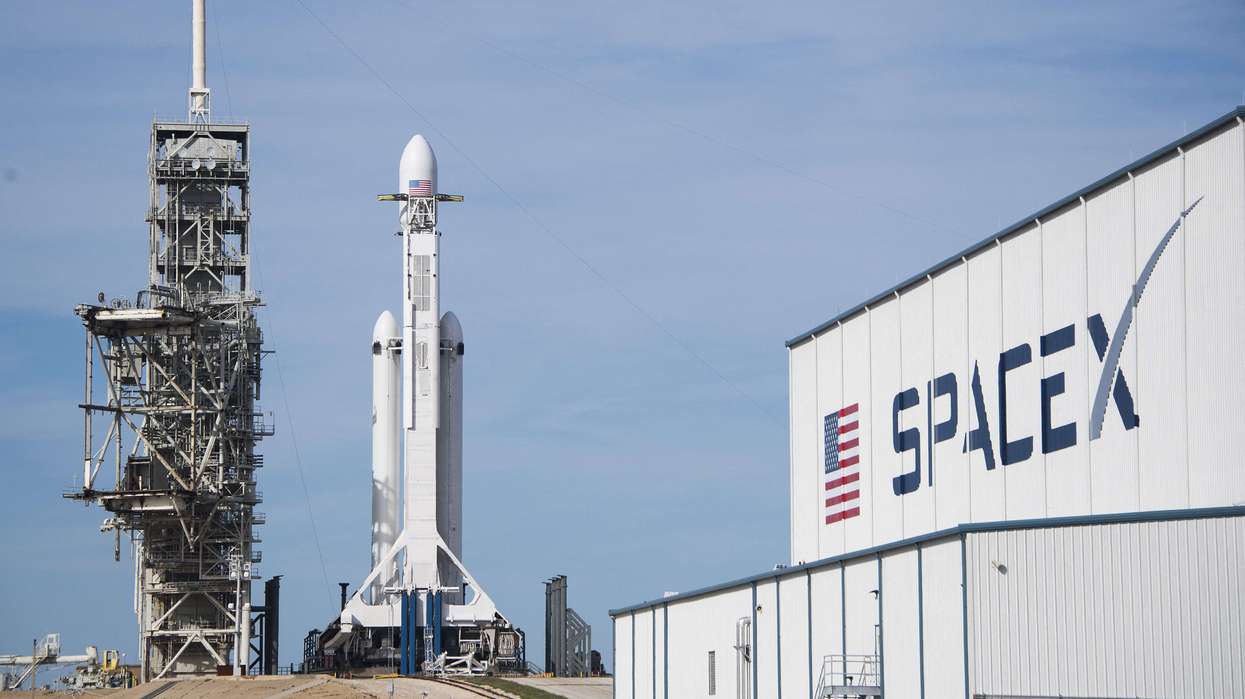

- Launch aborted seconds before liftoff due to weather
- Falcon Heavy to carry ViaSat-3 F3 for Asia-Pacific internet
- Rocket’s first three missions continue to shape its role
SpaceX called off its Falcon Heavy launch on April 27 less than 30 seconds before liftoff, halting the countdown due to weather concerns. The rocket had already been fuelled when the delay was issued. A fresh attempt is now scheduled for April 28 at 10:17am ET (7:47pm IST).
The mission, set to launch from Kennedy Space Center, will carry the ViaSat-3 F3 satellite, part of a programme aimed at expanding high-speed internet coverage across the Asia-Pacific region. If successful, the launch will also feature Falcon Heavy’s signature dual booster landing at Cape Canaveral, an event that typically produces sonic booms across Florida’s Space Coast.
Falcon Heavy, built using three Falcon 9 cores, generates more than five million pounds of thrust, placing it among the most powerful rockets currently in operation. While it has flown far fewer missions than the Falcon 9, its role has been shaped by a small number of early launches and the broader evolution of SpaceX’s Falcon programme.
The decade that built Falcon Heavy
Falcon Heavy’s capabilities are rooted in nearly a decade of development of the Falcon 9.
The programme began with Falcon 9’s first successful launch in June 2010, which placed a Dragon test spacecraft into orbit. Between 2010 and 2013, SpaceX completed six missions focused largely on NASA cargo deliveries and spacecraft testing, establishing baseline reliability.
By 2014, launch activity had increased, with six successful missions that included both commercial satellite deployments and ISS resupply flights. This period also marked the start of booster recovery experiments, with controlled ocean landings testing the feasibility of reusability.
In 2015, SpaceX achieved its first successful first-stage landing in December, a milestone that shifted the industry towards reusable rockets. The same year also saw a setback with the CRS-7 failure in June, which temporarily grounded operations.
By 2016, the system had stabilised, with eight successful launches and multiple booster landings, including the first successful droneship recovery.
The pace accelerated sharply in 2017, with 18 successful launches and the first reuse of an orbital-class booster during the SES-10 mission. This marked a turning point in reducing launch costs and improving turnaround times.
In 2018, SpaceX carried out 21 launches and introduced the Block 5 version of Falcon 9, designed for repeated reuse. This was also the year Falcon Heavy made its debut.
By 2019, the system had matured, with 13 successful launches, including the Crew Dragon Demo-1 mission and the first Starlink deployment. Reusability had become routine, with boosters flying multiple times.
Across the decade, SpaceX completed 80 Falcon-family missions with a success rate of over 96 per cent, laying the groundwork for heavier launch systems.
Three missions that defined Falcon Heavy
Falcon Heavy itself has flown only a handful of missions, but its first three launches between 2018 and 2019 established its role clearly.
February 6, 2018 — Demonstration flight
The rocket’s debut carried a Tesla Roadster into heliocentric orbit, serving as a high-profile test of its triple-core design. All 27 engines ignited successfully, validating the vehicle’s ability to operate at scale.
The two side boosters landed simultaneously at Cape Canaveral, marking a major milestone in reusable rocket operations. The central core failed during its landing attempt after engine relight issues.
April 11, 2019 — Arabsat-6A
Falcon Heavy’s second mission marked its first commercial deployment, launching a communications satellite into geostationary transfer orbit.
All three boosters were successfully recovered, including the central core landing on a droneship. This demonstrated improved reliability and recovery precision for heavy-lift missions.
June 25, 2019 — STP-2
The third mission, conducted for the US Department of Defense, involved deploying multiple payloads into different orbits.
The mission achieved all objectives, showcasing Falcon Heavy’s flexibility in handling complex orbital requirements. The side boosters were recovered, while the central core was lost during landing.
What the relaunch means
The delayed April 27 mission, now targeting April 28, will carry the ViaSat-3 F3 satellite to support broadband connectivity across Asia and the Pacific.
As with previous launches, the two side boosters are expected to return to Cape Canaveral shortly after liftoff, while the central core will be expended due to the mission’s trajectory.
Falcon Heavy’s launch frequency remains limited, but its early missions continue to define its role — handling fewer flights, but those requiring high payload capacity and complex deployment profiles.


 Trent Alexander Arnold of Real Madrid in action during the LaLiga EA Sports 2026/27 match between Real Betis Balompie and Real Madrid at Estadio La Cartuja on September 04, 2026 in Seville, Spain. Photo by Fran Santiago/Getty Images
 Trent Alexander-Arnold of Real Madrid is challenged by Marcus Thuram of Internazionale during the UEFA Champions League 2026/27 League Phase MD1 match between Real Madrid C.F. and FC Internazionale Milano at Estadio Santiago Bernabeu on September 08, 2026 in Madrid, Spain. Photo by Angel Martinez/Getty Images


