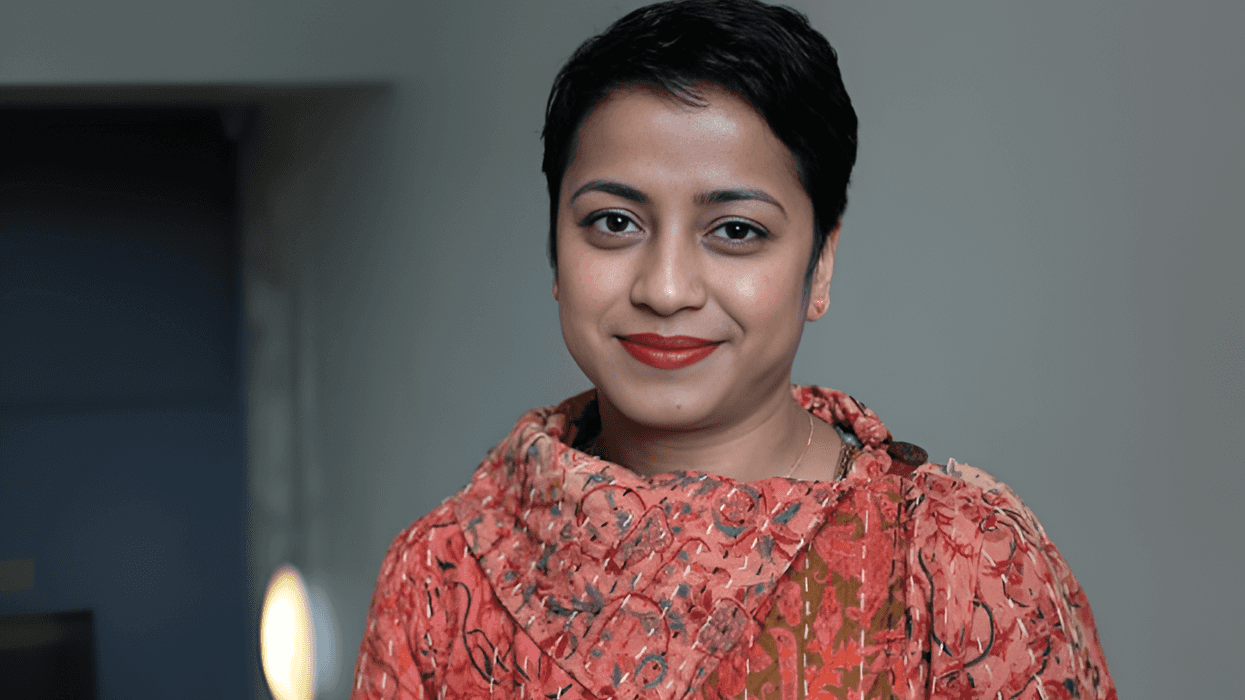

A LENGTH of bright fabric streaming behind her as she ran through the seaside streets of Brighton captured something essential about Poppy Jaman’s approach to leadership. On a cool April morning in 2025, she completed the Brighton Marathon wearing a saree – a deliberate and symbolic choice that blended cultural pride with personal endurance.
The run, inspired by International Women’s Day, raised over £7,000 for nursing scholarships for two young, under-resourced women in Bangladesh.
The gesture was striking, but it was also deeply considered. Since August 2024, Jaman had been quietly training, increasing her distance from 2.7km to 27km while managing lupus, navigating menopause and continuing her demanding professional life. Running in a saree paid tribute to women across the world who walk long distances every day in traditional clothing. For Jaman, movement is not merely exercise but a metaphor for wellbeing – an embodiment of her belief that cultural identity, expression and physical activity can intersect to support mental health.
That philosophy informs the work she leads globally through MindForward Alliance, the organisation she founded and where she serves as executive vice chair. In January, her advocacy reached a new milestone when she convened senior figures from business and government at the House of Lords to discuss the future of workplace health.
Throughout 2025, Jaman also expanded the organisation’s work into a rapidly evolving frontier: the impact of artificial intelligence on mental health at work. Chairing discussions among senior leaders from MindForward’s global membership, she steered a nuanced conversation about the opportunities and risks of AI-driven workplaces.
Alongside these policy conversations, Jaman’s advocacy often takes more intimate and personal forms. During South Asian Heritage Month she explored mental health through the lens of heritage and identity, reflecting on her own experience as a British Bangladeshi woman. On that occasion she wore a Bandhini-meets-Bhujodi saree – a garment that fused the ancient tie-dye traditions of the Indus Valley with the weaving heritage of the Vankar community in Kutch.
It was a reminder that for Jaman, cultural expression is not decorative but deeply connected to emotional wellbeing.
That same philosophy underpins SareeNaSorry, the intergenerational workshops she hosts regularly. Marking Age Without Limits’ Challenge Ageism Day, one such gathering brought women together to share stories through the act of draping a saree. During the session, one participant arrived with a saree her husband had bought her 30 years earlier – a garment she had never previously worn. Draping it became a moment of quiet validation and rediscovery.
Behind the creativity lies more than three decades of sustained advocacy on mental wellbeing and race equality. Jaman’s commitment is also deeply personal. The loss of a close friend to suicide became a defining moment in shaping her mission.
“Every 40 seconds, someone somewhere in the world is dying by suicide. But when it then happens in your own network, which is inevitable because with that many people dying with mental health related challenges, it just brings it home,” she told the GG2 Power List last year. “And it's exhausting at times. I'd be lying if I said that if I didn't have times like that. But then there's always something within the friends and family network that turn around and you think, ‘well, this is not done yet’.”
Her journey began in the late 1990s as a community development worker in Portsmouth and then joined the Department of Health. Over time she emerged as one of the most influential advocates for mentally healthy workplaces.
She has been open about her own mental health journey, a candour that has helped shift conversations about wellbeing within business and government circles. She is also involved with Change the Race Ratio, the coalition of UK business leaders working to increase ethnic minority representation on boards and in senior leadership across FTSE 100 companies.
For Jaman, the mental health agenda is still evolving. “Mental health isn't a static agenda, it's one of the agendas that's had the least research everywhere in the world because of the stigma attached to it,” she said. “Because it's the Cinderella of services, what we've seen over the past decade is a real evolution of what mental health actually means. We've gone from mental illness to mental health, mental wellness, and that's still changing.”
Earlier in her career she collaborated with Lord Patel of Bradford on the groundbreaking Count Me In census, conducted between 2005 and 2010 to examine race equality within mental health services. Two decades later, she argues it is time to revisit that work, suggesting that the NHS Race Observatory should assess what progress has been made.
Under her leadership, MindForward Alliance has grown into a global platform addressing workplace mental health. The organisation now operates across Hong Kong, Australia, Singapore, New Zealand, the US, the UAE and the UK, with expansion under way in Europe.
Research conducted by the organisation involving 12,200 people across 12 markets identified three core ingredients of mentally healthy workplaces. The most striking finding was also the simplest: when leaders openly discuss mental health, employees feel their organisation cares. Eighty-five per cent of respondents said such conversations reduced their desire to leave while increasing motivation and collaboration.
“That I think is something that every company can do and it's free,” Jaman said. “Its leaders not saying I've got mental ill health, but just saying we, as an organisation, value mental health, mental well-being and our people in all of their health and this is what we are doing about it.”
Before MindForward Alliance UK, Jaman was the founder and CEO of Mental Health First Aid England. She led the development of the organisation from a small government initiative into an independent community interest company, recognised as one of the fastest-growing SMEs in Europe by the Financial Times in 2017.
She was also an advisor on the Board of Public Health England for six years and played a key role in the creation of the NHS’s Every Mind Matters platform. In 2018, she was awarded an OBE in recognition of her outstanding achievements in the mental health sector.
ENDS