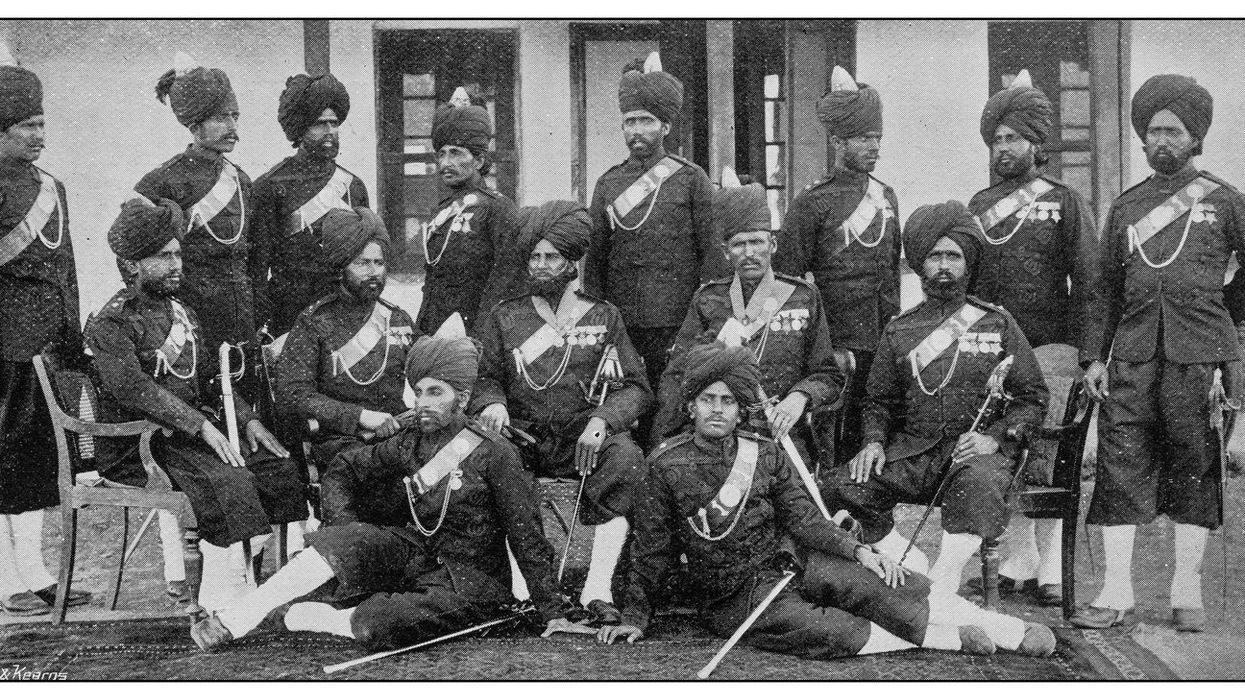

Plans to set up a memorial to the British Indian Army in Kelvingrove Park in Glasgow have been given a go-ahead.
The plans for the structure, which will be erected near Kelvingrove Art Gallery and Museum, were submitted on behalf of Colourful Heritage, which records first-hand accounts from first-generation members of the South Asian community located in Scotland, according to Glasgow Times.
The report said that the application to build the memorial was approved by Glasgow City Council, with conditions applying.
They include samples of the materials for building the pavilion and surrounding blocks being submitted for acceptance.
Besides, full details of the designs and content of carvings into the stone are also being submitted seeking clearance.
The planned memorial will feature a 'Chattri' (Dome), pillars which will be carved to make a South Asian design; benches where people can sit and reflect; and planting of new cherry trees.
It will be the first permanent memorial wall in Scotland to recognise the service and sacrifice made by more than four million soldiers who served in the British Indian Army.
The memorial also aims to represent the diversity of various religions such as Hindus, Muslims, Sikhs, Christians, and Gurkhas and others who fought alongside British troops during the First (1914-18) and Second (1939-45) World Wars and celebrate the special link between Scotland and Force K6, the all-Muslim Punjabi regiment that escaped from Dunkirk during the Second Great War and reached Scotland.
The upcoming structure also aims to uphold the key values of selfless commitment and respect for others that was epitomised by Isobel Harling BEM, who tended to Force K6 graves in Kingussie for more than 70 years.






 Curator Emma Slocombe with ikat robes and arabachi coats in the Peter the Great Room in Blickling Hall Amit Roy
 View of the entrance to Blickling Hall on a rainy autumn dayAmit Roy
 Kente cloth from Ghana in the Long Gallery in Blickling Hall
 Decoration in the Great Hall at Blickling Hall Amit Roy
 Palampore fragment made in coastal south-east India in the Brown Room in Blickling Hall Amit Roy
 Bed valance dating from early 1700s in the Italian Print Room at Blickling Hall Amit Roy
 Indian inspired fabric draped on sofas in the South Drawing Room in Blickling Hall Amit Roy
 Indian inspired fabric draped on sofas in the South Drawing Room with Indian carpet in Blickling Hall Amit Roy
 Karun Thakar has picked out the geometric patterns in the bookcase and the Kente cloth in the Long Gallery in Blickling Hall Amit Roy
 Large tapestry depicting Peter the Great defeating the Swedish army at the Battle of Poltava in 1709 Amit Roy
 ikat robes and arabachi coats in the Peter the Great Room in Blickling Hall Amit Roy
 Baghs and kanthas made by women provide contrast to the men only portraits in the Great Hall at Blickling Hall Amit Roy
 Baghs and kanthas in the entrance Great Hall at Blickling Hall Amit Roy
 Baghs and Kanthas in the Great Hall in harmony with stained glass window at Blickling Hall Amit Roy
 Kimonos reflect Japanese influence in Upper Ante Room in Blickling Hall Amit Roy
 Kimono in Upper Ante Room in Blickling Hall
 A view of the Palace and fort at Agra shows romantic side of India Amit Roy
 Blickling Hall Amit Roy
 Table carpet, European 1670-1680 Amit Roy
 Unfinished 17th century Italian embroidery in the Print Room at Blickling Hall Amit Roy
 Picture of Kashmir shows a romantic view of India Amit Roy
 A panel of Ashburnham bed hangings made in Gujarat for sale in Europe in the Brown Room in Blickling Hall Amit Roy
 Colcha made in the 1600s by women in Bengal for the Portuguese market in the Long Gallery at Blickling Hall Amit Roy




