
Skip to content
Search

Latest Stories

Pakistan lifts ban on radical anti-France party

Pakistan lifts ban on radical anti-France party

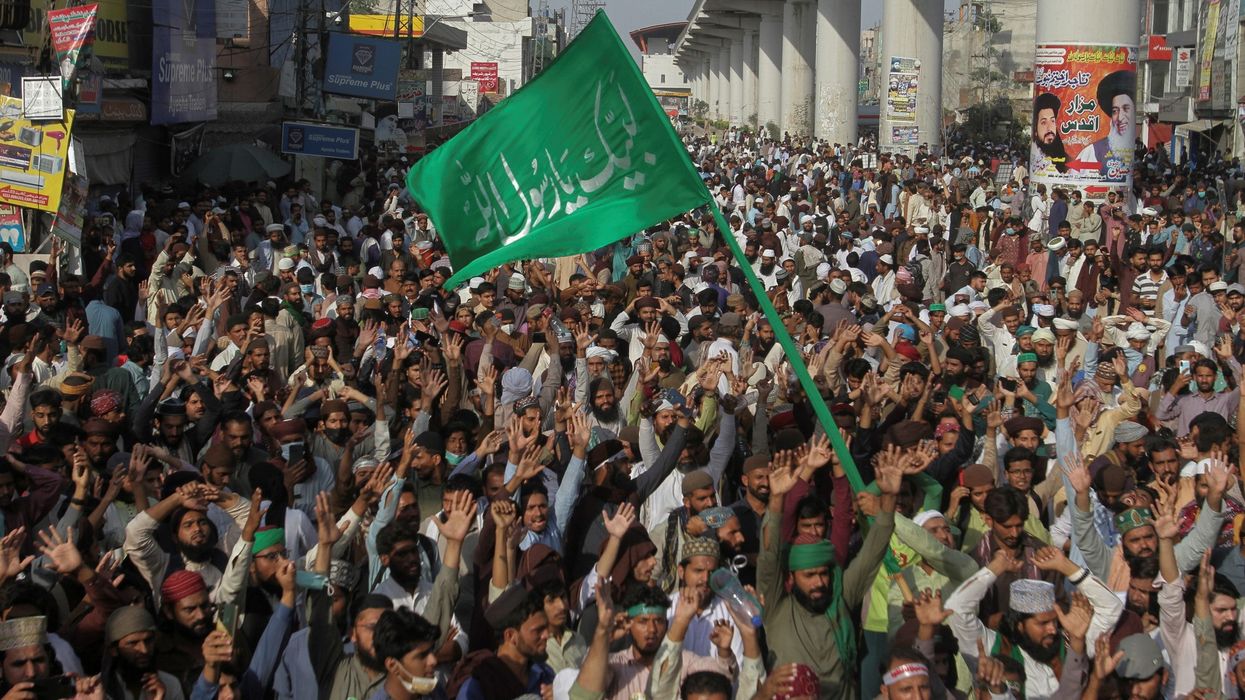
PAKISTAN'S government has lifted a ban on a radical party that staged massive anti-France protests, after striking a deal with the group which ended the latest rounds of deadly protests.

In a notification published on Sunday (7), the government said the move was in the "national interest", coming after seven police officers were killed in clashes during a rally that began last month.


The Tehreek-e-Labbaik Pakistan has staged a series of disruptive protests over the past several years linked to the flash-point issue of blasphemy in Muslim-majority Pakistan.

"The federal government is pleased to remove the name of the Tehreek-i-Labbaik Pakistan as a proscribed organisation," the government said in a statement.

It added the decision was made after assurances from the group - which has three members in the nation's parliament - that it would abide by the law.

Hundreds of detained TLP supporters were also released from detention earlier this month as part of the deal.

"This label has been a source of major concern for us as all our activists were being booked under anti-terrorism act. We were told last night about the decision," TLP spokesman Sajjad Saifi said on Monday (8).

But TLP leader Saad Rizvi, who was arrested in April when the group was first banned, remains in detention.

The party has waged an anti-France campaign after Paris-based satirical magazine Charlie Hebdo republished cartoons depicting the Prophet Mohammed - an act deemed blasphemous by many Muslims.

Protests in April led to the French embassy issuing a warning for all its citizens to leave the country.

The latest protests, which drew thousands to the streets of the eastern city of Lahore, were against the detention of Rizvi and also called for the expulsion of the French ambassador from the country.


More For You

Falklands sovereignty row erupts days before King Charles meets Trump

No 10 was quick to respond, with the prime minister's spokesman saying the government "could not be clearer" on its stance

Getty Images

Falklands sovereignty row erupts days before King Charles meets Trump

Highlights

  • A Pentagon email reported by Reuters suggested the US was considering reviewing its support for UK sovereignty over the Falklands.
  • Downing Street said sovereignty "rests with the UK" and the islanders' right to self-determination is "paramount".
  • Report emerged just three days before King Charles and Queen Camilla are due to meet Trump at the White House.
A report suggesting the US may be rethinking its position on the Falkland Islands has sparked a strong response from Downing Street, coming just days before King Charles and Queen Camilla head to Washington to meet president Donald Trump.
An internal Pentagon email, reported by Reuters, suggested the US was looking at ways to put pressure on Nato allies it felt had not supported its war in Iran.
One of the options discussed was a review of American backing for British sovereignty over the Falklands.
No 10 was quick to respond, with the prime minister's spokesman saying the government "could not be clearer" on its stance.
"Sovereignty rests with the UK and the islanders' right to self-determination is paramount," he told BBC, adding that this had been "expressed clearly and consistently to successive US administrations."
He was firm that "nothing is going to change that."
The Falkland Islands government backed London's position, saying it had "complete confidence" in the UK's commitment to defending its right to self-determination.
Previous US administrations have recognised Britain's administration of the islands but have stopped short of formally backing its sovereignty claim.

Political reaction grows

The report triggered sharp reactions from across British politics. Conservative leader Kemi Badenoch called the reported US position "absolute nonsense", adding: "We need to make sure that we back the Falklands.

They are British territory." Reform UK's Nigel Farage said the matter was "utterly non-negotiable" and confirmed he would raise it with Argentina's president Javier Milei when they meet later this year.

Keep ReadingShow less