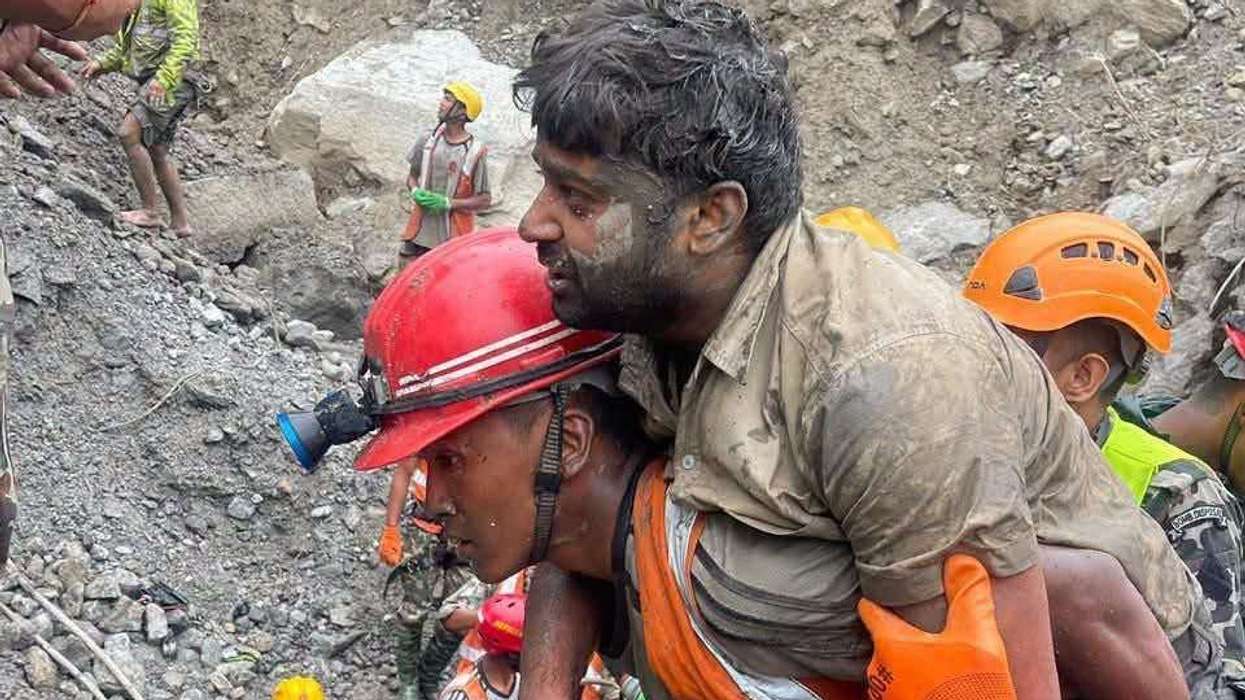

For nine days, deep inside a flooded tunnel in Nepal, Sanjay Sah had little idea whether he would make it out alive.
With darkness around him and the rescue operation unfolding somewhere beyond the tunnel, the 30-year-old employee of the Nepal Electricity Authority held on to one thing he could still do, chant the Hare Krishna mahamantra.
On Friday, Sah was finally brought out alive.
The timing carried an extraordinary significance. His rescue came on Krishna Janmashtami, the Hindu festival celebrating the birth of Lord Krishna.
“I was chanting Hare Krishna mahamantra for the past nine days,” Sah said shortly after being rescued.
His words gave an intensely personal dimension to a rescue that had already captured attention across Nepal, as security teams worked for days to reach workers trapped inside the tunnel at the Trishuli 3A hydropower project.
A prayer through nine days of uncertainty
Sah, a 30-year-old foreman from Saptari district in Madhesh province, was among two workers rescued from the tunnel on Friday.
According to security sources, his condition was stable and he had no immediate health concerns. He was taken to a local hospital in Trishuli for treatment.
For the nine days he spent trapped underground, Sah said he continued chanting the Hare Krishna mantra.
The coincidence of his rescue with Janmashtami made the moment particularly poignant.
Janmashtami is observed by Hindus around the world as the birth anniversary of Lord Krishna, with devotees marking the occasion through prayers, chanting and religious ceremonies.
For Sah, the festival arrived on the same day he emerged from the tunnel alive after nine days of uncertainty.
His rescue was also a moment of relief for those involved in the search operation, which had continued despite the difficult conditions inside the long tunnel.
He stayed behind when others fled
Sah was working in the control room when the disaster struck.
Rather than immediately fleeing, he said he stayed behind because he felt responsible for the safety of others at the project.
“I was working in the control room. My responsibility was to save everyone's life,” Sah said.
He recalled urging others to run after the accident.
But by the time the others had escaped, it was too late for Sah to get out.
He subsequently became trapped inside the tunnel.
His account also offered a glimpse into the uncertainty surrounding those who may still be inside.
Sah said he had heard or communicated with three or four people nearby, either by talking or making noises.
“There were only three or four people with whom we were able to communicate, nearby, by talking or making noises.”
But he warned that others could have been trapped deeper inside.
“Not everyone may have been able to escape. The tunnel is very long,” he said.
Sah added that the force of the floodwater could have carried people further into the tunnel, including towards the powerhouse.
Two workers rescued as search continues
Sah was one of two workers brought out safely on Friday (4).
The other was 45-year-old Kabir Maharjan, who was airlifted to Nepal Army Hospital in Chhauni, Kathmandu, after developing health complications and requiring further medical treatment.
The Nepal Army-led security command has continued the search and rescue operation using specialised equipment as teams attempt to establish whether more people remain trapped inside.
For Sah, however, the immediate ordeal ended with his emergence from the tunnel on a day already filled with spiritual significance for millions of Hindus.
After nine days underground, his first account was not about the darkness, the floodwater or the fear.
It was about the mantra he had continued to chant while waiting to be found.
“I was chanting Hare Krishna mahamantra for the past nine days,” he said.
And on the day devotees were celebrating the birth of Krishna, Sah walked out alive.