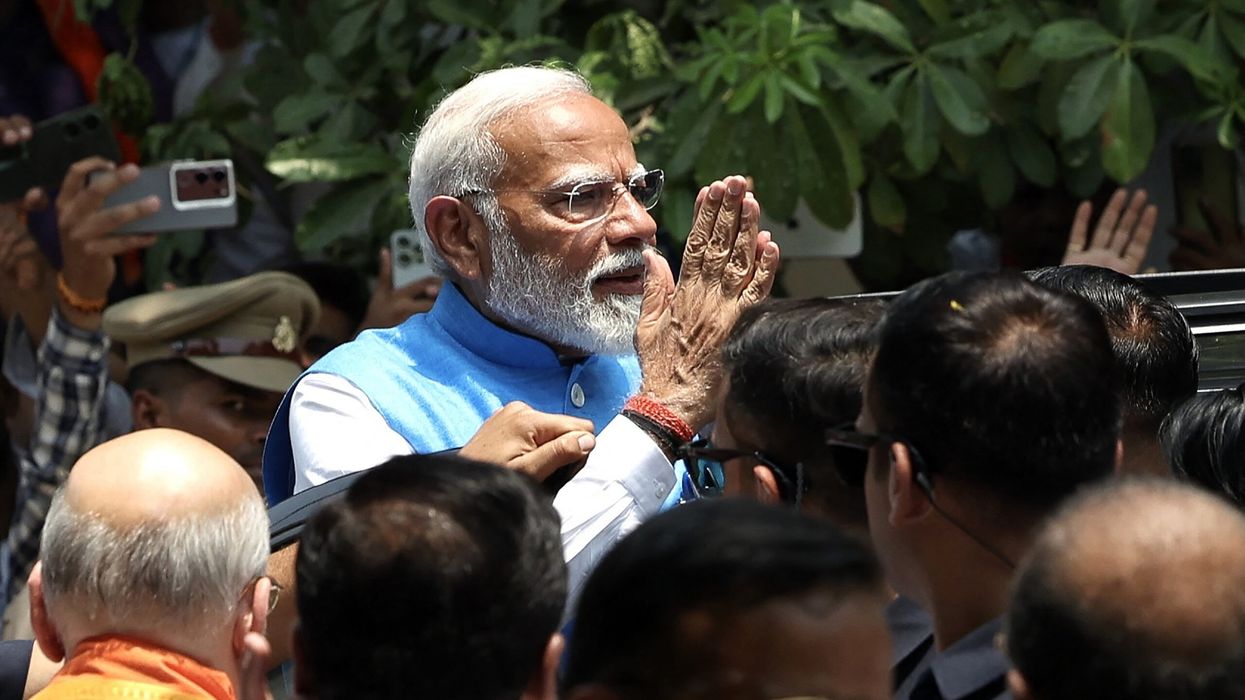
As the India elections head towards the fifth phase, Indian prime minister Narendra Modi submitted his candidacy for the Varanasi parliamentary seat on Tuesday amidst enthusiastic crowds.
Varanasi, revered as the spiritual nucleus of Hinduism, holds profound significance, drawing pilgrims from across India for sacred rituals along the Ganges river. Modi has represented this constituency since his resounding victory a decade ago.
Before handing over his nomination papers, Modi solemnly declared, "I swear on God... I will have faith and allegiance to India's constitution," flanked by a Hindu sage clad in traditional attire.
Hundreds of supporters gathered outside the local government office where Modi filed his nomination, after two days brimming with public displays of devotion.
"It's our good fortune that Modi represents our constituency of Varanasi," said devout Hindu Jitendra Singh Kumar, echoing sentiments shared by many in the crowd. "He is like a God to people of Varanasi. He thinks about the country first, unlike other politicians."
Following the nomination process, Modi expressed gratitude to his supporters, stating on social media platform X, "The amazing love and blessings I have received from all of you in the last 10 years have inspired me to work with a constant spirit of service and full determination."
The 73-year-old PM, renowned for his religious observances, commenced the day with temple visits and prayers along the Ganges banks. Tens of thousands lined the streets of Varanasi on Monday to welcome Modi, showering his procession with marigold flowers and waving BJP's saffron-coloured flags.
Accompanied by Uttar Pradesh chief minister Yogi Adityanath, Modi visited the Kaal Bhairav temple before submitting his nomination papers at the Varanasi collectorate. Alongside Adityanath and two of his proposers, Modi was joined by senior BJP figures, including party chief JP Nadda and union ministers Amit Shah, Rajnath Singh, and others.
Notably absent from the event was Bihar chief minister Nitish Kumar, citing health reasons. Modi's nomination proposers included Pandit Ganeshwar Shastri, Baijnath Patel, Lalchand Kushwaha, and Sanjay Sonkar. Shastri and Patel were present during the filing process.
Modi, adorned in a white kurta-pyjama and blue sadri, acknowledged the gathered crowd before departing. His busy agenda included a meeting with BJP workers at the Rudraksha Convention Centre.
Meanwhile, India witnessed a robust voter turnout of over 67 per cent in the fourth phase of the Lok Sabha (lower house of parliament) elections, spanning 96 constituencies across 10 states and union territories. Despite sporadic violence in West Bengal and Andhra Pradesh, West Bengal recorded the highest turnout at 78.44 per cent, followed closely by Andhra Pradesh at 78.25 per cent and Odisha at 73.97 per cent.
The election commission noted a turnout of 37.98 per cent in the Srinagar constituency, the highest in decades since the revocation of Article 370. Bihar, Jharkhand, Maharashtra, Telangana, and Uttar Pradesh reported varying voter turnout percentages. Madhya Pradesh registered a provisional voter turnout of 71.72 per cent.
The first three phases of the Lok Sabha elections recorded turnout rates ranging from 65.68 to 66.71 per cent.
(Agencies)






 Curator Emma Slocombe with ikat robes and arabachi coats in the Peter the Great Room in Blickling Hall Amit Roy
 View of the entrance to Blickling Hall on a rainy autumn dayAmit Roy
 Kente cloth from Ghana in the Long Gallery in Blickling Hall
 Decoration in the Great Hall at Blickling Hall Amit Roy
 Palampore fragment made in coastal south-east India in the Brown Room in Blickling Hall Amit Roy
 Bed valance dating from early 1700s in the Italian Print Room at Blickling Hall Amit Roy
 Indian inspired fabric draped on sofas in the South Drawing Room in Blickling Hall Amit Roy
 Indian inspired fabric draped on sofas in the South Drawing Room with Indian carpet in Blickling Hall Amit Roy
 Karun Thakar has picked out the geometric patterns in the bookcase and the Kente cloth in the Long Gallery in Blickling Hall Amit Roy
 Large tapestry depicting Peter the Great defeating the Swedish army at the Battle of Poltava in 1709 Amit Roy
 ikat robes and arabachi coats in the Peter the Great Room in Blickling Hall Amit Roy
 Baghs and kanthas made by women provide contrast to the men only portraits in the Great Hall at Blickling Hall Amit Roy
 Baghs and kanthas in the entrance Great Hall at Blickling Hall Amit Roy
 Baghs and Kanthas in the Great Hall in harmony with stained glass window at Blickling Hall Amit Roy
 Kimonos reflect Japanese influence in Upper Ante Room in Blickling Hall Amit Roy
 Kimono in Upper Ante Room in Blickling Hall
 A view of the Palace and fort at Agra shows romantic side of India Amit Roy
 Blickling Hall Amit Roy
 Table carpet, European 1670-1680 Amit Roy
 Unfinished 17th century Italian embroidery in the Print Room at Blickling Hall Amit Roy
 Picture of Kashmir shows a romantic view of India Amit Roy
 A panel of Ashburnham bed hangings made in Gujarat for sale in Europe in the Brown Room in Blickling Hall Amit Roy
 Colcha made in the 1600s by women in Bengal for the Portuguese market in the Long Gallery at Blickling Hall Amit Roy




