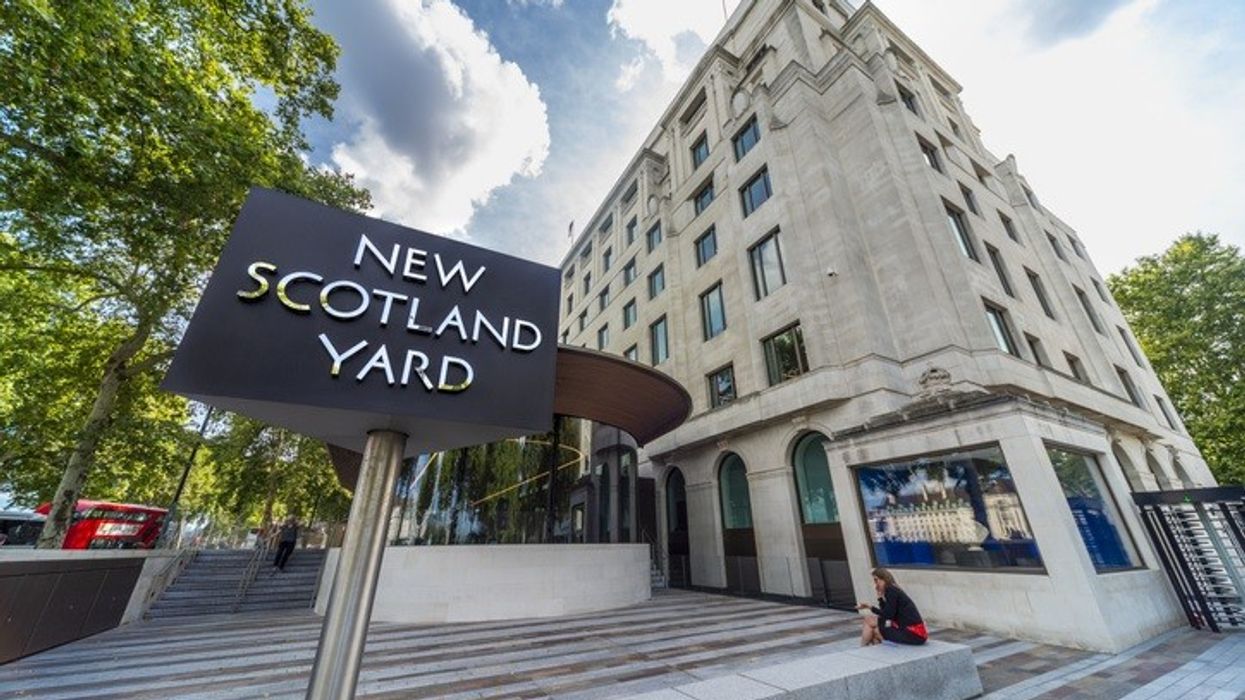

The police announced on Tuesday (16) that specialist officers will evaluate whether to initiate a war crimes investigation into Israel's conflict with Hamas, following a referral from an advocacy group for Palestinians.
The Metropolitan Police said its small war crimes team, which is hosted within its counter-terrorism command, would determine if any further action or formal investigation will be launched.
The Met confirmed it had received a "referral" last Friday (12) "relating to allegations linked to the ongoing Israel-Hamas conflict."
"The information within the referral will now be assessed by specialist officers as part of a scoping exercise to determine whether any further action or formal investigation will be carried out," a police spokesman said.
"At this time, there is no UK-based investigation into this matter, or any other matters relating to this particular conflict."
The spokesman noted the assessment would be done using guidelines for probing possible war crimes crafted with the Crown Prosecution Service (CPS), which makes the final decisions on prosecuting cases in England and Wales.
However, the CPS must seek permission from the attorney general -- a senior government minister and the state's chief legal advisor -- over war crimes prosecutions.
Met Commander Dominic Murphy, who leads its counter terrorism command, insisted the force would adhere to the "very clear set of guidelines which we use when assessing all war crimes referrals made to us."
The UK-based International Centre of Justice for Palestinians (ICJP) -- an independent organisation of lawyers, academics and politicians advocating for Palestinian rights -- said it had filed a "war crimes complaint" with the Met.
The group said its investigators had handed the Met a 70-page "evidence dossier" which detailed a range of alleged crimes by Israel in recent months.
Announcing the move, ICJP director Tayab Ali said they include attacks against properties, monuments, hospitals, and blocking humanitarian aid and basic necessities "to willfully cause great suffering or serious injury to body or health."
The dossier also accuses Israel of "intentionally using starvation of civilians and deprivation of objects indispensable to survival as a method of warfare."
It alleges complicity in that by "high-ranking Israeli officials and military personnel" as well as "nine named British citizens" serving in the Israeli military.
The file also includes "four British government ministers and officials alleged to have abetted these crimes."
The development comes as the International Criminal Court, the world's only independent court set up to probe the gravest offences including genocide, war crimes and crimes against humanity, continues its probe into the long-running conflict.
It opened an investigation in 2021 into Israel as well as Hamas and other armed Palestinian groups for possible war crimes in the Palestinian territories.
Meanwhile, South Africa has in recent weeks launched an emergency case at the International Court of Justice, arguing that Israel stands in breach of the UN Genocide Convention, signed in 1948 in the wake of the Holocaust. (AFP)






 Curator Emma Slocombe with ikat robes and arabachi coats in the Peter the Great Room in Blickling Hall Amit Roy
 View of the entrance to Blickling Hall on a rainy autumn dayAmit Roy
 Kente cloth from Ghana in the Long Gallery in Blickling Hall
 Decoration in the Great Hall at Blickling Hall Amit Roy
 Palampore fragment made in coastal south-east India in the Brown Room in Blickling Hall Amit Roy
 Bed valance dating from early 1700s in the Italian Print Room at Blickling Hall Amit Roy
 Indian inspired fabric draped on sofas in the South Drawing Room in Blickling Hall Amit Roy
 Indian inspired fabric draped on sofas in the South Drawing Room with Indian carpet in Blickling Hall Amit Roy
 Karun Thakar has picked out the geometric patterns in the bookcase and the Kente cloth in the Long Gallery in Blickling Hall Amit Roy
 Large tapestry depicting Peter the Great defeating the Swedish army at the Battle of Poltava in 1709 Amit Roy
 ikat robes and arabachi coats in the Peter the Great Room in Blickling Hall Amit Roy
 Baghs and kanthas made by women provide contrast to the men only portraits in the Great Hall at Blickling Hall Amit Roy
 Baghs and kanthas in the entrance Great Hall at Blickling Hall Amit Roy
 Baghs and Kanthas in the Great Hall in harmony with stained glass window at Blickling Hall Amit Roy
 Kimonos reflect Japanese influence in Upper Ante Room in Blickling Hall Amit Roy
 Kimono in Upper Ante Room in Blickling Hall
 A view of the Palace and fort at Agra shows romantic side of India Amit Roy
 Blickling Hall Amit Roy
 Table carpet, European 1670-1680 Amit Roy
 Unfinished 17th century Italian embroidery in the Print Room at Blickling Hall Amit Roy
 Picture of Kashmir shows a romantic view of India Amit Roy
 A panel of Ashburnham bed hangings made in Gujarat for sale in Europe in the Brown Room in Blickling Hall Amit Roy
 Colcha made in the 1600s by women in Bengal for the Portuguese market in the Long Gallery at Blickling Hall Amit Roy




