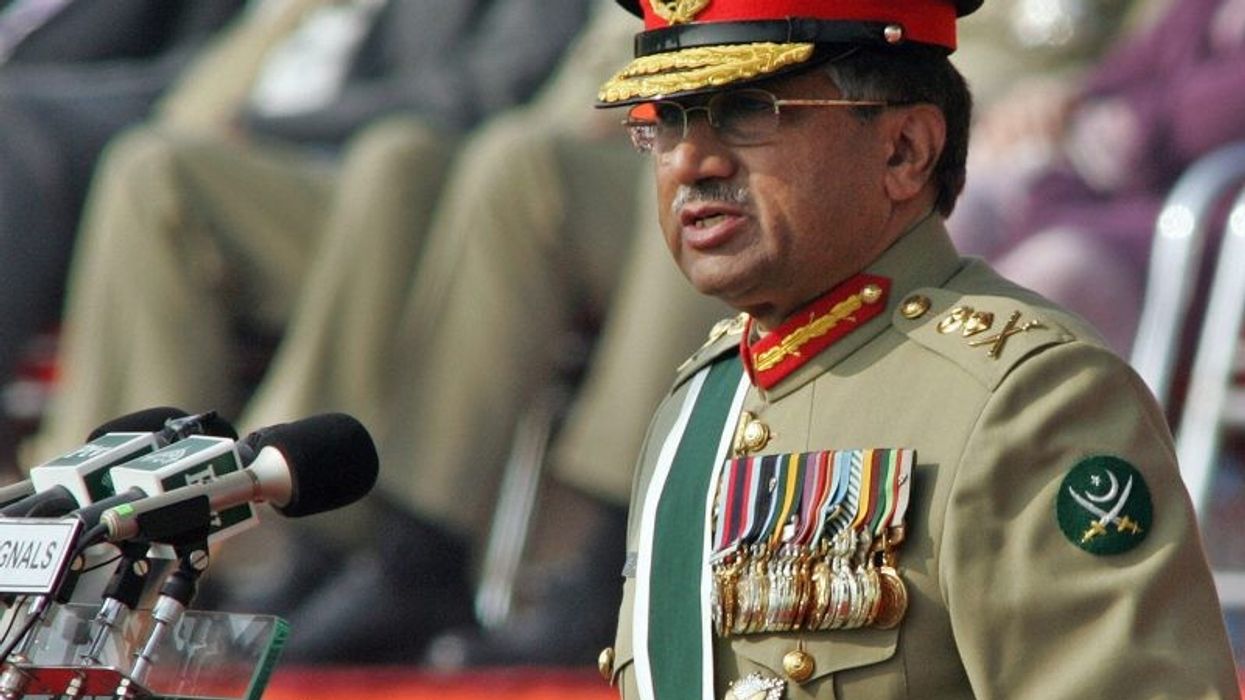

It was the "Kargil episode" of 1999 that created the biggest rift between then Pakistan president Parvez Musharraf and then prime minister Nawaz Sharif after he denied any knowledge of it to make himself look clean, according to a book written by the deceased ex-military ruler.
The book 'In the Line of Fire: A Memoir', first published on September 25, 2006, contains a collection of Musharraf's memories.
In the book, the former president and military ruler, who died on Sunday in Dubai after a prolonged illness, wrote in length about the Kargil operation.
"I was Army chief for only a year before the Army had to react against Nawaz Sharif. My working relationship with him was perfectly good in the beginning, with some minor disagreements over the sacking of two major generals, the appointment of two lieutenant generals, and his request to me to court-martial a journalist for treason," he wrote.
Musharraf wrote in the book that he was quite amused by his style of working. "I never saw him reading or writing anything," he wrote.
"The Kargil episode created the biggest divide. We had both wanted to put Kashmir firmly on the world's radar screen, politically as well as militarily. The Kargil initiative succeeded in doing so," he had claimed in the book, adding that when external political pressure forced Sharif to agree to a ceasefire, he broke down.
"Rather than deriving strength through national solidarity, he (Sharif) blamed the Army and tried to make himself look clean."
"He thought he would be more secure if he denied any knowledge of the Kargil operation. All kinds of carefully placed articles appeared, including a one-page advertisement in a newspaper in the United States, maligning the army and creating a divide between it and the government," Musharraf wrote.
Musharraf said it was in dealing with Kargil that Sharif exposed his mediocrity and set himself on a collision course with the Army and him.
"July 4 marked a cease-fire, negotiated by President Bill Clinton with Prime Minister Nawaz Sharif. International pressure for a cease-fire was intense. President Clinton was the only statesman who had influence in both Pakistan and India. Yet in truth, it was no negotiation at all. Sharif agreed to an unconditional withdrawal. To make matters worse, misperceptions of the military situation were rampant," he wrote.
Musharraf was the main architect of the Kargil War that took place months after then Prime Minister Nawaz Sharif signed a historic peace accord with his Indian counterpart Atal Bihari Vajpayee in Lahore.
After his failed misadventure in Kargil, Musharraf deposed the then Prime Minister Sharif in a bloodless coup in 1999 and ruled Pakistan from 1999 to 2008 in various positions - first as the chief executive of Pakistan and later as the President.
(PTI)