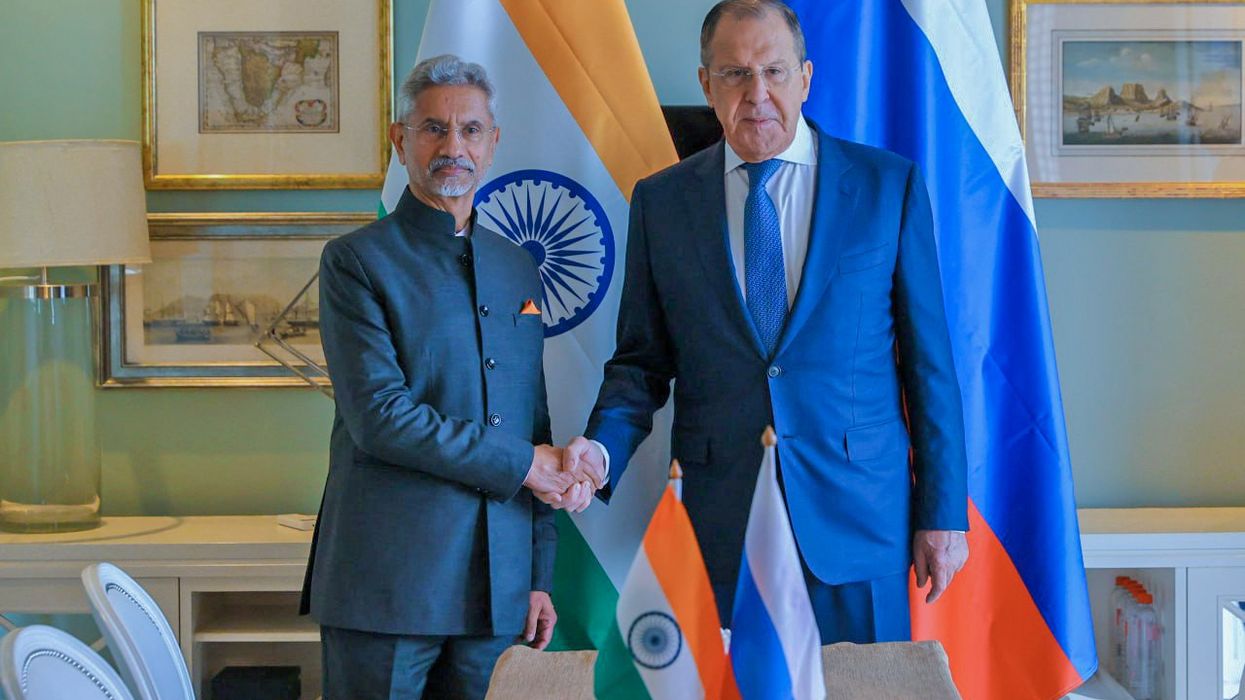

INDIA’S purchase policies “softened” the oil and gas markets by its decision to continue transactions with Russia, and New Dehi should be “thanked for managing global inflation” as a consequence, the country’s external affairs minister S Jaishankar said last week.
His remarks came in response to a question of India charting its own course in the face of Western sanctions against Russia for its invasion of Ukraine.
“Just imagine, for a moment, had we not bought oil from Russia – global oil prices would have gone higher; because we would have gone into the same market, to the same suppliers that Europe would have done, and frankly, as we discovered, Europe would have outpriced us,” said Jaishankar.
“We saw that in the LNG markets where the supplies traditionally coming into Asia go directly to Europe. And in fact, India was a big enough country to command some respect in the market, but there were much smaller countries that didn’t even get responses to their tender because the LNG suppliers were no longer interested in dealing with them. They have bigger fish to fry,” he said.
“So, we’ve actually softened the oil markets and the gas markets through our purchase policies. We have, as a consequence, actually managed global inflation. So frankly, we should be thanked. I’m waiting for the thank you,” he added.
The minister was speaking during an interaction entitled How a Billion People See the World at the Royal Over-Seas League in London last Wednesday (15) evening.
On India-Russia ties, Jaishankar reflected on the stability of the relationship dating to the 1950s which indicated a certain “fundamental structural balance” of bilateral ties. He noted the “exceptional steadiness” of India-Russia ties and pointed out that unlike in the West, Moscow is not viewed as a “revisionist power” in the east.
“My inference from that is actually, both sides recognise the importance of the relationship in keeping a kind of a continental balance, if you would, in that part of the world,” he said.
“Not just for India, but for countries east of Russia, it is a source of stability. Russia is not a revisionist power east of Russia… it is not automatic that if a country is perceived a certain way in the West, that logic would extend to the east. The perception of the east is very different,” he added.
Jaishankar noted the background of 70-odd years of history and working together influenced India’s approach to Russia in the context of the current conflict in Ukraine.
He reiterated that while he understood the Western approach on the issue, India’s views were influenced by its experiences of the past, when as a newly independent country it was attacked by Pakistan and no one condemned Islamabad.
He said: “In fact, it went to the UN Security Council, and thanks to the United Kingdom, what began as a problem called the aggression of Jammu and Kashmir, ended up as the India-Pakistan question.
“So, we have learned the hard way that [when] people speak of principles – I don’t say they are irrelevant or be cynical about it, but they are tempered by interests. And in this particular case, we have a very powerful interest to keep our relationship with Russia.