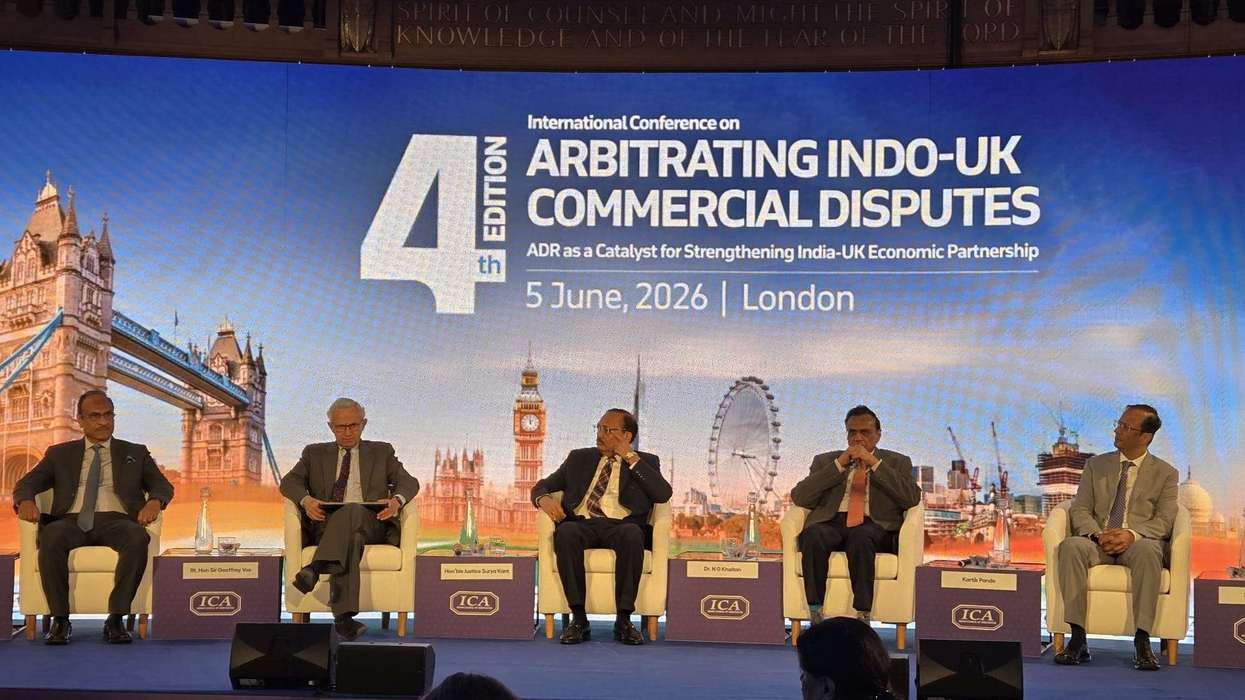

Senior judicial, legal and policy leaders from India and the United Kingdom gathered at Church House Westminster in London for the fourth edition of the International Conference on “Arbitrating Indo-UK Commercial Disputes”, where they underscored the vital role of arbitration, mediation and emerging technologies in strengthening cross-border trade and investment between the two nations.
Organised by the Indian Council of Arbitration (ICA) during London International Disputes Week 2026, the conference was centred on the theme “ADR as a Catalyst for Strengthening the India–UK Economic Partnership.”
The inaugural session featured addresses by Hon'ble Justice Surya Kant, Chief Justice of India, Rt. Hon. Sir Geoffrey Vos, Master of the Rolls and Head of Civil Justice of England & Wales, Kartik Pande, Deputy High Commissioner of India to the United Kingdom, and Brett Dixon, Vice-President of the Law Society of England & Wales. The conference was presided over by Dr N.G. Khaitan, President of ICA and Senior Partner at Khaitan & Co. LLP, while Arun Chawla, Director General of ICA, delivered the welcome address and vote of thanks.
Addressing delegates, Chief Justice Surya Kant described arbitration as a cornerstone of modern commerce and an essential enabler of the growing India–UK economic relationship. Referring to the recently concluded India–UK Free Trade Agreement, he said trade ambitions could only be realised when businesses had confidence that disputes would be resolved fairly, efficiently and cost-effectively.
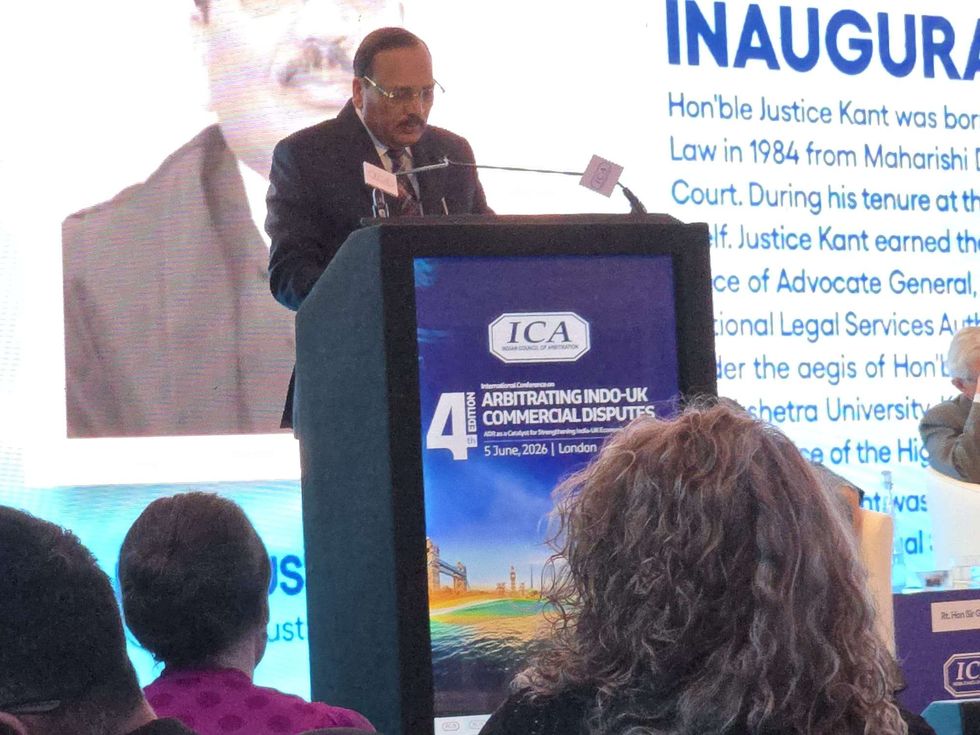 Justice Surya KantMahesh Liloriya
The Chief Justice traced the origins of arbitration from the medieval merchant courts of Europe to India's ancient community-based dispute resolution traditions, noting that arbitration succeeds when it remains accessible, timely and proportionate to the needs of businesses.
At the same time, he cautioned against growing structural challenges within international arbitration, including rising costs, lengthy proceedings, excessive procedural complexity and concentration of appointments among a limited group of practitioners. He warned that arbitration risked resembling the very litigation system it was originally designed to overcome.
Calling for reforms, Justice Surya Kant advocated greater institutional arbitration, enhanced transparency, wider participation, digital case management and more affordable mechanisms for small and medium-sized enterprises. He proposed the creation of joint India–UK arbitration accreditation programmes, fast-track dispute resolution procedures and stronger integration between arbitration and mediation to preserve commercial relationships.
“The next wave of India–UK trade will be driven not only by large corporations but also by start-ups, technology firms, clean energy businesses and medium-sized enterprises. Our dispute resolution systems must work effectively for them as well,” he said.
In his keynote address, Sir Geoffrey Vos highlighted the growing impact of artificial intelligence on dispute resolution and the future of international commerce. Drawing on his extensive engagement with India's legal system, he praised the rapid digitisation of Indian courts and the increasing use of technology within the judiciary.
Sir Geoffrey argued that reliable dispute resolution systems are fundamental to attracting investment and maintaining confidence in international trade. He noted that as economies become increasingly dependent on artificial intelligence and digital infrastructure, legal systems must adapt to ensure fairness, efficiency and accessibility.
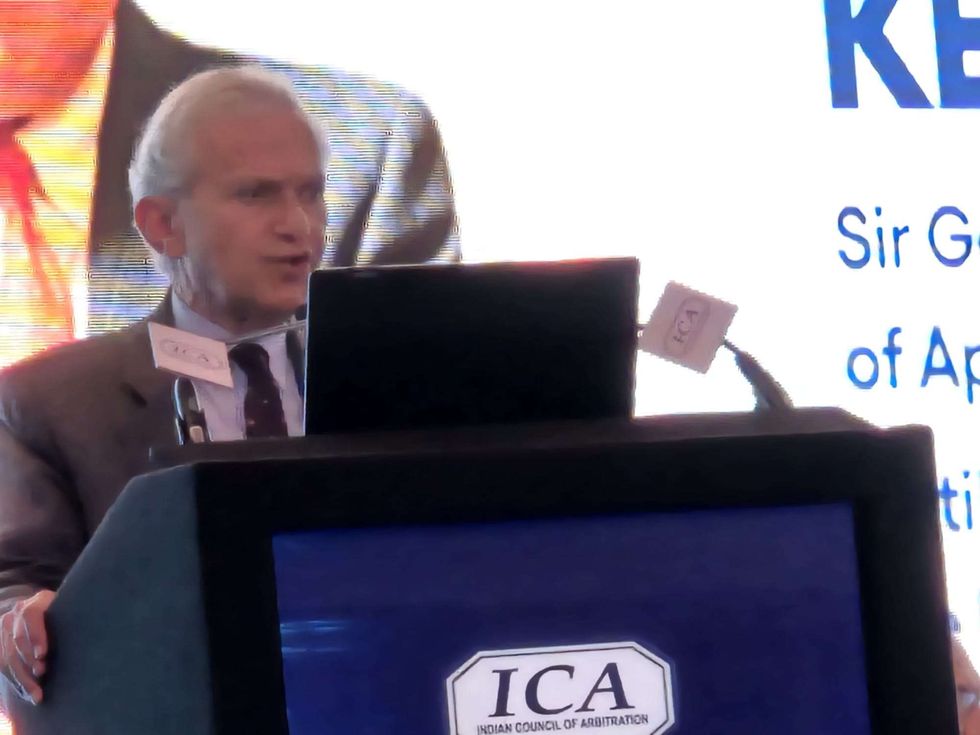 Rt. Hon. Sir Geoffrey VosMahesh Liloriya
He pointed to recent developments in AI-assisted arbitration and suggested that machine-assisted dispute resolution could offer significant advantages in terms of speed and cost. However, he stressed that any future AI-driven legal tools must be built upon domestic legal principles and carefully tested for fairness, reliability and bias.
“The legal community must move with the times. The world will not go backwards. These changes will accelerate, and we must ensure that AI solutions are grounded in our own legal traditions and the rule of law,” he said.
Deputy High Commissioner Kartik Pande placed the discussions within the broader context of the rapidly expanding India–UK economic partnership. He noted that bilateral trade has reached nearly £48 billion and said the recently concluded Free Trade Agreement had created fresh opportunities for businesses and investors in both countries.
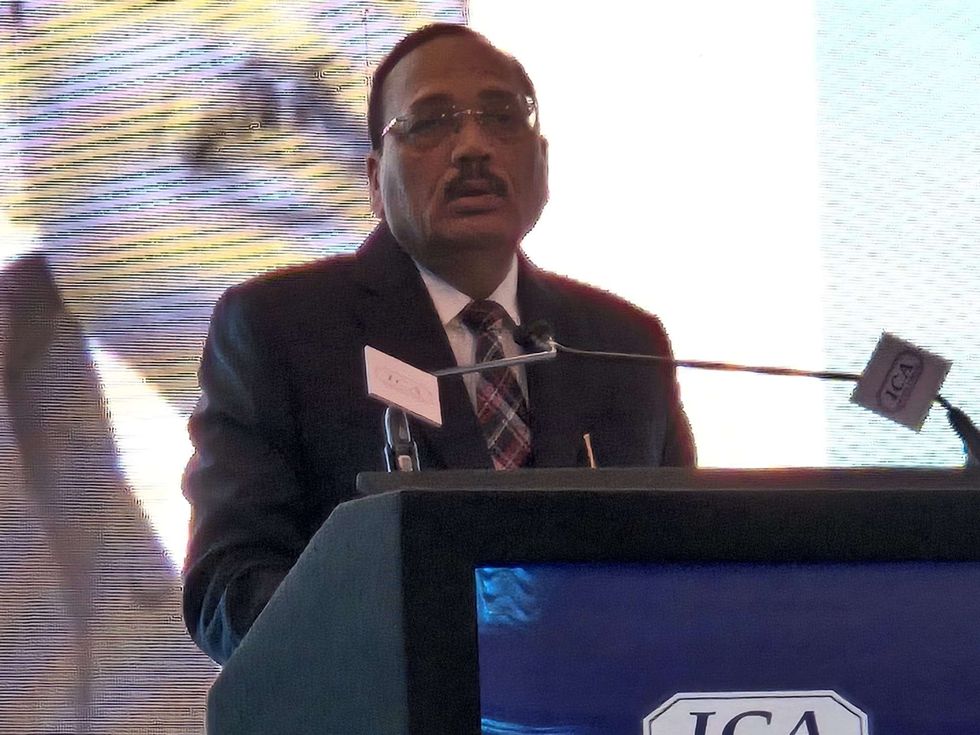 Justice Surya KantMahesh Liloriya
He highlighted major economic reforms undertaken by India, including infrastructure development, logistics modernisation, taxation reforms and investment-friendly policies, which are helping create a more transparent and efficient business environment.
Following the inaugural session, delegates participated in a high-level fireside discussion on “Building the India–UK Economic Corridor: The Role of Law, Institutions and ADR.” The conference also featured technical sessions on “Architecting Hybrid ADR Ecosystems for Complex Commercial Indo-UK Disputes” and “The Role of ADR in Cross-Border Trade and Investment.”
The conference concluded with a strong consensus that effective arbitration, mediation and technology-enabled dispute resolution will play a crucial role in supporting the next phase of India–UK economic cooperation and helping both countries build a more resilient and investor-friendly commercial ecosystem.