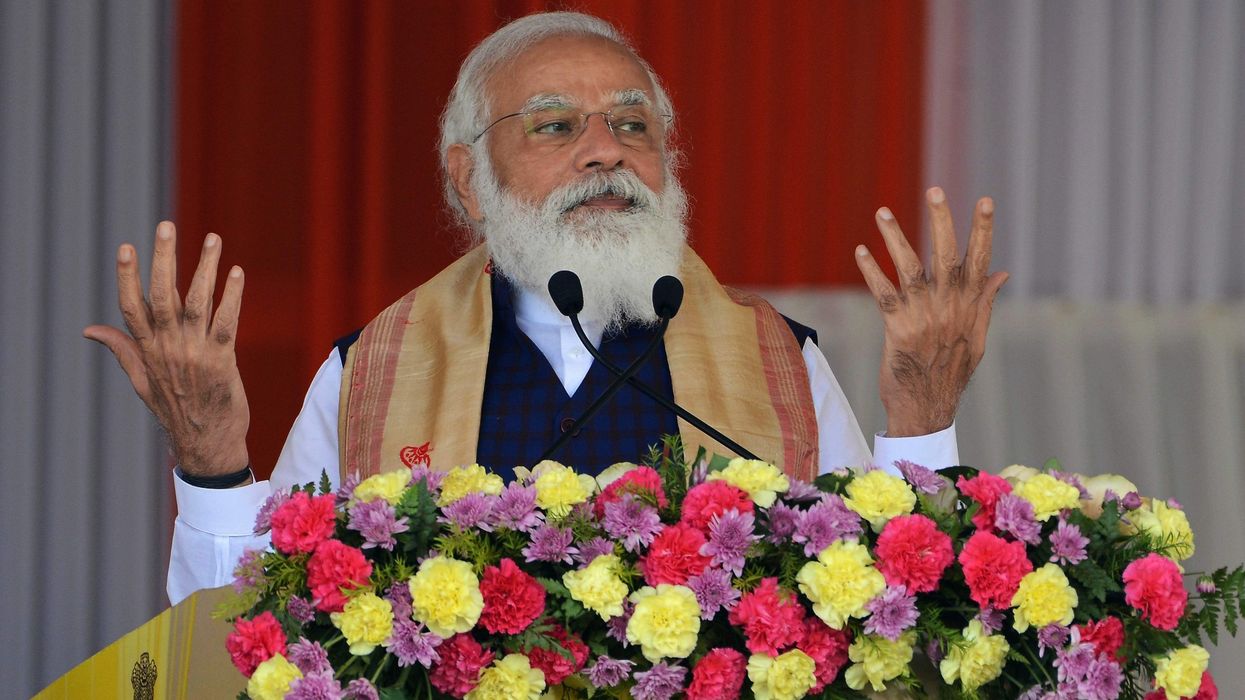

India will supply more locally made coronavirus vaccines to other countries, prime minister Narendra Modi said on Thursday, as he hailed the South Asian giant's fight against the pandemic.
India -- home to the world's largest vaccine manufacturer, the Serum Institute -- has embarked on a form of vaccine diplomacy, gifting millions of doses to neighbouring countries.
It has also exported commercial shots to Brazil and Morocco and expects to supply Saudi Arabia, South Africa, Canada, Mongolia, as well as other countries in Africa, the foreign ministry said Thursday.
"Today by sending vaccines to various countries... we are saving the lives of citizens in other countries also," Modi said in his address to the annual World Economic Forum in Davos.
"In the future we will have many more vaccines. India's upcoming vaccines will help other countries to fight the pandemic."
His virtual speech came as restrictions in the nation of 1.3 billion people were further eased, bucking the trend in many other countries as infection and death numbers fell sharply.
Government figures on Thursday showed that, in the previous 24 hours, 123 people died from the virus in India, with 11,666 new infections.
By comparison, the United States has posted daily death counts of more than 4,000 in recent weeks, while Britain and Brazil have seen daily totals of well over 1,000.
In September, at the peak of the outbreak in India, the country was recording almost 100,000 new cases and more than 1,000 deaths per day.
Addressing the gradual reopening, Home Secretary Ajay Kumar Bhalla said: "The number of active cases in the country have been declining steadily over the past four months."
But he noted the "need for maintaining caution and strict surveillance".
- 'Averted major tragedy' -
Modi said India had "averted a major tragedy by effectively controlling" the virus.
"(We) saved mankind from a big disaster by saving (our) citizens from the pandemic," he added.
India imposed one of the world's toughest lockdowns last March.
But with the economy one of the worst hit worldwide, India has gradually relaxed rules, allowing most economic activity and even its famously lavish weddings to resume -- albeit with numbers capped.
Recent months have seen mass religious festivals, and the new guidelines announced late Wednesday included opening swimming pools and allowing more than 50 percent capacity in cinemas.
Experts warned though that India could see another wave of infections and that it could be hit by new variants of the virus, as has happened in Brazil, Britain and South Africa.
"How well we are going to maintain surveillance in order to be able to detect new surges on account of new strains, should that happen, is what is crucial," Rajib Dasgupta, a health professor at Jawaharlal Nehru University, told AFP.
The country's tally of 11 million infections is second only to the US.
It has recorded more than 150,000 deaths, the third-highest toll behind the US and Brazil.
One serological survey released by the government this week suggested that more than 50 percent of people in the capital New Delhi had developed antibodies against the infectious disease.
India began vaccinating people on January 16 and so far has given one shot to almost 2.4 million health workers and others, with the aim of inoculating 300 million Indians by July.
On Wednesday, daily global deaths from Covid-19 topped 18,000 for the first time, prompting many countries, particularly in the West, to tighten restrictions on activities and gatherings.