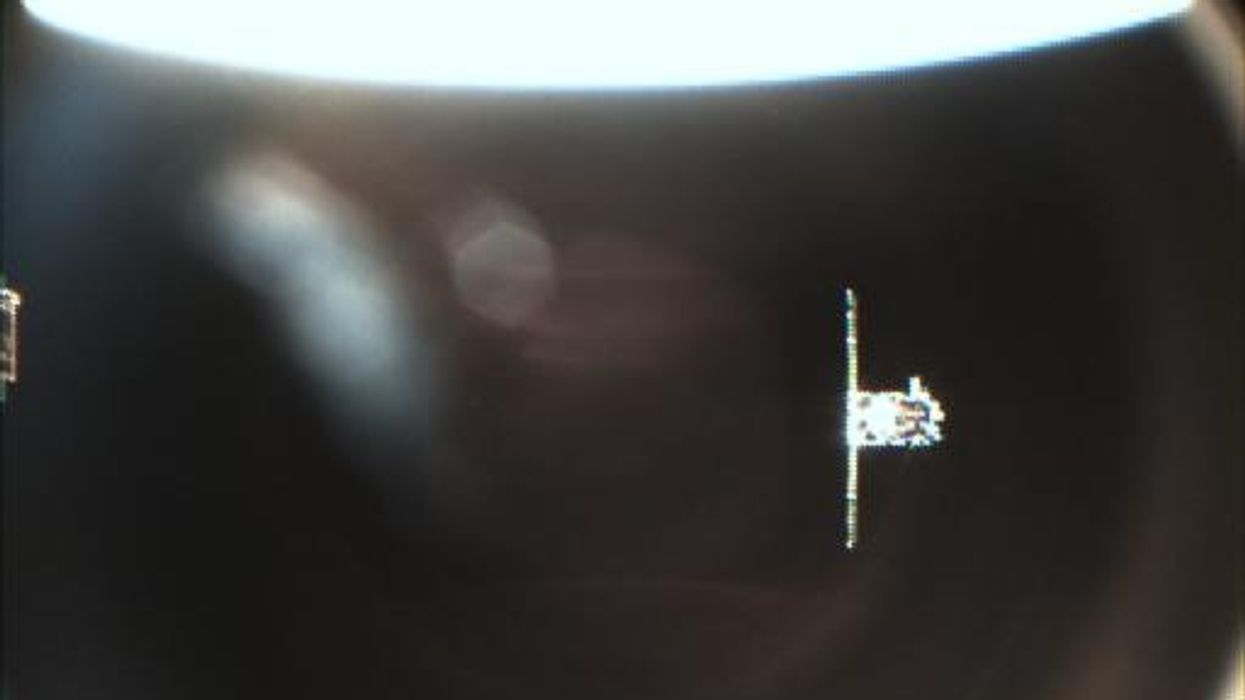

INDIA achieved a significant milestone in its space exploration efforts on Thursday, becoming the fourth nation in the world to successfully carry out a space docking mission.
The Space Docking Experiment (SpaDeX) was conducted by the Indian Space Research Organisation (ISRO) at 9 am IST (0330 GMT), involving two satellites, Target and Chaser, which docked and undocked in orbit after complex manoeuvres.
ISRO described the mission as a "historic moment" and highlighted its importance for advancing technologies required for satellite servicing, space station operations, and interplanetary missions.
The two satellites, each weighing 220 kilograms (485 pounds), had been launched in December 2023 on a single rocket from Sriharikota. They were separated in orbit before being manoeuvred back together for the docking experiment.
Indian prime minister Narendra Modi congratulated Indian scientists on the achievement, stating, "It is a significant stepping stone for India's ambitious space missions in the years to come."
Congratulations to our scientists at @isro and the entire space fraternity for the successful demonstration of space docking of satellites. It is a significant stepping stone for India’s ambitious space missions in the years to come.
— Narendra Modi (@narendramodi) January 16, 2025
The mission also involved demonstrating the transfer of electric power between docked spacecraft, a capability vital for future applications such as in-space robotics and composite spacecraft control.
The SpaDeX mission faced delays due to technical challenges. Initial postponements were required for additional ground simulations, while a subsequent delay addressed excess drift between the satellites.
Despite these hurdles, ISRO successfully demonstrated the indigenous docking technology, which is critical for building a space station and conducting complex lunar missions.
India’s growing space programme is central to its ambitions of expanding its presence in the global space market, estimated to reach £820 billion by 2030. Currently accounting for just 2 per cent of this market, India aims to increase its share to £36 bn by 2040.
This latest success follows India’s achievement in August 2023, when it became the fourth country to land an unmanned craft on the Moon. As part of its broader space agenda, ISRO is also working on deep-space exploration, astronaut missions, and planetary defence projects, including collaborations with NASA.
The mission included additional experiments, such as observing plant growth in microgravity. Eight cowpea seeds sent aboard the rocket germinated within four days, marking another small step in understanding life sciences in space.
(With inputs from agencies)