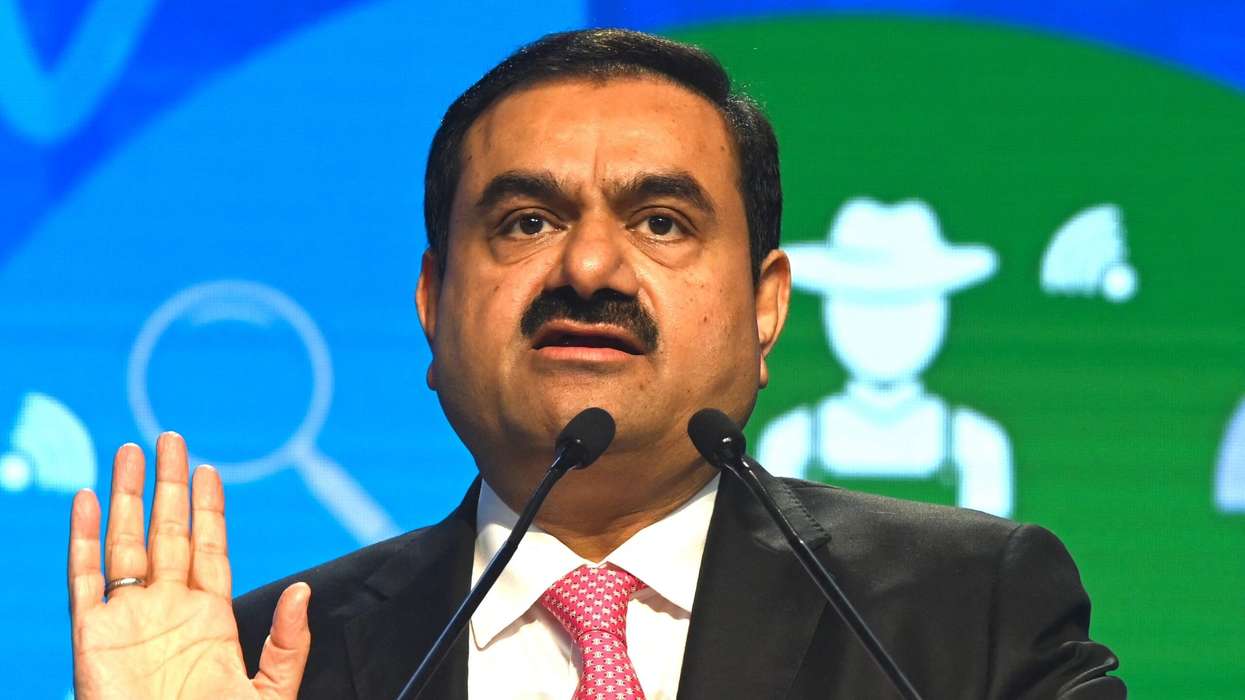

A US judge on Monday dismissed criminal charges against Indian billionaire Gautam Adani but said the Justice Department's decision to abandon the fraud and bribery case was concerning.
Brooklyn-based US District Judge Nicholas Garaufis granted federal prosecutors' request to dismiss the case after questioning their reasons for doing so, including whether Adani's November 2024 promise to invest $10 billion in the United States had influenced the decision.
The Justice Department's decision was the latest instance in which federal prosecutors had sought to drop a high-profile white-collar criminal prosecution during Republican president Donald Trump's second term.
Garaufis said he was satisfied that Adani's investment pledge had not influenced the decision to drop the charges. He also said judges had a limited role in reviewing federal prosecutors' decisions to dismiss charges.
However, he criticised Principal Associate Deputy Attorney General Trent McCotter for working with Adani's defence lawyers to decide to dismiss the charges without input from prosecutors or agents who had investigated the case.
“The irregularities in the decision to dismiss the indictment are concerning,” Garaufis wrote. “McCotter appears to have eschewed the professional opinions of innumerable officials from various federal offices and replaced them with his singular judgment.”
A Justice Department spokesperson pointed to a July 4 filing in which McCotter said he decided to drop the charges after meeting with defence lawyers and other Justice Department lawyers and conducting his own research and analysis.
In a statement posted on X, Gautam Adani said, "I welcome the U.S. Court's decision with humility and deep respect for the judicial process."
The judge said his dismissal of the case should not be interpreted as his agreement with the Justice Department's decision or as an opinion on the merits of the case. He asked the Justice Department to provide more information to help him decide whether to dismiss charges against additional defendants.
Adani was charged in 2024 with agreeing to bribe Indian government officials so a subsidiary of Adani Group could win approval to develop a solar energy plant. He was also accused of misleading US investors by providing reassuring information about his company's anti-corruption practices. Adani Group has consistently denied wrongdoing.
Adani himself has not appeared in a US court to respond to the charges.
In the July 4 court filing, McCotter said the case was primarily foreign, hard to prove and inconsistent with the agency's current priorities.
In a separate resolution to civil charges brought by the US Securities and Exchange Commission, Gautam Adani agreed to pay $6 million and his nephew, Sagar Adani, agreed to pay $12 million.
Adani Enterprises Limited separately agreed to pay $275 million to the US Treasury Department to settle alleged violations of Iran sanctions.
McCotter also denied in the filing what he called media stories suggesting he had sought to dismiss the case partly because of Adani's promise to invest in the United States.
In a sworn declaration filed in court on July 15, Adani acknowledged that he had previously promised to invest $10 billion in the US. He said his lawyers told the Justice Department in meetings that the pledge "might be part of a resolution of these matters."
Robert Giuffra, a lawyer for Adani, said in a July 15 court declaration that the defendants had told the Justice Department the Adani Group was "amenable" to following through on Adani's investment pledge as part of a resolution to the case.
Garaufis wrote that he took "no position on the ultimate propriety of Mr. Giuffra's repeat attempts to resolve this bribery case with monetary offers."
"It is up to the public to decide what effect offers of this kind have on the equal administration of justice and the rule of law," the judge wrote.
(With inputs from agencies)