'Spirituality is an inner process and not just about knowledge'
THE Vedas are among the most ancient scriptures on this planet and yet the most comprehensive in content.
Vedas are not books, and the content of the Vedas is not something that someone invented; it is not a moral code that somebody made up. Vedas are a series of discoveries both of the outward and the inward.
It was the knowledge book of the past in this culture. It deals with various aspects like how to eat, how to build a bullock cart, how to build an airplane with solid fuels, how to deal with your neighbour, how to deal with the beings of the beyond and how to attain to your ultimate nature. So Vedas are not really books to be read, they are like a blueprint to the existence in many dimensions.
Various aspects of Vedas are just converting form into sound; that is all they are. If you feed any sound into an oscilloscope – a sound measuring instrument – depending upon the sound’s vibration, frequency and amplitude, the oscilloscope will give out a certain form.
Today, it is an established fact that every sound has a form attached to it. Similarly, every form has a sound attached to it. The relationship between this form and this sound is what we refer to as the mantra. The form is called a yantra and the sound is referred to as a mantra.
The technology of using this form and sound together is called tantra.
This relationship between the various forms of existence and the sound was mastered. Most of the Rig Veda, the Sama Veda and the Atharva Veda is about this relationship – converting the existence into a sound form so that you can let the existence reverberate within yourself by uttering certain sounds.
By having mastery over the sound, you also have mastery over the form.
This is the science of mantras which has unfortunately fallen into very bad misuse and misinterpretation. These sciences are subjective sciences; they cannot be studied by going to a college. It is because of this subjective quality that all kinds of misinterpretation and misuse have entered into this to such a point of ridiculousness that now, the whole thing is being wiped out as some kind of mumbo-jumbo. It needs a very deep sense of involvement and dedication. You have to wear your life out for it, otherwise it does not yield to you. It does not yield to you because you want to get a qualification or because you are seeking it as a profession. You have to give yourself to it. Only then it yields to you.
The Vedic systems have always focused on raising human perception, not on raising human knowledge. Today, our education is totally focused on information, not on perception. All the study and trying to accumulate information will become meaningless as technology progresses. So what is most crucial for effective and sensible functioning of a human being on this planet is that he has to enhance his perception. His ability to perceive should go beyond his present limitations; only then he will function in a totally different way.
Yoga has innumerable devices through which a person can go beyond his five senses, so that his perception raises beyond the physical. Only when perception raises beyond the physical, a true spiritual process begins. Spirituality will not happen because you read about it or because you accumulate knowledge about it. All the spirituality that you have gathered, if it is just memory recorded in your head, it is really of no consequence, because spirituality is an inner process.
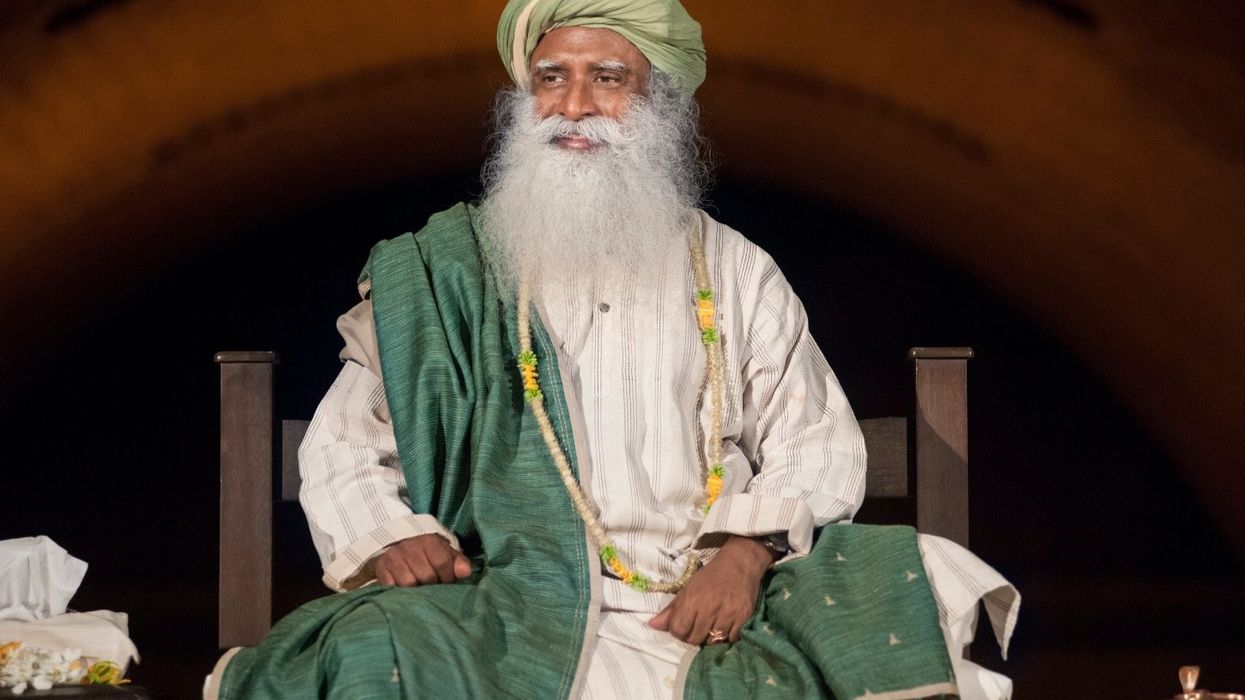
Ranked among the fifty most influential people in India, Sadhguru is a yogi, mystic, visionary and bestselling author. Sadhguru was conferred the Padma Vibhushan, the Indian government’s highest annual civilian award, in 2017, for exceptional and distinguished service.





 Harpreet with KondalsYourLavaan
 A couple who met from YourLavaanYourLavaan