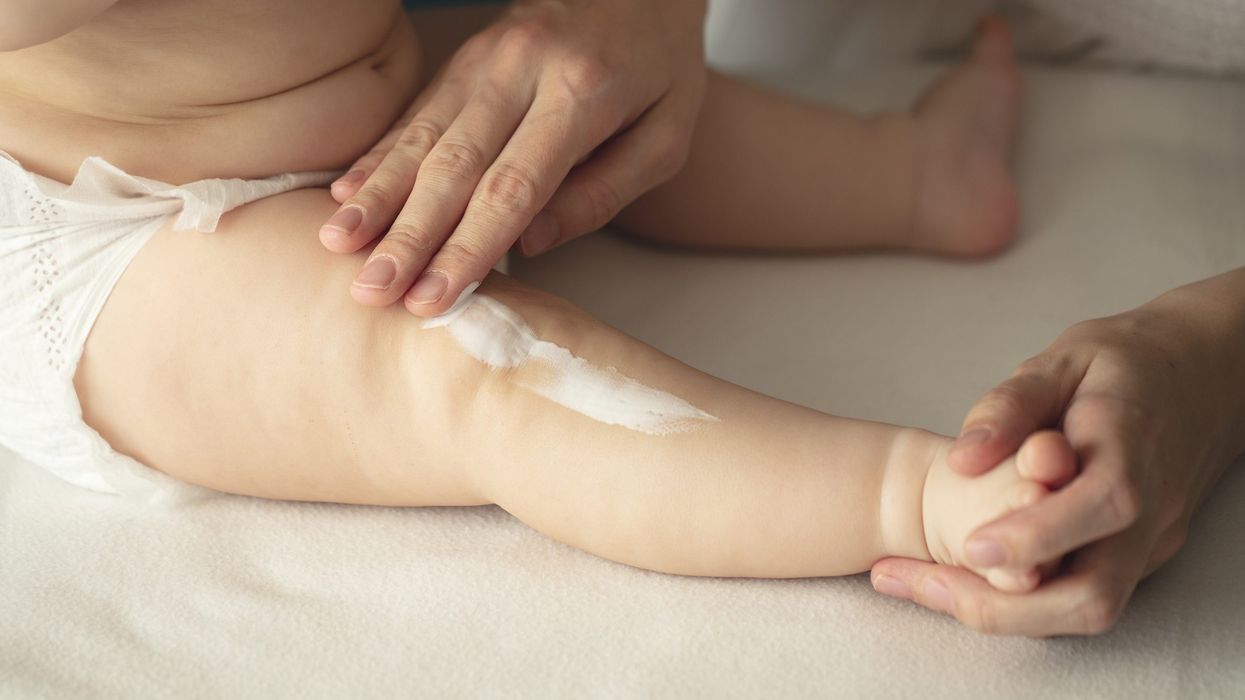

It’s important to pay attention to the kind of products you apply on your skin, especially those with sensitive skin, need to be more cautious as any product that doesn’t suit the skin could lead to itchiness, redness, inflammation, acne, and so on. You’ve probably heard that those with sensitive skin tend to use baby skincare products in the hope that these products are less harsh and will be beneficial for their skin.
“However, it doesn’t work like that,” warns Dr Gurveen Waraich, a dermatologist who took to her Instagram account to explain that there’s a reason why there is a separate skincare range for babies, The Indian Express reports.
The expert informs, “There’s a structural difference between the skin of babies and that of adults. A baby’s skin has almost nil sebum, sweat, and melanin production in comparison to adults. So, how can a cleanser and shampoo meant for babies work for us?”
Newborn babies’ skin and hair are very different and need gentle cleansing. Adults, on the other hand, are exposed to plenty of pollutants daily. Moreover, an adult’s skin’s cell turnover process is completely different from a baby’s and therefore requires a different skincare regimen. Ignoring this fact will only prevent your skin from being thoroughly cleansed and as a result, you may develop blackheads, explains an earlier report in IDiva.
Explaining the difference between babies’ skin and the skin of adults, Dr Gurveen adds, “A baby’s skin has less natural moisturising factors and lipids, and their skin barrier is not yet fully developed. So, their moisturiser has more oils and occlusive ingredients.” This can lead to skin acne and congestion in adults.
Also, a baby’s skin is not exposed to the sun, environmental pollution, sun, stress, and hormones.
“So, if your skin is sensitive, don’t use baby products. Instead, use brands and products meant for sensitive skin,” the dermatologist advises.
Agreeing, Dr Chandni Jain Gupta, Dermatology, Venereology and Cosmetology, Elantis Healthcare, New Delhi, India reportedly said, “Baby products are pH balanced, and contain ingredients which fortify skin as it doesn’t produce oils until a certain point. A shampoo or body wash for babies, for example, is a much milder and more protective product than a thorough cleanser.
“So, if you use it on yourself, you might find your skin, especially parts of your body with large pores, getting clogged and feeling greasy. The adult body has much larger pores than a baby’s and is much oilier on average, meaning it needs a whole other level of cleansing.”
Another reason baby skincare products may be harmful and irritating for adults is because of their fragrance. “A lot of skincare for babies has fragrance, even though it isn’t overpowering. This doesn’t work out well for adult skin prone to inflammation—something we tend to ignore because it feels good to smell,” Dr Chandni said.
The expert goes on to explain that it is important to note that products meant for babies don’t contain ingredients that focus on skin problems – this is because babies don’t have any skin issues. “Baby products also don’t exfoliate skin because babies don’t need it. The day there is a two-month-old with acne, pigmentation, or blackheads, we can discuss using that child’s skincare.
“Till then, those of us with skin issues which need treating will have to use specialised skincare which actually treats our grown-up skin troubles,” she said.






 Curator Emma Slocombe with ikat robes and arabachi coats in the Peter the Great Room in Blickling Hall Amit Roy
 View of the entrance to Blickling Hall on a rainy autumn dayAmit Roy
 Kente cloth from Ghana in the Long Gallery in Blickling Hall
 Decoration in the Great Hall at Blickling Hall Amit Roy
 Palampore fragment made in coastal south-east India in the Brown Room in Blickling Hall Amit Roy
 Bed valance dating from early 1700s in the Italian Print Room at Blickling Hall Amit Roy
 Indian inspired fabric draped on sofas in the South Drawing Room in Blickling Hall Amit Roy
 Indian inspired fabric draped on sofas in the South Drawing Room with Indian carpet in Blickling Hall Amit Roy
 Karun Thakar has picked out the geometric patterns in the bookcase and the Kente cloth in the Long Gallery in Blickling Hall Amit Roy
 Large tapestry depicting Peter the Great defeating the Swedish army at the Battle of Poltava in 1709 Amit Roy
 ikat robes and arabachi coats in the Peter the Great Room in Blickling Hall Amit Roy
 Baghs and kanthas made by women provide contrast to the men only portraits in the Great Hall at Blickling Hall Amit Roy
 Baghs and kanthas in the entrance Great Hall at Blickling Hall Amit Roy
 Baghs and Kanthas in the Great Hall in harmony with stained glass window at Blickling Hall Amit Roy
 Kimonos reflect Japanese influence in Upper Ante Room in Blickling Hall Amit Roy
 Kimono in Upper Ante Room in Blickling Hall
 A view of the Palace and fort at Agra shows romantic side of India Amit Roy
 Blickling Hall Amit Roy
 Table carpet, European 1670-1680 Amit Roy
 Unfinished 17th century Italian embroidery in the Print Room at Blickling Hall Amit Roy
 Picture of Kashmir shows a romantic view of India Amit Roy
 A panel of Ashburnham bed hangings made in Gujarat for sale in Europe in the Brown Room in Blickling Hall Amit Roy
 Colcha made in the 1600s by women in Bengal for the Portuguese market in the Long Gallery at Blickling Hall Amit Roy




