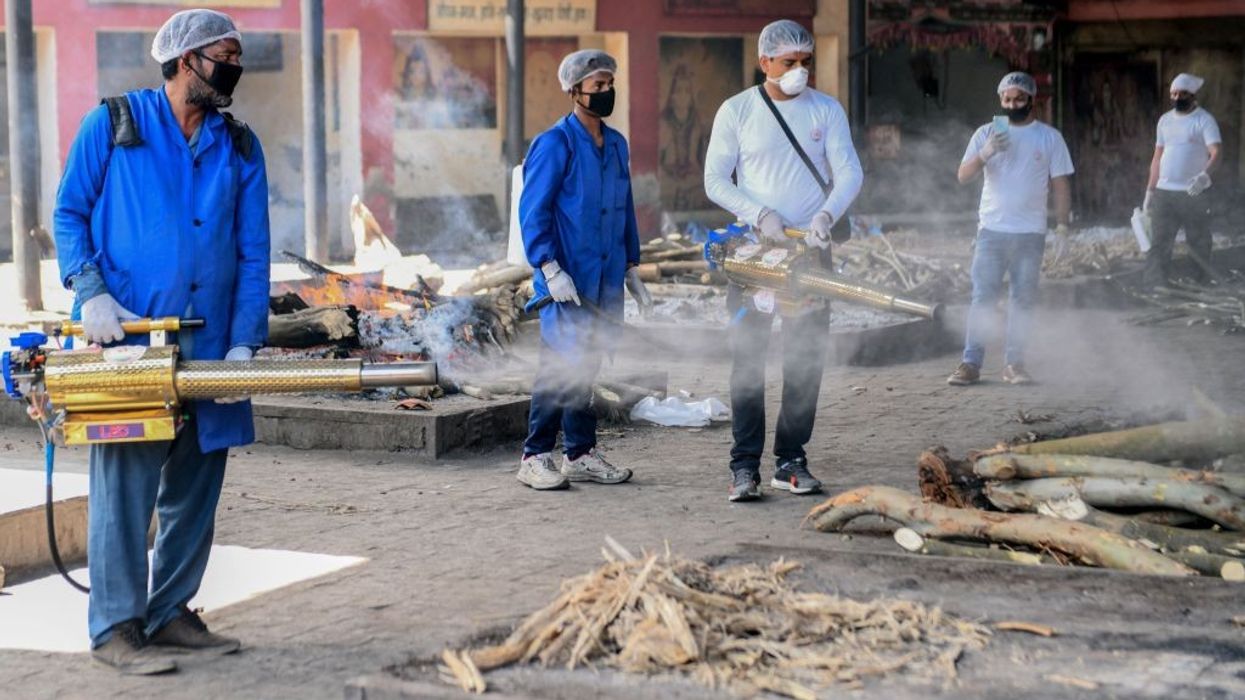

INDIA’S top court has ordered state authorities to pay Rs 50,000 (£494) as compensation for each death caused by Covid-19, as a way to help families cope with the loss, according to its order reviewed on Tuesday (5).
India has recorded 449,260 deaths overall, a tally experts say is a massive undercount, as millions more may have died in the vast hinterlands. In major cities, including the capital New Delhi, experts said a large number of deaths were unreported as hospitals ran out of beds and oxygen supplies.
Petitioners had appealed to the Supreme Court to provide at least eight times the compensation, or Rs 400,000 (£3,950), under the National Disaster Management Authority, through which the government provides some financial help in natural disasters such as earthquakes.
The government, in its affidavit, which was approved by the top court, agreed to the minimum payable amount to be disbursed by local authorities under the State Disaster Response Fund.
These funds would be over and above those paid by federal and state authorities under various other schemes, it said.
"All concerned authority shall act as a helping hand, so as to wipe off the tears of those who have suffered due to loss of a family member due to Covid-19," the Supreme Court said in its order.
India's Supreme Court ordered state administrative bodies to brush past long bureaucratic procedures and settle all claims within 30 days of submission.
The country's healthcare system buckled under a devastating rise in infections in April and May, driven largely by the more infectious and dangerous delta variant, which killed at least 170,000 people in May alone, official data showed.
Deaths have since come down sharply, and daily infections have settled around 34,000 since August.
India's health ministry did not respond to a request for comment on determining the allocation amount.
India has reported 33.85 million infections overall, the second-highest globally behind the United States.






 Curator Emma Slocombe with ikat robes and arabachi coats in the Peter the Great Room in Blickling Hall Amit Roy
 View of the entrance to Blickling Hall on a rainy autumn dayAmit Roy
 Kente cloth from Ghana in the Long Gallery in Blickling Hall
 Decoration in the Great Hall at Blickling Hall Amit Roy
 Palampore fragment made in coastal south-east India in the Brown Room in Blickling Hall Amit Roy
 Bed valance dating from early 1700s in the Italian Print Room at Blickling Hall Amit Roy
 Indian inspired fabric draped on sofas in the South Drawing Room in Blickling Hall Amit Roy
 Indian inspired fabric draped on sofas in the South Drawing Room with Indian carpet in Blickling Hall Amit Roy
 Karun Thakar has picked out the geometric patterns in the bookcase and the Kente cloth in the Long Gallery in Blickling Hall Amit Roy
 Large tapestry depicting Peter the Great defeating the Swedish army at the Battle of Poltava in 1709 Amit Roy
 ikat robes and arabachi coats in the Peter the Great Room in Blickling Hall Amit Roy
 Baghs and kanthas made by women provide contrast to the men only portraits in the Great Hall at Blickling Hall Amit Roy
 Baghs and kanthas in the entrance Great Hall at Blickling Hall Amit Roy
 Baghs and Kanthas in the Great Hall in harmony with stained glass window at Blickling Hall Amit Roy
 Kimonos reflect Japanese influence in Upper Ante Room in Blickling Hall Amit Roy
 Kimono in Upper Ante Room in Blickling Hall
 A view of the Palace and fort at Agra shows romantic side of India Amit Roy
 Blickling Hall Amit Roy
 Table carpet, European 1670-1680 Amit Roy
 Unfinished 17th century Italian embroidery in the Print Room at Blickling Hall Amit Roy
 Picture of Kashmir shows a romantic view of India Amit Roy
 A panel of Ashburnham bed hangings made in Gujarat for sale in Europe in the Brown Room in Blickling Hall Amit Roy
 Colcha made in the 1600s by women in Bengal for the Portuguese market in the Long Gallery at Blickling Hall Amit Roy




