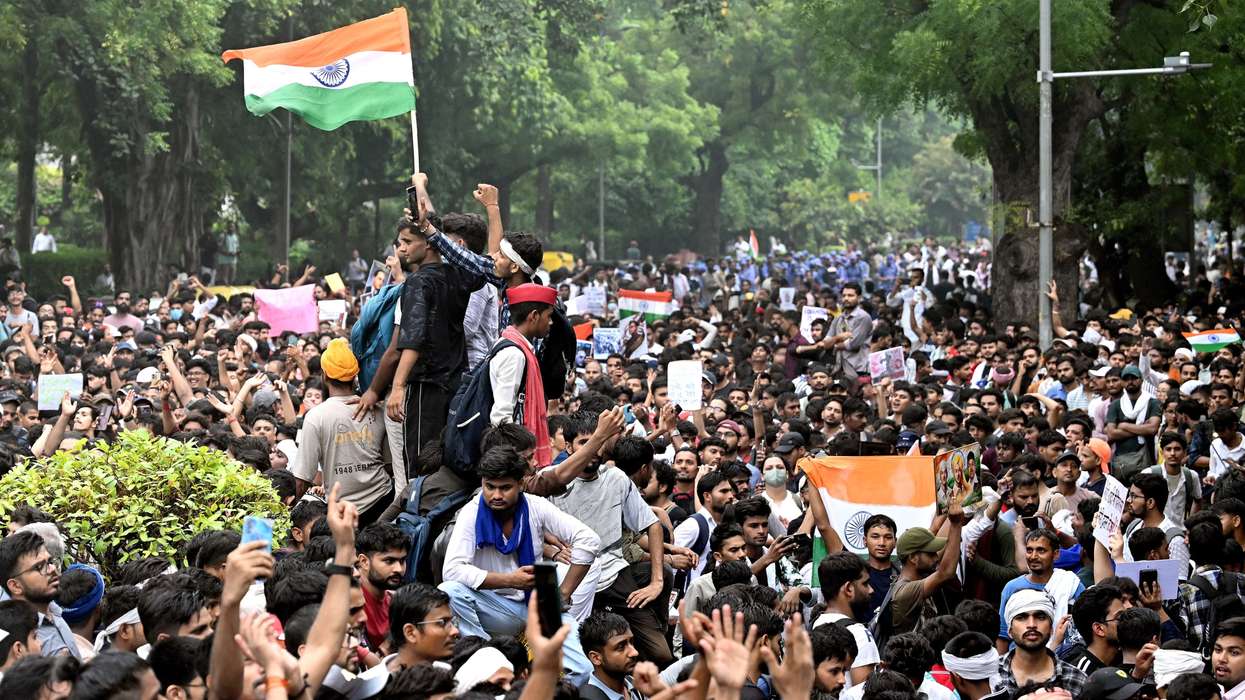

Nearly five weeks after leaders of India's youth Cockroach Janta Party (CJP) launched protests demanding the resignation of the education minister over exam paper leaks, prime minister Narendra Modi posted a selfie video saying he was pained by their suffering and promising remedial steps.
The video, posted on Instagram late on Thursday, came after the CJP had gained 22 million followers, mostly from Gen Z, within days of its launch in May. But it failed to satisfy thousands of protesters gathered in central Delhi. Days after they faced a police crackdown and as protests spread across the country, Education Minister Dharmendra Pradhan resigned on Saturday, meeting the protesters' main demand.
Pradhan's resignation marks a win for the CJP, whose supporters have mocked Modi through raps, placards and graffiti. It also marks a rare setback for the prime minister, who has dominated Indian politics since taking office in 2014.
"A large number of people who were at the protest may actually be his supporters — and that's quite different from other kinds of protests in the past," said Sanjay Srivastava, anthropology professor at SOAS University of London.
"What might be interpreted as a win is the fact that there is now a much wider cross-section of people questioning the government. A much wider cross-section has begun to question the idea that the ruling party is necessarily good for the country."
The protests began over a leaked medical entrance exam, but analysts said they also reflected wider concerns among young people, including unemployment and fears that AI could replace jobs in sectors such as India's IT back offices.
"The paper leak is a trigger point," political analyst Amitabh Tiwari said. "It is largely a reflection of the anxiety, nervousness, discontent, frustration and anger among the youth."
Modi's senior ministerial colleague Rajnath Singh said the government's "top priority remains to understand our students’ genuine concerns, address them promptly, and ensure that they know their voices are being heard".
Indians aged between 18 and 40 are estimated to account for about 40 per cent of the population but hold only about 10 per cent of seats in the lower house of parliament, down from more than double that share in the 1950s, Tiwari said. The average age of the cabinet is more than 60.
Although the CJP is not a political party, opposition parties have tried to benefit from the protests by backing the students' demands.
The first electoral test of the youth anger could come in state elections next year in Uttar Pradesh, Punjab and Modi's home state of Gujarat. The BJP governs both Uttar Pradesh and Gujarat.
A bigger challenge for Modi could emerge in the 2029 general election if the CJP decides to enter politics. Its founder, Abhijeet Dipke, has said no decision has been taken on joining electoral politics.
Some analysts said younger voters have largely voted along religious or caste lines in the past, helping Modi's Bharatiya Janata Party. They say that pattern may now be changing.
An actor, leading his own party and backed by opposition parties, was recently elected chief minister of Tamil Nadu after building support through an Instagram-focused Gen Z following.
"This has been a moment of reckoning for PM Modi - and it shows how they are completely out of touch with what Gen Z wants," said author Anurag Minus Verma.
"For years, the BJP's digital political strategy was centred on platforms like X, where much of the political conversation took place. But that conversation has increasingly shifted to Instagram now, particularly among younger users."
The BJP says it is the world's largest political party and governs most of India. It has around 10 million Instagram followers, less than half the number the CJP gained in a matter of days. The BJP has 23 million followers on X and 18 million on Facebook, while Modi's personal following across the three platforms ranges from 60 million to 107 million.
"You need a kind of authenticity for Instagram," said columnist Santosh Desai. "Pre-laboured, carefully massaged messages won’t work. This medium was created by this generation and has become what it has thanks to this generation. This generation has no reverence."
For a decade, Modi has projected himself as a decisive leader who rarely admits mistakes, and his government has generally resisted removing ministers under pressure. Farmers protested for nearly a year before Modi repealed contentious farm laws in 2021.
"From now, a leader who listens is likely to do well," Tiwari said. "And that is what Modi is trying to show."