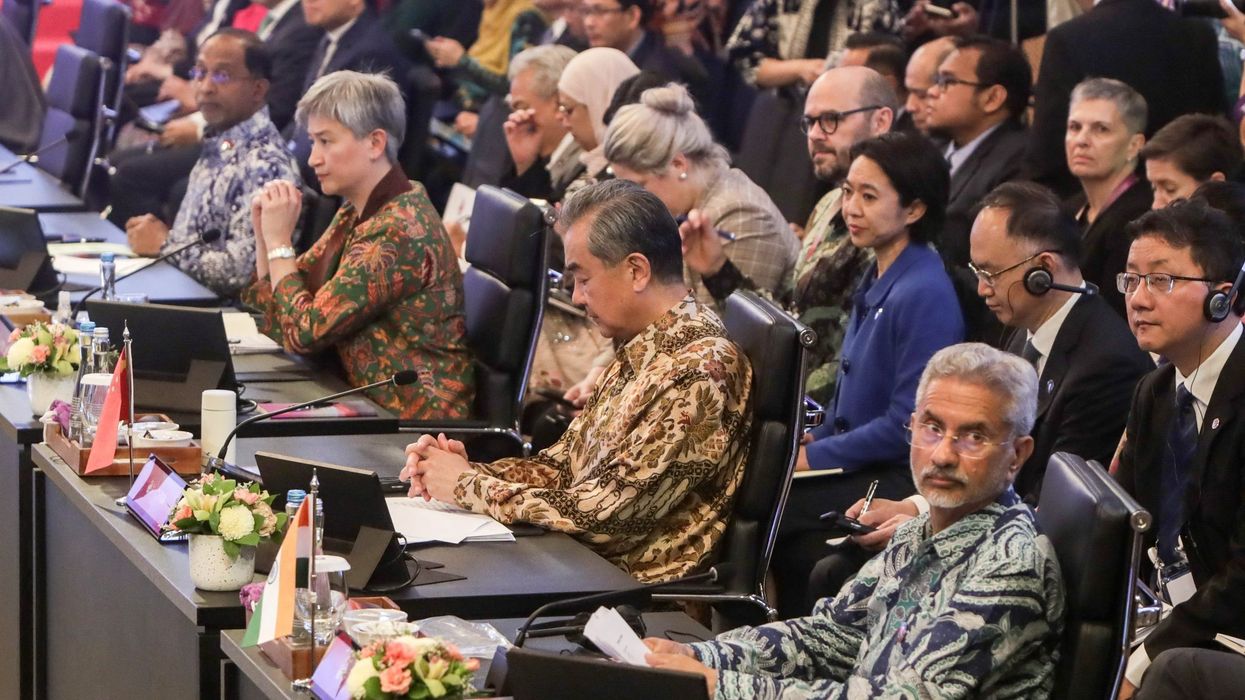
CHINA'S top diplomat Wang Yi told the Indian foreign minister bilateral ties need to be stabilised, as the neighbours searched for ways to ease simmering military tensions along their vast border.
On the sidelines of ASEAN meetings in the Indonesian capital of Jakarta, Wang told India’s external affairs minister, Subrahmanyam Jaishankar, that mutual support between the two nations is needed instead of suspicion, according to a readout from the Chinese foreign ministry.
"China and India's common interests clearly outweigh their differences," said the Chinese diplomat, adding, "The two sides should support each other, rather than... suspect each other.”
India and China share a 3,800-km (2,360-mile) frontier, much of it poorly marked, and fought a brief but bloody war over it in 1962.
Beijing also claims the Indian state of Arunachal Pradesh as part of Tibet, and it considers Kashmir a disputed territory.
"It is hoped that the Indian side will meet China halfway and find a solution to the border issue that is acceptable to both sides," Wang said.
Since the 1990s, ties have improved after a series of border agreements, and China is now India's second-largest trading partner.
A setback in 2020, however, when 20 Indian soldiers and four Chinese soldiers were killed in hand-to-hand fighting during a border clash, spurred both militaries to fortify positions and deploy large numbers of troops and equipment.
Several rounds of military and diplomatic talks have helped to ease tensions between the two armies, but New Delhi has described the situation on the border as fragile and dangerous.
China and India need to work in the same direction to find a solution to border issues acceptable to both sides, Wang told Jaishankar during their meeting last Friday (14).
"The two sides should support each other and accomplish things together, rather than wear each other down or suspect each other," Wang said.
India and China should not let specific issues define their overall relationship, he said.
Both sides agreed to hold the next round of military commander-level talks on border issues at an early date, the Chinese foreign ministry said.
Since 2020, New Delhi has also ramped up scrutiny of Chinese businesses, banning more than 300 Chinese apps, including TikTok. It has also intensified scrutiny of investments by Chinese firms.
"China is highly concerned about India's recent restrictive measures against Chinese companies," Wang added, while urging New Delhi to provide a "fair, transparent and non-discriminatory business environment".
(Agencies
China seeks stable ties with India
New Delhi and Beijing should support, rather than suspect, each other: Chinese diplomat