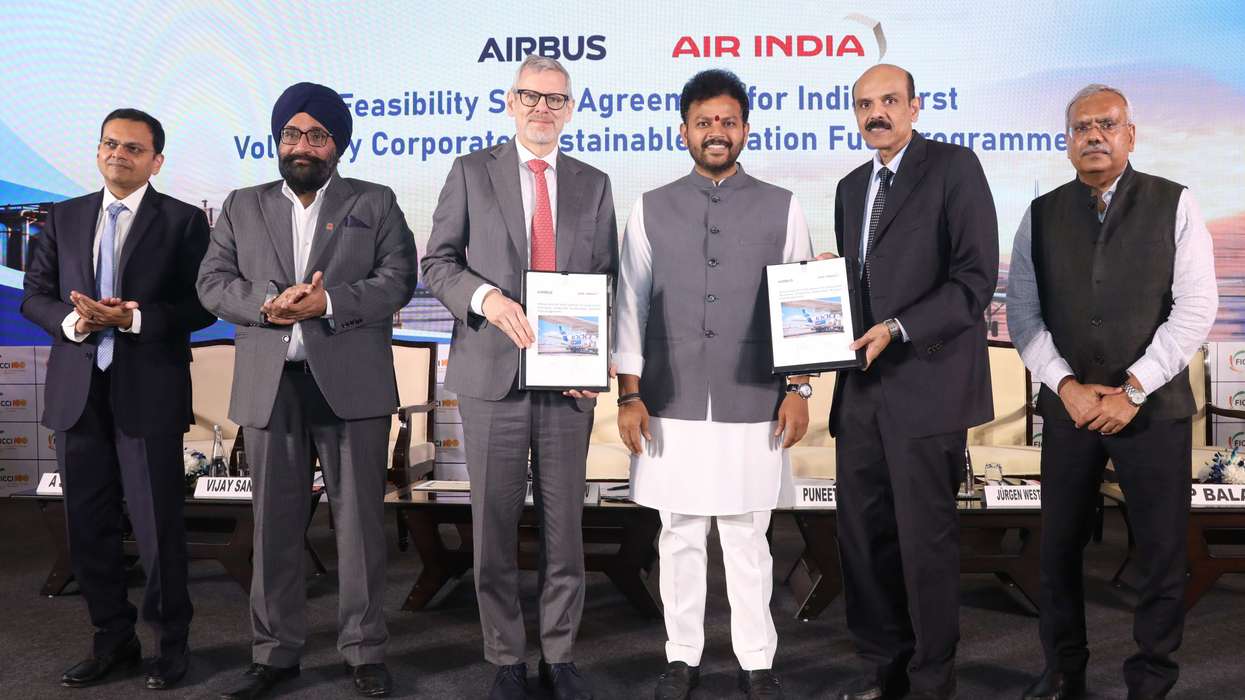

Air India and European aircraft manufacturer Airbus have joined hands to develop a framework for India's first voluntary corporate Sustainable Aviation Fuel (SAF) programme, aimed at helping businesses reduce the carbon footprint of their air travel.
The proposed programme would allow Air India to voluntarily purchase and use SAF on selected routes and transfer the associated Scope 3 SAF certificates (SAFc) to eligible corporate customers.
Companies participating in the initiative would be able to use the certificates to track and report reductions in emissions linked to their business travel.
A feasibility study agreement for the programme was announced in London on Tuesday (17). It was signed by Airbus India and South Asia President and Managing Director Jürgen Westermeier and Air India Group Head of Governance, Risk and Compliance and Corporate Affairs P Balaji, in the presence of Civil Aviation Minister Rammohan Naidu.How the corporate SAF programme would workThe feasibility study will examine how the programme can be structured and made available to businesses across different sectors.
Under the proposed framework, emissions savings would be calculated by comparing the lifecycle carbon footprint of SAF with that of conventional jet fuel, using internationally recognised standards.
Participating companies could use the verified savings to report their progress towards the aviation industry's ambition of achieving net-zero carbon emissions by 2050, supported by the Air Transport Action Group (ATAG), the International Air Transport Association (IATA) and the International Civil Aviation Organisation (ICAO).
SAF is produced from renewable sources or waste materials and is intended to serve as an alternative to conventional aviation fuel. It must meet recognised sustainability criteria and certification requirements covering its production and supply chain.Why Air India says demand is the missing pieceAir India said the initiative would give companies a way to contribute to the adoption of SAF while addressing emissions associated with business travel.
Air India CEO and Managing Director Tewolde Gebremariam said: "Achieving aviation's decarbonisation goals will require collective action across the ecosystem."
He said the partnership with Airbus was exploring "a credible mechanism" through which companies could support SAF adoption and reduce emissions from business travel.
"Expanding demand for SAF is essential to scaling production and building a sustainable aviation ecosystem in India, and we are pleased to help lead that effort," he added.
Balaji said developing a viable SAF ecosystem required demand, collaboration and industry participation.
"Through this initiative, we aim to create a framework that enables corporates to play a meaningful role in accelerating SAF adoption in India," he said.Airbus calls SAF the most realistic routeWestermeier said SAF had the "most realistic potential to decarbonise aviation" and that Airbus was working with regulators, airlines, airports, fuel producers and research organisations to support its wider adoption.
Describing the partnership with Air India as a "crucial stepping stone" for the region, he said decarbonising aviation required industry-wide action.
He also invited other companies to join the proposed programme.Part of Air India's bigger emissions pushThe initiative forms part of wider efforts by Air India and Airbus to reduce aviation emissions through fleet renewal, improved aircraft technology, operational changes and greater use of SAF.
Air India has 600 new aircraft on order, including 350 from Airbus, as part of its fleet modernisation programme. The airline expects the new aircraft to help reduce emissions from its operations.
It is also looking to increase the number of non-stop routes, which it says could reduce emissions associated with flight itineraries.
The airline has introduced flight planning and optimisation systems to improve fuel efficiency, alongside measures such as single-engine taxiing, more frequent engine and airframe washing, and autonomous electric vehicle towing.
Other initiatives include reducing single-use plastics and using lighter materials for cutlery and dishes.
Why the programme matters
The feasibility study will assess how a corporate SAF programme could encourage businesses to contribute to the growth of the fuel market in India.
Airlines and fuel producers need greater demand to support increased SAF production and wider availability. The proposed certificate mechanism is intended to give companies a way to support its use and account for the associated emissions savings.What happens nextThe partnership is currently at the feasibility study stage. Air India and Airbus will assess the proposed framework before deciding on its implementation.
If introduced, the programme would be India's first voluntary corporate SAF initiative. Airbus has said it is open to bringing more companies into the programme.