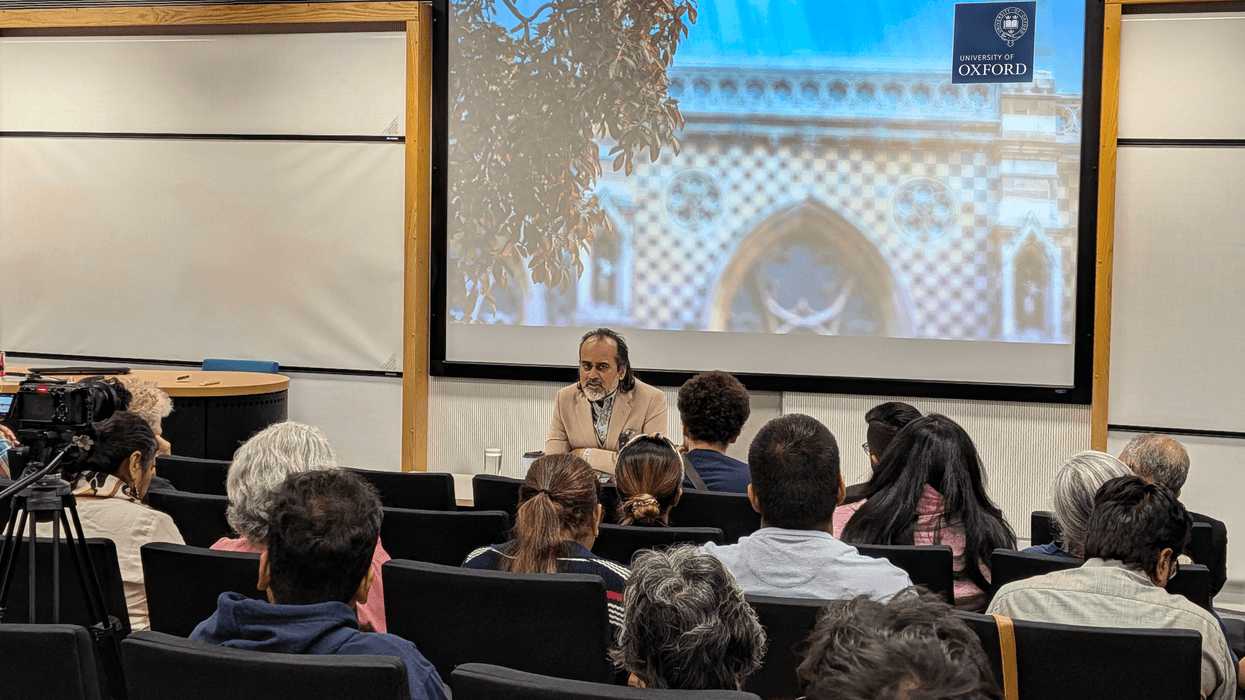

Indian philosopher and bestselling author Acharya Prashant delivered a lecture at Oxford University, drawing students, researchers and academics from across the UK, Europe and the United States for a discussion on the relevance of Vedantic wisdom in addressing contemporary global challenges.
Speaking at Oxford's Manor Road Building, home to the University's Department of Economics, Acharya Prashant explored teachings from the Ishavasya Upanishad, one of India's oldest philosophical texts. The lecture formed part of his ongoing UK tour, which has attracted growing interest at leading academic institutions.
Reflecting on Oxford's historic connection with Indian philosophy, Acharya Prashant noted that the Ishavasya Upanishad was first translated into English at Oxford in the 19th century by renowned scholar Max Müller. He described the occasion as an opportunity to revisit the text's relevance in today's world.
Addressing issues ranging from climate change and environmental degradation to mental health and social conflict, he argued that technological progress and economic growth alone cannot resolve humanity's deepest crises without greater self-awareness and inner transformation.
"The world has advanced enormously in science and technology, but the human mind remains largely unexplored," he told the audience. He suggested that modern society has accumulated vast knowledge of the external world while neglecting the understanding of the self.
During the interactive session, Acharya Prashant discussed themes of ego, identity and human responsibility, emphasising that lasting solutions to global challenges must begin with a deeper examination of individual consciousness. He urged audiences to complement scientific and economic progress with what he described as "education of the self".
The event highlighted the continuing global interest in India's philosophical heritage and its potential contribution to contemporary debates on sustainability, leadership and human wellbeing.





 Ambaji DhajaMahesh Liloriya