

The new memoir of Prince Harry has made the headlines, thanks to a series of explosive accusations he has brought against members of his family, including private confrontations with other senior royals, but the book also has details about some witty incidents.
For example, the Duke of Sussex has revealed in his 'Spare' that he had once requested his wife Meghan Markle not to take a picture in front of the Taj Mahal, India's iconic 17th century mausoleum, ahead of a trip she made to the south Asian country.
But why did Prince Harry, 38, give his wife such advice when the established practice for foreign dignitaries visiting the Taj is to pose for the lensmen with the ivory-white structure in the background?
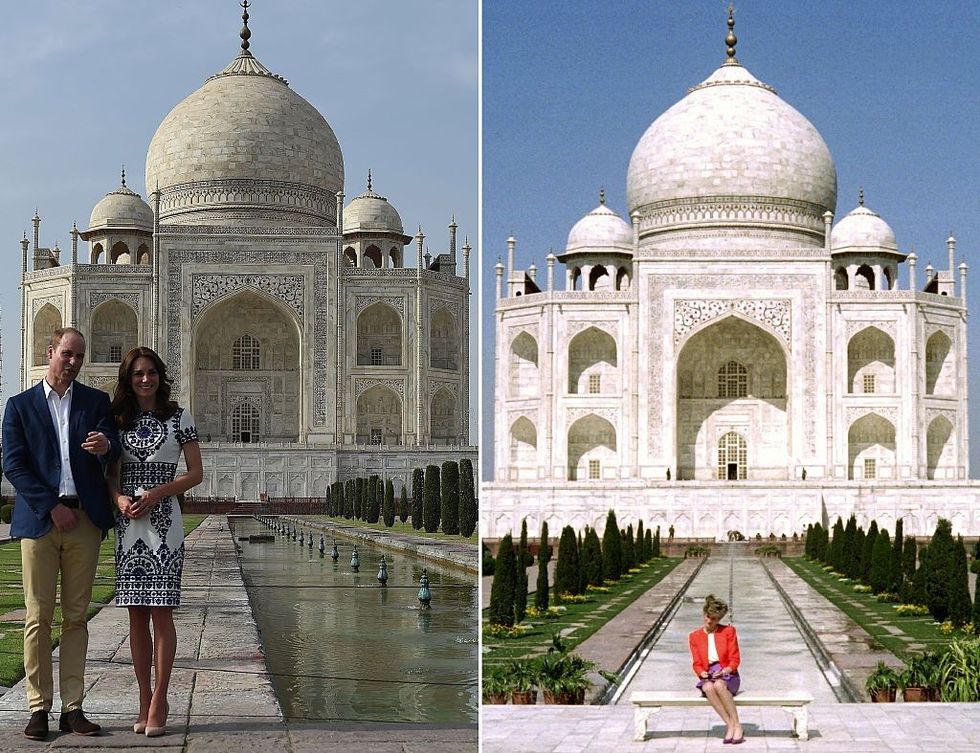 (FILES) This combination photograph shows (RIGHT) Princess Diana of Wales as she poses at The Taj Mahal in Agra on February 11, 1992, and (LEFT) Britain's Prince William, then Duke of Cambridge (L) and Catherine, then Duchess of Cambridge as they pose during their visit to The Taj Mahal in Agra, India, on April 16, 2016.(Photo by DOUGLAS CURRAN,PRAKASH SINGH/AFP via Getty Images)
In his memoir, Harry wrote that he made such a request since he did not want people to assume she was mimicking Princess Diana, his late mother who died in a car crash in France in 1997.
'Spare' revealed that Prince Harry and his wife laughed about the advice he gave her.
“Do not take a photo in front of the Taj Mahal. She’d asked why and I’d said: My mum,” Prince Harry wrote.
“I’d explained that my mother had posed for a photo there, and it had become iconic, and I didn’t want anyone thinking Meg was trying to mimic my mother,’ the Duke of Sussex said in his memoir.
In an interview ahead of the release, Prince Harry said that his brother William, the Prince of Wales, and his wife Kate Middleton, the Princess of Wales, "stereotyped" Markle as a "divorced biracial American actress".
He also claimed that his elder brother and sister-in-law never got on with his wife "from the get-go".
“There was a lot of stereotyping that was happening, that I was guilty of as well, at the beginning. American actress, right, and that was playing out in the British press in the media at the time as well. Some of the things that my brother and sister-in-law – some of the way that they were acting or behaving – definitely felt to me as though, unfortunately, that stereotyping was causing a bit of a barrier to them really sort of, you know, introducing or welcoming her in," Prince Harry said.
Harry married Markle in May 2018.






 Curator Emma Slocombe with ikat robes and arabachi coats in the Peter the Great Room in Blickling Hall Amit Roy
 View of the entrance to Blickling Hall on a rainy autumn dayAmit Roy
 Kente cloth from Ghana in the Long Gallery in Blickling Hall
 Decoration in the Great Hall at Blickling Hall Amit Roy
 Palampore fragment made in coastal south-east India in the Brown Room in Blickling Hall Amit Roy
 Bed valance dating from early 1700s in the Italian Print Room at Blickling Hall Amit Roy
 Indian inspired fabric draped on sofas in the South Drawing Room in Blickling Hall Amit Roy
 Indian inspired fabric draped on sofas in the South Drawing Room with Indian carpet in Blickling Hall Amit Roy
 Karun Thakar has picked out the geometric patterns in the bookcase and the Kente cloth in the Long Gallery in Blickling Hall Amit Roy
 Large tapestry depicting Peter the Great defeating the Swedish army at the Battle of Poltava in 1709 Amit Roy
 ikat robes and arabachi coats in the Peter the Great Room in Blickling Hall Amit Roy
 Baghs and kanthas made by women provide contrast to the men only portraits in the Great Hall at Blickling Hall Amit Roy
 Baghs and kanthas in the entrance Great Hall at Blickling Hall Amit Roy
 Baghs and Kanthas in the Great Hall in harmony with stained glass window at Blickling Hall Amit Roy
 Kimonos reflect Japanese influence in Upper Ante Room in Blickling Hall Amit Roy
 Kimono in Upper Ante Room in Blickling Hall
 A view of the Palace and fort at Agra shows romantic side of India Amit Roy
 Blickling Hall Amit Roy
 Table carpet, European 1670-1680 Amit Roy
 Unfinished 17th century Italian embroidery in the Print Room at Blickling Hall Amit Roy
 Picture of Kashmir shows a romantic view of India Amit Roy
 A panel of Ashburnham bed hangings made in Gujarat for sale in Europe in the Brown Room in Blickling Hall Amit Roy
 Colcha made in the 1600s by women in Bengal for the Portuguese market in the Long Gallery at Blickling Hall Amit Roy




