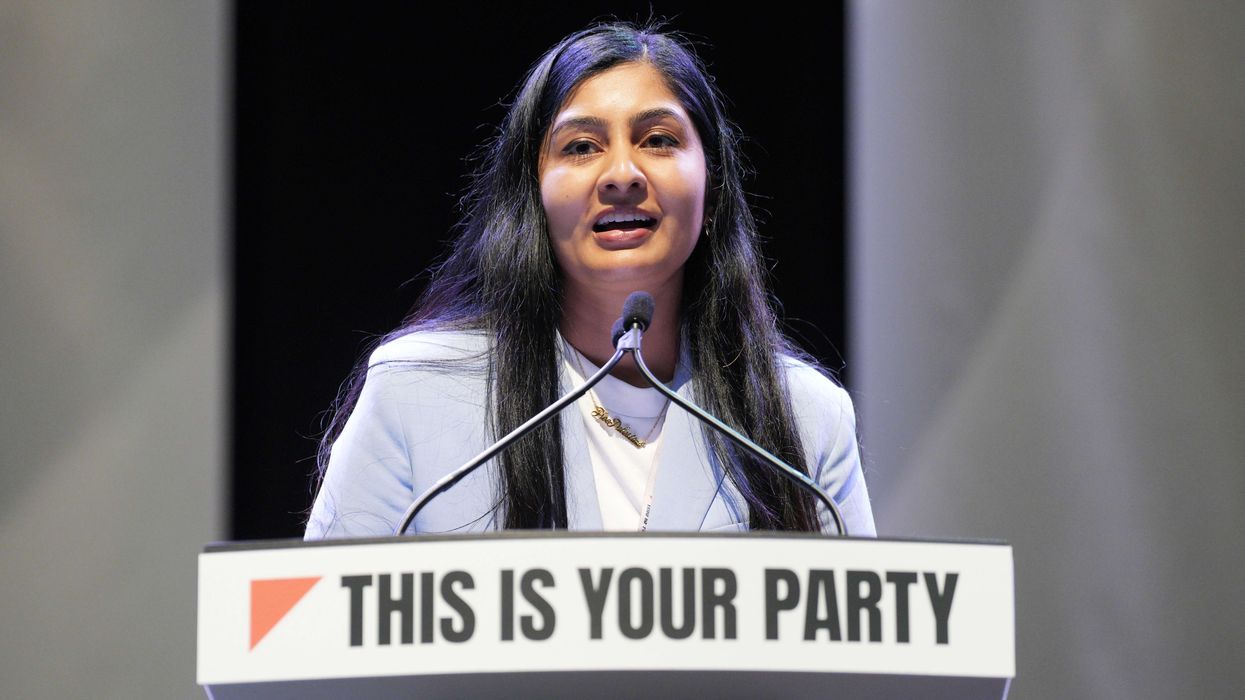

VIDHYA ALAKESON stepped into the centre of British power at a moment when the ground beneath it was shifting.
In February, she was named joint acting chief of staff to prime minister Keir Starmer, sharing the role with fellow deputy Jill Cuthbertson after the abrupt resignation of Morgan McSweeney.
McSweeney, widely credited with masterminding Labour’s landslide victory in the 2024 general election, stepped down after acknowledging he had advised Starmer to appoint Peter Mandelson as UK ambassador to Washington despite security services raising concerns during the vetting process about Mandelson’s well-documented ties to convicted sex offender Jeffrey Epstein.
The political aftershock was immediate. McSweeney had been Starmer’s chief of staff since October 2024 but, more significantly, he had long been the intellectual architect of Labour’s strategic repositioning, guiding the party’s journey back to the centre ground and ultimately back into government after 14 years in opposition. His departure left the prime minister facing what commentators described as the gravest crisis of his premiership.
Starmer’s response was to turn inward rather than outward, elevating the two women already running the daily operations of Downing Street. Alakeson, 49, and Cuthbertson suddenly found themselves responsible for stabilising a government reeling from internal disruption.
What distinguishes Alakeson in the often insular world of Downing Street is the breadth of experience she brings to the role. Unlike many senior political advisers, whose careers are forged almost entirely within party machines, her professional life has ranged across Whitehall, Washington, the NHS, the think-tank world and the voluntary sector.
Born to a British Sri Lankan family, she was privately educated at Wimbledon High School for Girls before reading modern languages at Oxford and completing an MSc at the London School of Economics.
Her early career unfolded within Whitehall. In 2005 she joined HM Treasury as a senior policy adviser before moving to the Prime Minister’s Strategy Unit. A year later she crossed the Atlantic as a Commonwealth Fund Harkness Fellow in Health Care Policy, spending four years in Washington DC at the US Department of Health and Human Services. There she served as lead analyst for mental health at the Office of the Assistant Secretary for Planning and Evaluation.
Returning to Britain, she carried that expertise into the NHS, becoming mental health lead for the personal health budgets delivery programme at NHS England.
In January 2011 she joined the Resolution Foundation, the influential think tank focused on improving living standards for low-to-middle income households. Rising to deputy chief executive, she became a key figure in an organisation whose research has shaped much of Labour’s economic thinking, particularly around wages, inequality and living standards.
In 2015 Alakeson left the think-tank world to build a new institution from the ground up. Power to Change had been established with a £150 million endowment from the National Lottery Community Fund to support community-led businesses across England. As its founding chief executive, she spent seven years turning that mission into an operational reality.
Under her leadership the number of community businesses in England grew from around 5,500 to more than 11,000. More than £100 million in grants and support programmes were distributed, with over two-thirds of the funding reaching the most disadvantaged 30 per cent of the country.
During that period, she also served on the government’s expert advisory panel on high streets.
When the Black Lives Matter movement prompted renewed scrutiny of institutional racism in 2020, Alakeson commissioned an internal review into Power to Change’s own record on equality and inclusion, acknowledging that the organisation had not yet done enough. The following year she was appointed an OBE for services to social equality in the Queen’s Birthday Honours.
Her move into frontline politics came in 2022, when she joined Starmer’s team as director of external relations. The role required a very different style of operation: faster paced, more transactional and acutely sensitive to political timing. Alakeson was tasked with rebuilding Labour’s relationships with business leaders and major institutions after years of strained relations.
The results were visible by the spring of 2024. When 121 founders, chief executives and former senior figures from across financial services, retail and manufacturing signed a letter in the Times declaring that Labour had changed and that they wanted to work constructively with the party, many credited Alakeson with orchestrating the groundwork. One external affairs director from a FTSE 100 company told the Guardian: “Vidhya is clearly working all hours of the day and night. She is absolutely the person you want on your team.”
Hanover Communications, which tracks corporate engagement with Westminster, described her as “the person Starmer turns to for the final view on who he should be meeting” – a figure whose ability to navigate internal factions made her “the crucial conduit for industry”.
When Labour won the July 2024 election, Alakeson entered government as political director, overseeing an expanded team responsible for government messaging, internal research and relations with the Labour membership. Four months later, following the departure of Sue Gray as chief of staff, Alakeson was promoted to deputy chief of staff with responsibility for policy and delivery.
By the time she was elevated again in February this year, she had spent 16 months inside the machinery of government, building an unusually detailed understanding of how Starmer’s administration functions. The Institute for Government has noted that her time as both political director and deputy chief of staff gives her one of the longest continuous tenures at the upper levels of the prime minister’s operation.
Now, as joint acting chief of staff, Alakeson stands at the centre of Downing Street’s power structure. Her task is less about strategy than stability: keeping the machinery of government moving while a bruised premiership regains its footing. In a government suddenly short of certainties, she has become one of its most consequential constants.
ENDS