
SOME of the old witticisms are the best. Take, for example, this observation on America in The Picture of Dorian Gray by Oscar Wilde:
“When good Americans die, they go to Paris.”
“Where do bad Americans go?”
“They stay in America.”
It seems nothing can stop Donald Trump from becoming the Republican candidate in the US presidential election due on November 5 this year.
First, Vivek Ramaswamy, the garrulous son of Indian immigrants, pulled out after the Iowa primary and endorsed Trump, probably hoping to be his running mate.
What was unexpected was the decision of Ron DeSantis, the hard-right governor of Florida, also to pull out this week and throw his weight behind Trump.
Ahead of the New Hampshire primary on Tuesday, he said: “It’s clear to me that a majority of Republican primary voters want to give Donald Trump another chance. He has my endorsement because we can’t go back to the old Republican guard of yesteryear, a repackaged form of warmed over corporatism that Nikki Haley represents.”
Trump responded: “I just want to thank Ron and congratulate him on doing a very good job. He was very gracious, and he endorsed me. I appreciate that, and I also look forward to working with Ron.”
The ex-president achieved the impossible by lowering the level of US political debate by questioning Haley’s racial origins.
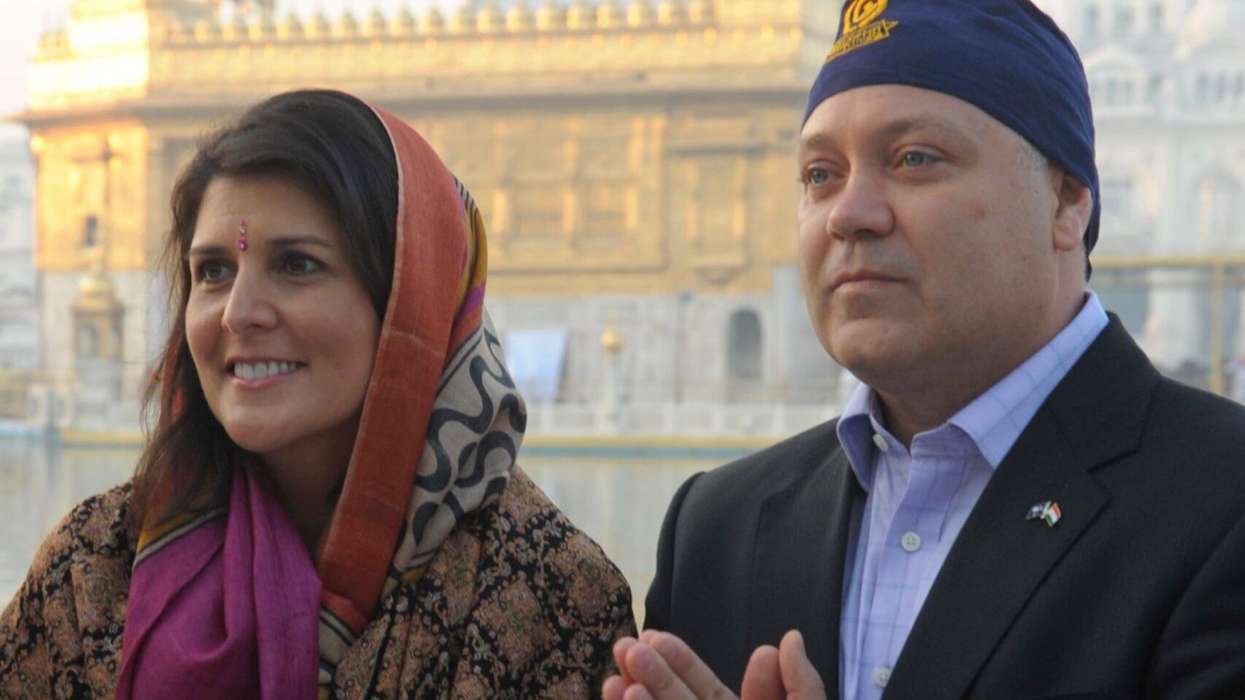
She was born Nimarata Nikki Randhawa at Bamberg County Hospital in Bamberg, South Carolina, to immigrant Sikh parents from India. Her father, Ajit Singh Randhawa, was a professor at Punjab Agricultural University, and her mother, Raj Kaur Randhawa, received her law degree from the University of Delhi. Haley, who uses her middle name, converted to Christiantity in 1997. She and her husband, Michael Haley, who married in 1996, have two children, Rena and Nalin.
Trump spent years falsely claiming that Barack Obama was ineligible for the presidency, spreading lies that he was born in Kenya rather than Hawaii.
He has started referring to Haley as “Nimrada”, a misspelling of her given first name on social media.
Asked about the attacks during a CNN town hall meeting, Haley said: “Well, first, I am the proud daughter of Bamberg, South Carolina, so I love my sweet town and I’m proud to say I’m from there. So, that’s the first question, we can throw that out the window.”
She went on: “The name calling? I know President Trump well. That’s what he does when he feels threatened, that’s what he does when he feels insecure. I don’t take these things personally. It doesn’t bother me. I know I am a threat. I know that’s why he’s doing that”.
Speaking about her own experience, she said later:
“We had plenty of racism that we had to deal with, but my parents never said we lived in a racist country, and I’m so thankful they didn’t. Because, for every brown and black child out there, if you tell them that they live in or were born in a racist country, you’re immediately telling them they don’t have a chance.”
It has been drummed into most of us since we have been children that the United States is the most important country in the world.
Then how come it is prepared to re-elect Donald Trump as president?