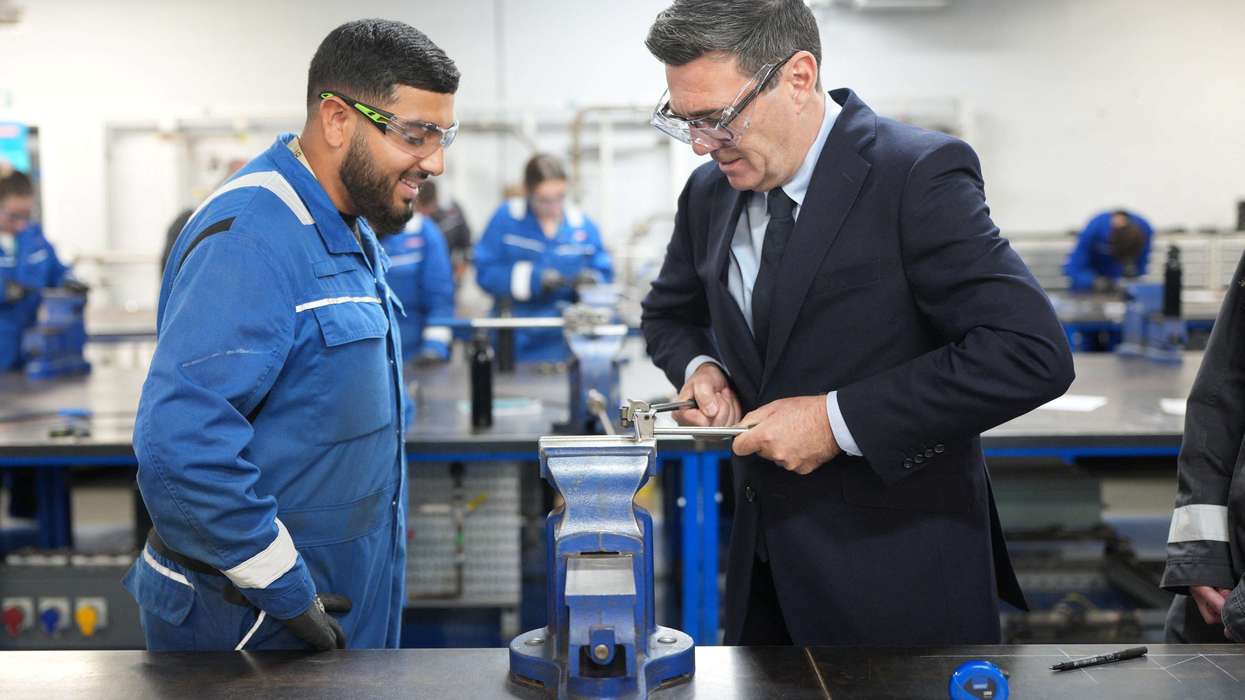

LAST month, prime minister Andy Burnham set out his ambition to create an education system “based on parity between academic and technical” and for Britain to “value the hard hat as much as the graduation cap”.
Yet the changes announced will affect pupils long before they enter a construction site or begin university. From the age of 14, pupils will soon be offered a range of new technical education pathways. Mirroring those proposed in the Centre for Social Justice’s recent report, Rewiring Education1, they will recognise pupils who combine English, maths and science with a vocational qualification, such as digital or design and technology.
Currently, the only school performance measure based on the qualifications a pupil achieves is the English Baccalaureate, which requires pupils to study English, maths, the sciences, geography or history, and a language.
From September 2028, that will no longer be the case.
So why have these reforms been introduced, what do they aim to achieve, and how are they expected to make a difference? The new pathways are a direct response to mounting concerns over youth inactivity.
The UK now has more than one million 16- to 24-year-olds who are not in education, employment or training (NEET), equivalent to 13.5 per cent of that age group. This has coincided with a worrying rise in long-term inactivity rather than short-term unemployment.
That said, this is not a new issue. The NEET rate has fallen below 10 per cent only once since 2000. For more than two decades, the UK has left one in 10 young people unprepared or unable to move into work after leaving fulltime education.
The picture is even more concerning when compared with our European neighbours. In the Netherlands, only 4.1 per cent of young people are NEET, and the rate has not exceeded six per cent in more than 15 years. In Germany, it last rose above eight per cent in 2011.
Examining why these countries are more successful at protecting young people’s potential helps explain the rationale behind Burnham’s reforms.
Germany and the Netherlands are internationally recognised for their technical education systems. A genuine parity of esteem – something the prime minister hopes to replicate – combined with deeply embedded workplace learning gives pupils the skills and experience needed to move smoothly from school into work.
A key feature of both systems, and one of the clearest differences from England’s education system, is that pupils are placed on different educational pathways at the end of primary school.
In Germany, pupils join one of two types of secondary school at the age of 10: one providing a general education with an emphasis on practical subjects, and another academic route that prepares them for university.
A similar structure exists in the Netherlands. At the age of 12, pupils begin either pre-vocational, general or pre-university education. Within the pre-vocational pathway, they are further grouped by ability and occupational sector, and often take part in work-study programmes that include practical learning outside the classroom.
 Ben MillerThe Centre for Social Justice
Early and clearly defined pathways allow education to be tailored more effectively to pupils’ individual needs. Longer exposure to technical education also builds the skills and experience needed for their future occupations, helping ensure they are ready for work.
Since the announcement, critics have raised concerns about the impact on social mobility. Children from disadvantaged backgrounds often perform worse in academic tests at the end of primary school, and determining their educational pathway at that stage could limit their opportunities later in life.
However, these arguments often ignore the reality of the current education system. England employs one of the highest degrees of grouping by ability in the world, and the set a pupil is placed in has a significant influence on their eventual educational outcomes.
The status quo groups pupils by ability without tailoring education to their needs, ultimately condemning those who fall behind to remain behind.
As a result, we have failed to help disadvantaged children reach the country’s leading universities.
In seven out of 10 local authorities outside London, fewer than four per cent of pupils eligible for free school meals progress to the top third of higher education institutions.
Given this disparity, the new pathways are intended to provide a high quality technical alternative to the traditional academic route, which is failing too many pupils.
Burnham pioneered this approach as mayor of Manchester. Through the Manchester Baccalaureate, pupils can choose vocational qualifications at the age of 14 that lead to post-16 education linked to the Greater Manchester economy, including sectors such as construction and the green economy. The national rollout aims to align education more closely with the needs of local economies across the country.
Provided these new pathways are treated as genuine equals to their academic counterparts, with high-quality teaching, well-designed courses and fully-funded schools, they could finally stem the flow of young people into long-term inactivity.
1. centreforsocialjustice.org.uk/library/rewiring-education-from-school-to-work
(The author is a senior analyst at The Centre for Social Justice)





 Dr Kalpana Lakhani Garavi Gujarat