
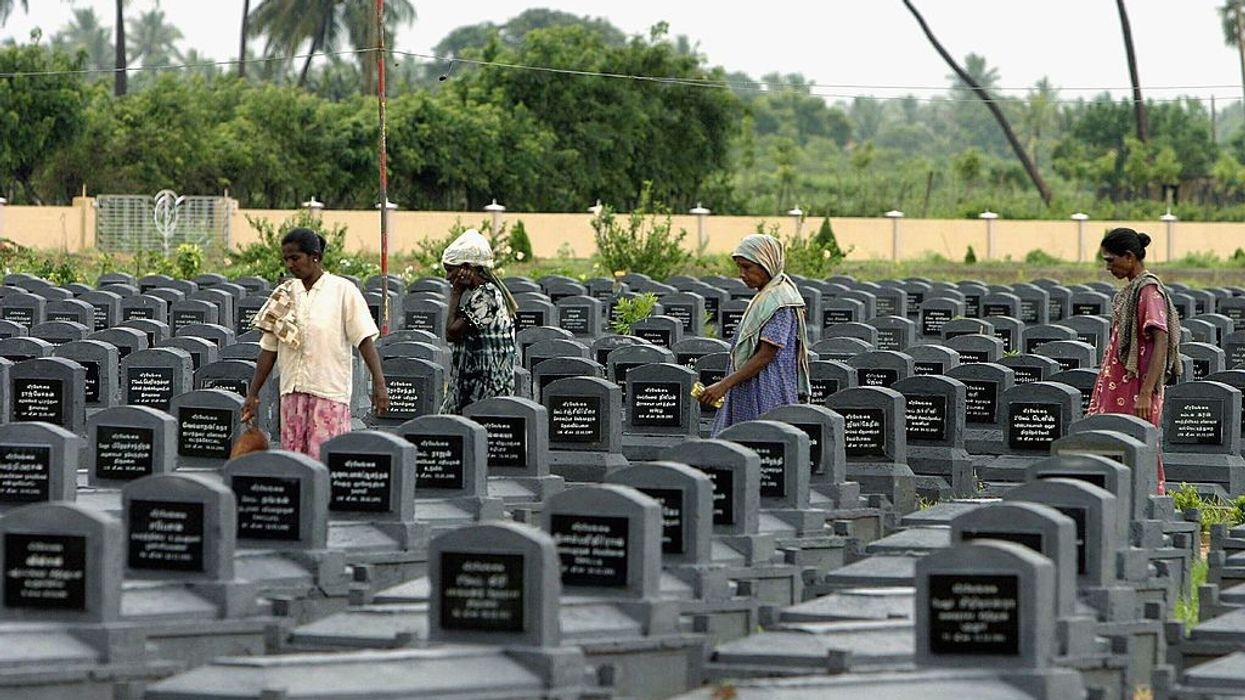
TAMILS who resettled in Britain after fleeing the Sri Lankan civil war held a vigil in London on Wednesday (18), with some likening the island nation's current economic crisis to the conditions they faced during the decades-long conflict.
The gathering of Tamils seeking justice for those from their community who were killed in the south Asian country during the war, coincided with Sri Lanka's worst economic crisis since its independence in 1948 that has forced out its prime minister.
"The current crisis in Colombo reminds me of our struggles during the war. Shortage of fuel, food, medicine - the Tamil-dominated parts of Sri Lanka faced the same issues then as what the entire nation is facing today," Thanikai, 42, who came to Britain eight years ago, said.
He is amongst the hundreds of thousands of Tamils who fled the conflict, which ended in May 2009 with the Sri Lankan government defeating the Tamil Tiger rebels.
Human rights groups have since accused the country's military of killing civilians towards the end of the war, in which the rebels fought for a separate state for the Tamil minority.
"We need justice for all the people who were killed," Thanikai said.
The United Nations has accused both sides of war crimes and has been given a mandate to collect evidence.
The UN has also warned the failure of Sri Lanka to address past violations has significantly heightened the risk of human rights violations being repeated.
"My parents and friends are still in Sri Lanka but I have been too scared to go back," said Elilarasi Manoharan, who attended the peaceful demonstration in Trafalgar Square to mark the 13th anniversary of the end of the war.
"But now with the economic crisis and the changes we are seeing, maybe if the Sri Lankan system changes it will open up doors for us to be able to visit our loved ones."
(Reuters)
UK Tamils seek justice for civil war victims






 Curator Emma Slocombe with ikat robes and arabachi coats in the Peter the Great Room in Blickling Hall Amit Roy
 View of the entrance to Blickling Hall on a rainy autumn dayAmit Roy
 Kente cloth from Ghana in the Long Gallery in Blickling Hall
 Decoration in the Great Hall at Blickling Hall Amit Roy
 Palampore fragment made in coastal south-east India in the Brown Room in Blickling Hall Amit Roy
 Bed valance dating from early 1700s in the Italian Print Room at Blickling Hall Amit Roy
 Indian inspired fabric draped on sofas in the South Drawing Room in Blickling Hall Amit Roy
 Indian inspired fabric draped on sofas in the South Drawing Room with Indian carpet in Blickling Hall Amit Roy
 Karun Thakar has picked out the geometric patterns in the bookcase and the Kente cloth in the Long Gallery in Blickling Hall Amit Roy
 Large tapestry depicting Peter the Great defeating the Swedish army at the Battle of Poltava in 1709 Amit Roy
 ikat robes and arabachi coats in the Peter the Great Room in Blickling Hall Amit Roy
 Baghs and kanthas made by women provide contrast to the men only portraits in the Great Hall at Blickling Hall Amit Roy
 Baghs and kanthas in the entrance Great Hall at Blickling Hall Amit Roy
 Baghs and Kanthas in the Great Hall in harmony with stained glass window at Blickling Hall Amit Roy
 Kimonos reflect Japanese influence in Upper Ante Room in Blickling Hall Amit Roy
 Kimono in Upper Ante Room in Blickling Hall
 A view of the Palace and fort at Agra shows romantic side of India Amit Roy
 Blickling Hall Amit Roy
 Table carpet, European 1670-1680 Amit Roy
 Unfinished 17th century Italian embroidery in the Print Room at Blickling Hall Amit Roy
 Picture of Kashmir shows a romantic view of India Amit Roy
 A panel of Ashburnham bed hangings made in Gujarat for sale in Europe in the Brown Room in Blickling Hall Amit Roy
 Colcha made in the 1600s by women in Bengal for the Portuguese market in the Long Gallery at Blickling Hall Amit Roy




