
Highlights
- Ayushmann Khurrana plays a Pakistani agent who loses his memory and begins to believe he is an Indian patriot.
- The spy comedy uses India-Pakistan tensions as the backdrop for slapstick humour and political mockery.
- While the identity confusion generates some effective laughs, the film struggles with crude jokes and stereotypes.
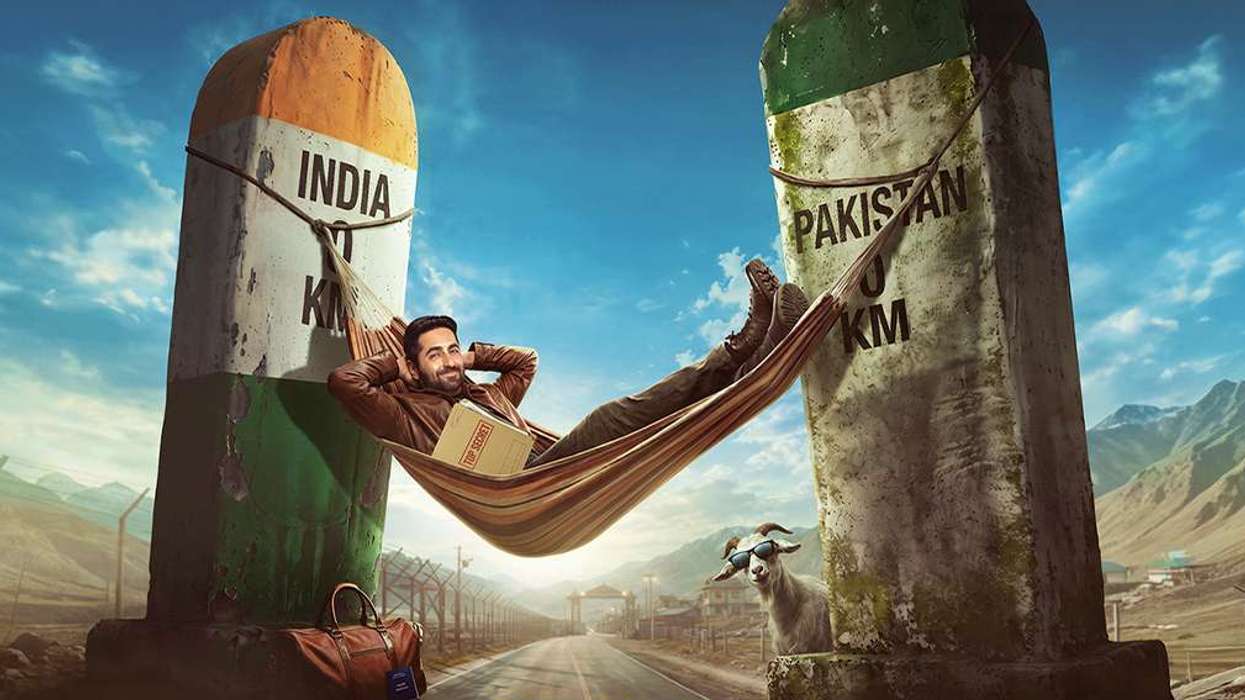
Ayushmann Khurrana’s latest film, Udta Teer, takes a comic approach to espionage, turning the familiar India-Pakistan conflict into a farcical spy story. Directed by Akash A Kaushik, the Hindi-language comedy follows a Pakistani agent who infiltrates India’s counter-terrorism unit but loses his memory and forgets which country he is supposed to serve.
The premise offers opportunities for mistaken identities and political satire. However, the film’s cartoonish humour and broad characterisations often undermine its comic potential, according to a review by Nandini Ramnath for Scroll.
‘Udta Teer’ review: A spy caught between two identities
Khurrana plays Bilal, a Pakistani operative who has established himself as Vikrant, a trusted member of India’s counter-terrorism unit. His position is particularly ironic because his wife, Yamini (Sara Ali Khan), works in the Defence ministry.
When Burman (Rahul Bose), Vikrant’s superior, suspects a mole within his office, he turns to the very agent working against him for help.
Bilal is secretly involved in a plot to facilitate the escape of Pakistani terrorist Maqsood (Mukul Dev). However, after losing his memory, he wakes up believing he is Vikrant and becomes determined to protect India.
The resulting confusion provides some of the film’s most effective comic moments. Bilal’s sudden transformation into a patriotic Indian creates an entertaining contrast with his former loyalties, giving the story a promising foundation.
Yet the humour becomes increasingly broad as the film turns to familiar stereotypes and slapstick.
‘Udta Teer’ review: Political satire gives way to stereotypes
The film directs much of its mockery towards Pakistani characters, including Bilal’s handler Niazi (Ram Kapoor) and army general Mir (Gulshan Grover), who is portrayed as excessively deferential to his Chinese contacts.
Maqsood, meanwhile, spends time swiping on a dating app called Hinder, undercutting the menace expected of a feared terrorist. The film also gives Rahul Bose opportunities for exaggerated comic reactions as Burman struggles to deal with the unfolding chaos.
However, the review argues that the satire extends beyond political figures to Muslim cultural and religious practices, including prayer and the reading of Urdu. The use of Nusrat Fateh Ali Khan’s celebrated qawwali Dum Mast Qalandar Mast during a shootout is another example of the film drawing on cultural references for comic effect.
Rather than developing its political humour with greater subtlety, Udta Teer often relies on caricatures and obvious targets. The result is a comedy in which intelligence, in both the espionage and intellectual senses, is in short supply.
Running for 137 minutes, the film keeps its plot moving through a series of increasingly chaotic events. Yet its pace does not always translate into sharper comedy, and some supporting performances leave a stronger impression than Khurrana’s lead turn.
Ultimately, Udta Teer finds occasional humour in its central identity crisis but struggles to sustain it. Its broad jokes and cartoonish treatment of India-Pakistan tensions leave the spy comedy short of the wit its premise promises.