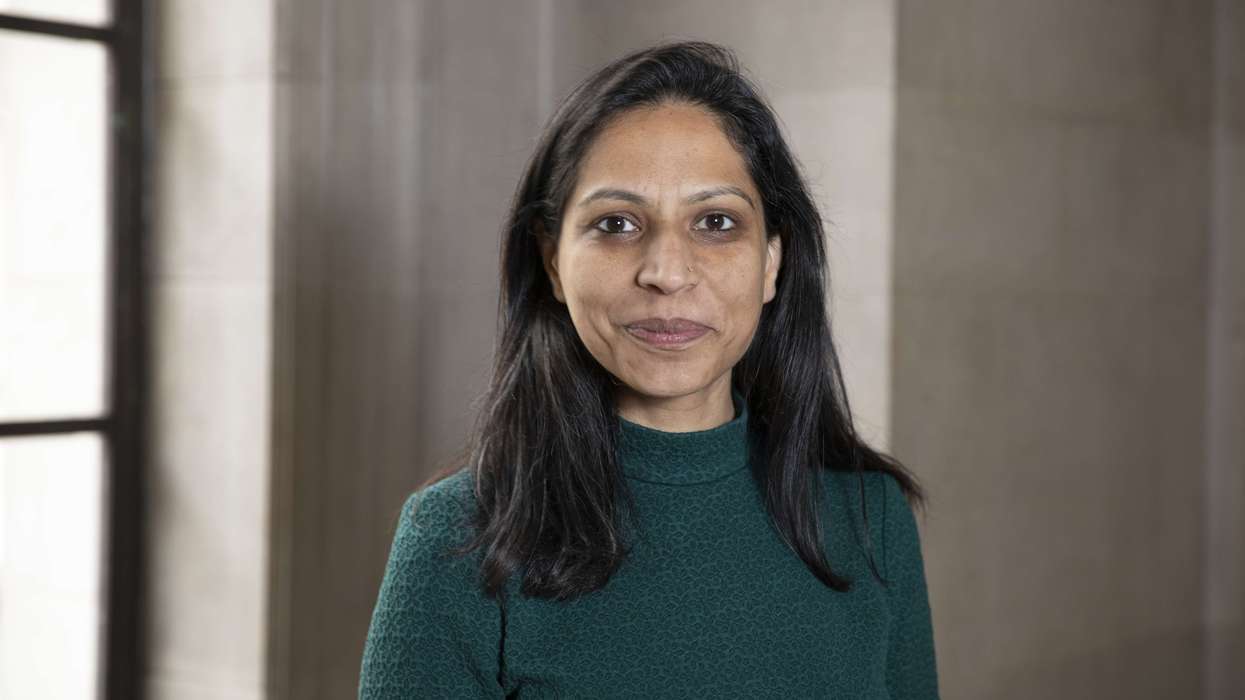

The economist Dr Swati Dhingra must be highly regarded at the Bank of England. She was the first Asian woman to be appointed an external member of the Bank’s Monetary Policy Committee (MPC) for three years beginning 9 August 2022. This was renewed for a second term running from 9 August 2025 to 8 August 2028.
Her job is to help to set the interest rate, which as she explained in an interview, is much more than influencing the mortgage rate. A small percentage change, she said, affects the whole economy.
The Bank of England in Threadneedle Street is built like a fortress with a small entrance. Inside, there is a Roman mosaic floor, portraits and statues of men – Montague Norman, the longest serving governor of the Bank (1920 to 1946) commands both. There is a dizzying staircase, 165ft from top to bottom, once the longest in Europe. There is an indoor garden. There is a room set aside for the MPC, which meets eight times a year. From her office, Dhingra – she came to the Bank from the London School of Economics – can see the Shard and the Lombard Street building.
As an associate professor at the LSE, Dhingra’s particular contribution is to bring academic rigour to the proceedings of the MPC.
Asked what novels she would take to a desert island, she responded: “I don’t read for pleasure, I read for knowledge and work.”
She is serious and passionate about her work.
It has been a swift climb for her to the top as she arrived in the UK only in 2011. She was born in India in 1980 and grew up in Saharanpur, a small “wild west” town in Uttar Pradesh. She is grateful her parents – her father is a small businessman – sent her to the famous Welham Girls’ School in Dehradun. After an undergraduate degree from Delhi University and an MA from the Delhi School of Economics, she obtained an MS and a PhD in economics from the from the University of Wisconsin and a post doctoral fellowship at Princeton University. Her first job was at the LSE.
“I’m so grateful to my colleagues at the LSE,” she said. “It’s a fantastic place. If I hadn’t been there, I don’t think my career would have been as strong.”
She was based at the Centre for Economic Performance, which had been set up by the economist, Lord (Peter Richard Grenville) Layard.
“He set it up with very much the intention that we as academics shouldn’t just be talking to ourselves,” she said. “We’ve got to do things which are policy relevant, and going to benefit society.”
There is a two-week period of purdah before every meeting of the MPC, so that nothing leaks out. The meeting itself lasts for two days, before the interest rate is announced – always on a Thursday. Dhingra’s ability to assess which way the data is pointing is where her influence is particularly valuable.
“There is a two-week period of getting completely immersed in what’s happening on the data side,” she said. “Typically, we have a lot of briefings from the (Bank) staff. There are about 50 people working on updating what’s going on in the economy. They look at it through different lenses, cutting the data in different ways, say something about the mechanisms driving wage growth. There are a lot of briefings on what’s happening on the labour market side, what’s happening to consumption, and, most importantly, what’s happening to inflation. On the Monetary Policy Committee, people say I am on the dovish side of the spectrum, which is to say I argued earlier for a slower pace of rate hikes.”
She offered an insight into why she was picked for the MPC: “As an academic, I should be providing scrutiny, not just saying, oh, there is this argument or that argument. That’s a little bit how we differ from journalists, whose aim is to reflect different points of view. My job is to ask, ‘Where’s the weight of the evidence really pointing to?’ ”
To complicate matters further, sometimes the data will point in a certain direction but her instinct will make her cautious about accepting the suggested solution.
She said: “Taking those judgement calls in real time is challenging. But, of course, that’s what we should be doing. Otherwise, there’s no check on what unelected people like me are doing.”
She explained why her work and those of other members of the MPC is so important.
“If the interest rate goes up by 25 to 50 basis points, there are repercussions throughout the entire economy. First think of the individual decision. Some of the biggest expenditures you’re going to have to make in your life are on things like housing, which are directly tied to the mortgage rate.
“But you have to think more broadly. Suppose I’m in a firm which was wobbling along. It’s now got new interest rate payments to make. It might think of shutting up shop. Suddenly, people start to get unemployed. (Previously) You had activity generating around suppliers.
“Typically, in any economy, whether it’s the UK, the US, or the euro area, the bulk of growth comes from consumption. Though wage growth has been high, real incomes have not really grown as much. The SME sector is typically on a variable rate. (Employers will think) do I want to employ the next worker? Do I give a bit more to my workers? The public sector runs on borrowings. The private sector working capital investment decisions are based on interest rates. It might look small – 25 basis points – but over a three or four year horizon, each of those numbers is accumulating up quite substantially. When everybody is starting to feel the pinch, it has macro-economic consequences.”
At a sociological level, Dhingra would like to see greater diversity among economists. “If you look at the younger cohorts, about 30 per cent are women. I feel like we’re at the point where there’s almost a backlash against that. In the senior ranks, you just don’t see enough women. You don’t see people of colour. I have yet to meet many economists who come from a working class background, which is even more disturbing. If class isn’t represented more broadly, we should really question ourselves about what we’re recommending.”
ENDS