
BOOMING sales of home self-test kits for Covid are prompting Indian authorities to tighten the rules around their sale and fuelling long-held fears of underreporting as cases surge.
In the last seven days, India recorded more than 1.9 million new infections -- an increase of 57 per cent on the previous week, according to reports.
Experts have long worried that actual infections and deaths could be much higher in the country of 1.4 billion people due to widespread underreporting.
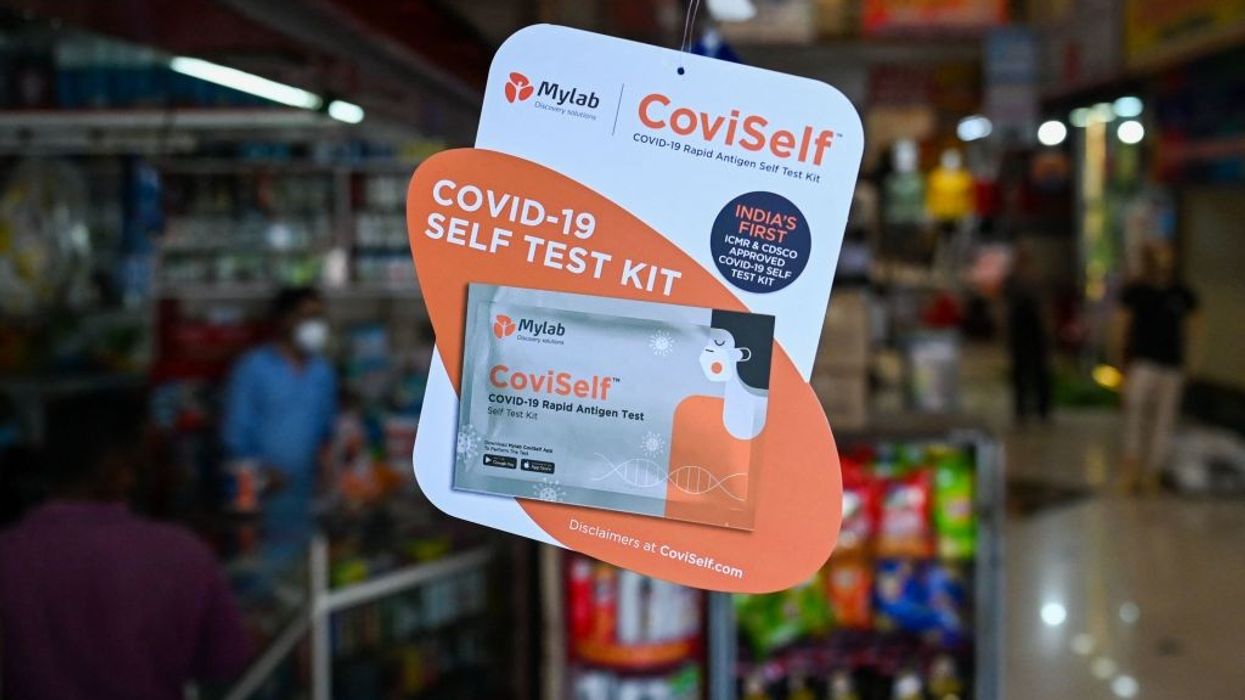
Self-test kit manufacturers and pharmacies have reported a surge in demand, particularly in bigger cities and towns.
But with not all kit users believed to be sharing their results, some authorities -- including in the crowded financial hub Mumbai -- are calling on people to report if they test positive and for pharmacists and manufacturers of self-test equipment to report sales and customers' details.
Leading local producer Mylab Discovery Solutions, which released the country's first home test kit last year, has said it ramped up production this month from a base of 200,000 kits a day to two million.
"Whatever we are manufacturing is going into the market immediately," said Mylab's serology head Shrikant Pawar.
Experts said demand has been fuelled by the lower cost of the kit, which retails at Rs 250 ($3.40), as well as results in 15 minutes instead of the more accurate PCR test's 24-48 hours.
Some 13 to 16 million tests are recorded by the ICMR every day, but there are no nationwide figures for the sales or use of self-test kits.
Authorities in Mumbai, home to 20 million people, said 125,000 residents have shared their self-test results with the government since new reporting rules were imposed a week ago.
The city is also trying to keep tabs on asymptomatic contacts, even though national health authorities recently recommended that testing is only required for people showing symptoms after exposure to positive cases.
"Mumbai is one of the most densely populated cities in the world. So suppose a single person is positive, he may infect 20-30 people," sai Mumbai's additional municipal commissioner Suresh Kakani.
"So even if they are asymptomatic... we should isolate them so that further spread can be checked."
Mumbai saw daily cases surge above 20,000 two weeks ago before flattening to less than half that figure in recent days, but officials warn hospitalisations could rise in coming weeks.
"You're seeing test positivity in the big cities in India typically somewhere between 30 and 50 percent," said Gautam Menon, a professor at India's Ashoka University who has worked on Covid infection modelling.
"It's an obvious indication that we're not counting cases accurately. We're now somewhat far away from understanding the true measure of Covid-19 in India."
(AFP)