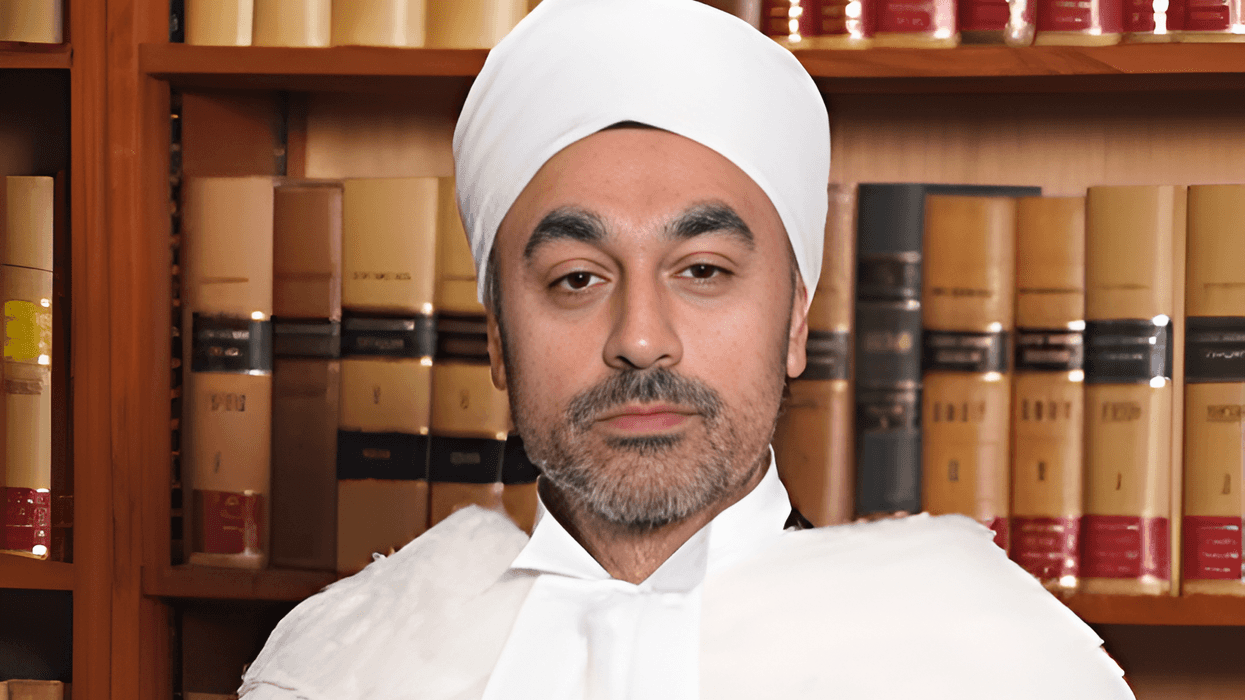

A PLACARD outside a London courtroom, a hacked phone carrying the secrets of a dissident’s life, and a question about how far a state’s power should reach. These moments – seemingly small episodes in the daily churn of litigation – have repeatedly placed Mr Justice Pushpinder Saini at the centre of cases testing the limits of authority and the resilience of individual liberty.
In January this year, the High Court judge delivered a striking ruling that reverberated far beyond the courtroom. Saudi Arabia was ordered to pay more than £3 million in damages to London-based dissident and satirist Ghanem al-Masarir, whose phones had been targeted with Pegasus spyware.
The judgment laid bare what Saini described as “exceptionally grave invasions” of privacy: a covert surveillance operation that effectively transformed the claimant’s smartphones into “bugging” devices, transmitting vast amounts of personal data to a hostile state.
Saini concluded that al-Masarir, a YouTube satirist whose channels have attracted more than 300 million views, had suffered psychiatric harm after discovering that his devices had been hacked. He further found, on the balance of probabilities, that Saudi Arabia was responsible for a physical attack on the dissident outside Harrods in 2018.
The judgment was a reminder of the unusual reach of the English courts in an era where digital surveillance blurs the boundaries of jurisdiction. It was also typical of Saini’s judicial approach: forensic, quietly assertive, and attentive to the principle that the law must remain capable of protecting the individual against powerful actors – whether states, corporations or institutions.
A similar theme ran through another widely discussed decision a year earlier. In April 2024, Saini dismissed a controversial case against Trudi Warner, a 69-year-old climate activist who had been charged with contempt of court after holding a placard outside Inner London Crown Court. The sign read: “You have an absolute right to acquit a defendant according to your conscience.”
To prosecutors, the message was an attempt to influence jurors. To Saini, the prosecution itself was the greater constitutional problem. In his ruling, he declared the case a “disproportionate approach” that unlawfully interfered with Warner’s right to freedom of expression.
The judgment revisited the long-standing principle of jury equity – the ability of jurors to reach a verdict according to conscience – observing that the doctrine had been recognised and tested in the highest courts of England and Wales, as well as in jurisdictions including Canada, New Zealand and the US.
The decision reaffirmed a constitutional tradition stretching back centuries: that juries serve as a safeguard against the overreach of the state. In doing so, Saini placed himself squarely within a lineage of judges who see the courtroom not just as a venue for resolving disputes, but as a space where democratic freedoms are quietly defended.
That instinct was shaped during a formidable career at the Bar. Called in 1991 at Gray’s Inn, Saini spent nearly three decades at Blackstone Chambers in London, establishing a reputation as one of the leading advocates in public law, human rights, commercial litigation and media law.
He appeared in major human rights cases before domestic courts, the European Court of Justice in Luxembourg and the European Court of Human Rights in Strasbourg. One of his most significant matters was Smith and others v Ministry of Defence, a landmark case concerning the territorial reach of the Human Rights Act 1998. The litigation arose from the deaths of British soldiers in Iraq and raised a profound question: did the protections of the Act extend to service personnel operating overseas?
The Supreme Court’s unanimous ruling – that the soldiers had been under the UK’s jurisdiction at the time of their deaths – marked a pivotal moment in the development of human rights law. The decision established a precedent that continues to influence cases involving military operations abroad.
His work frequently intersected with the worlds of sport, media and entertainment. In 2009, he represented the Indian Premier League in its first anti-doping prosecution, which resulted in a one-year ban for former Pakistan fast bowler Mohammed Asif. His client list over the years read like a catalogue of global celebrity: Michael Jackson, Pink Floyd, Simon Cowell, Queen guitarist Brian May and footballer Nicolas Anelka were among those who sought his legal expertise.
Yet the transition from advocate to judge in 2019 did little to reduce the public visibility of the cases passing across his bench. On the contrary, Saini has continued to preside over disputes that combine legal complexity with diplomatic or political sensitivity.
One such case involved the death of Harry Dunn, a teenager killed in a road accident near the US airbase at RAF Croughton in Northamptonshire. The suspect, Anne Sacoolas – the wife of a US intelligence official – claimed diplomatic immunity, sparking a diplomatic stand-off between London and Washington. Sitting on a divisional court, Saini ruled that Sacoolas was entitled to immunity under the relevant international agreements, though she later returned to the UK to face prosecution.
Behind these high-profile rulings lies a personal story shaped by migration and opportunity. Born to Punjabi immigrants from Kenya, Saini grew up in Southall, West London, attending Dormers Wells Comprehensive School before winning a place at Corpus Christi College, Oxford. There he achieved the rare distinction of graduating with two First Class law degrees.
The trajectory from Southall to the High Court reflects both personal determination and the gradual opening of the legal profession to a broader range of backgrounds. Saini has made that mission a visible part of his professional life. He has long been involved in mentoring aspiring lawyers from minority and underrepresented communities, encouraging them to consider careers at the Bar.
His work includes supporting initiatives such as Bridging the Bar, a charity dedicated to expanding access to the profession.
Institutionally, his influence continues to grow. He is currently the lead presider of the Western Circuit – a senior administrative role responsible for overseeing the deployment of judges and the allocation of cases across the circuit – and hears serious criminal trials as well as sitting in the Court of Appeal (Criminal Division).
ENDS