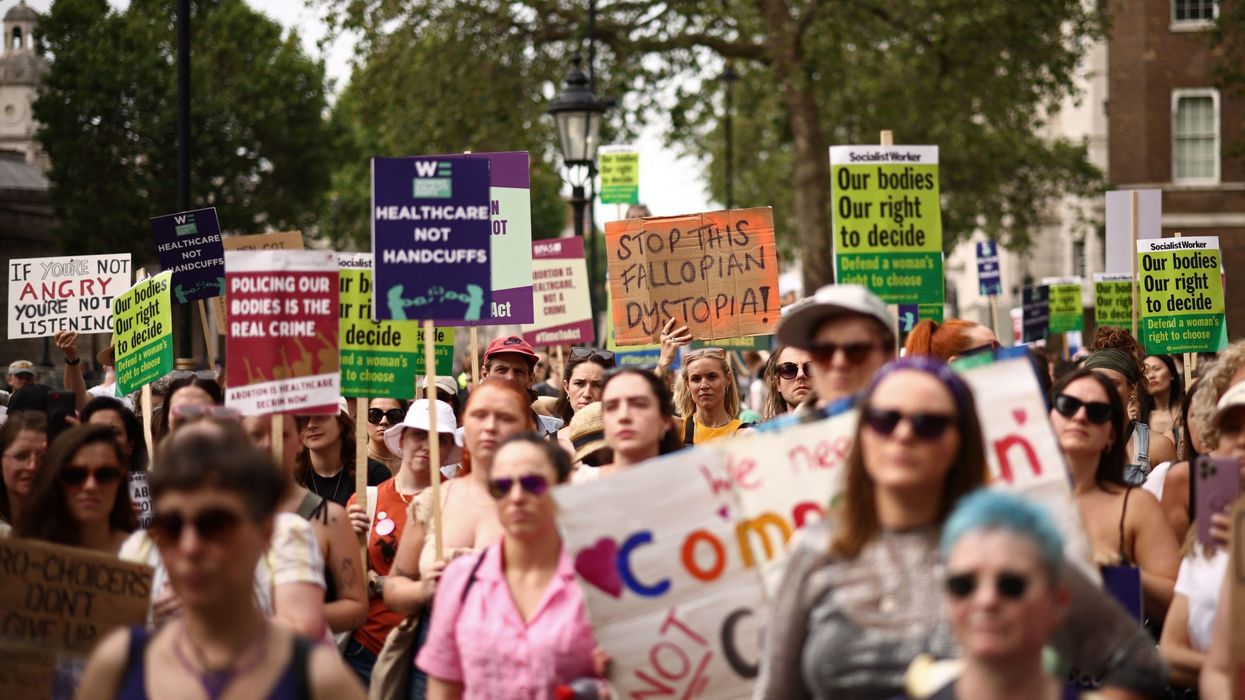

Thousands of protesters marched through London, advocating for the decriminalisation of abortion on Saturday (17).
The demonstration was sparked by the recent case of Carla Foster, who received a 28-month prison sentence for having a late abortion.
The marchers chanted "Free Carla Foster" while displaying signs proclaiming "abortion is healthcare" and "policing our bodies is the real crime."
Foster, a 44-year-old mother of three, was imprisoned on Monday and is required to spend 14 months in custody as part of her sentence.
In her confession, she acknowledged the act of unlawfully facilitating her own abortion while being between 32 and 34 weeks into her pregnancy.
She intentionally misled an abortion counsellor by falsely claiming to be approximately seven weeks pregnant, a period well within the legal limit for abortions.
Stella Creasy, opposition Labour Party MP, addressed the protesters and highlighted that the recent case exemplified the inadequacy of the existing legislation, which she deemed no longer "fit for purpose."
"...we now find a mum of three children, one of whom has special education needs, in prison," she said.
"Whose interests does that serve, to keep punishing this woman?"
She said there had been "67 legal prosecutions of women in the past 10 years under the offences against the person act of 1861”.
The law prohibiting abortion, which has been in effect for 162 years, underwent amendments in 1967, legalising abortions performed by authorised providers up to 28 weeks of pregnancy. However, in 1991, the legal limit was reduced to 24 weeks.
In England, Scotland, and Wales, there are only extremely restricted circumstances under which an abortion may be granted after this point.
These circumstances include situations where the mother's life is at risk or if the unborn child is expected to have a severe disability.
In May 2020, the British Pregnancy Advisory Service (BPAS) dispatched abortion-inducing drugs to Foster through the mail, as a result of a phone consultation necessitated by the pandemic lockdown.
Subsequently, after taking the drugs, she gave birth, but sadly, the child was declared dead after emergency services were contacted.
Clare Murphy, the chief executive of BPAS, expressed deep shock and dismay regarding the sentence handed to Foster, labelling the 19th-century law employed to prosecute her and others as the "most severe penalty worldwide."
"There has never been a clearer mandate for parliamentary action, and the need has never been so urgent," she said.
"Over the last three years, there has been an increase in the numbers of women and girls facing the trauma of lengthy police investigations and threatened with up to life imprisonment under our archaic abortion law," she added.
(AFP)