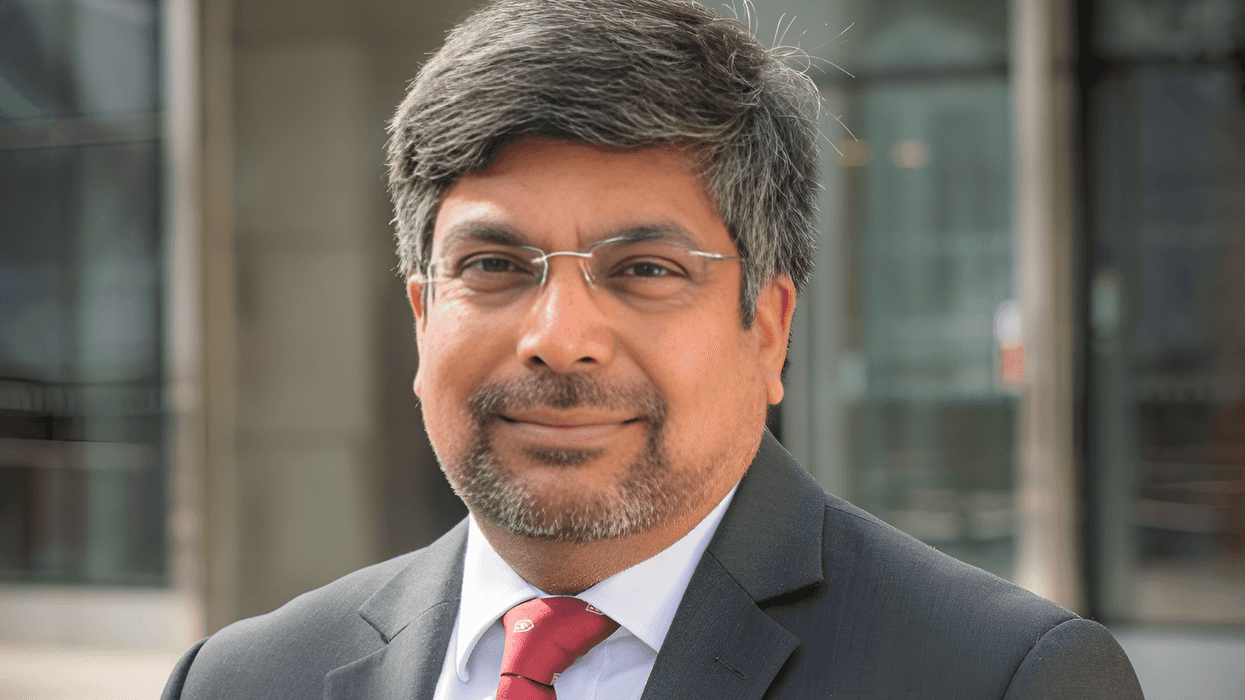

THIS YEAR brings an unusual clustering of milestones for Professor Sir Nishan Canagarajah. He turns 60. He and his wife Thabi celebrate their 30th wedding anniversary. And, as he notes with characteristic understatement, he is “off to the Palace to be knighted.”
For the boy who grew up in Jaffna, Sri Lanka, amid civil war – a boy whose family never owned a home and who could not always afford football boots – the arc of his life reads like a parable about the transformative power of education.
Since 2019, Canagarajah has served as president and vice-chancellor of the University of Leicester, becoming the first minority ethnic leader in the institution’s history. In that period, he has reshaped the university’s ambition, broadened its international reach and strengthened its civic identity. The results have not gone unnoticed. The Daily Mail named Leicester its University of the Year 2025, calling it “a model university for the 21st century and one of the best catches in British higher education”.
Beyond Leicester, his influence stretches across the sector. In October 2025, he became chair of the Universities and Colleges Employers Association (UCEA), placing him at the centre of the most fraught financial negotiations facing British higher education today.
Yet the foundations of that leadership were laid far from boardrooms and policy debates.
“I am a son of Sri Lanka,” he told the GG2 Power List. “I was not simply born there but it was the making of me. My values were forged there, my spirit was strengthened there, and my ambition was carved there.”
Growing up in Jaffna during the civil conflict, Canagarajah witnessed violence and the deaths of close friends. Material hardship was a constant presence. Both of his parents were teachers, people of modest means but immense belief in the value of learning.
“They instilled in me values of hard work, compassion, humility and sacrifice,” he said. “They taught me to respect others regardless of race, caste, colour, creed or social status.”
A scholarship to St John’s College in Jaffna offered his first academic foothold. Another scholarship then took him thousands of miles away to the University of Cambridge. The journey was more than geographical.
“The war claimed the lives of close friends and forced me at an early stage to make difficult choices about how I could make a difference,” he reflected. “The answer lay in education.”
Arriving at Cambridge in the early 1980s brought culture shock of a more comic variety. One early misunderstanding has become part of family folklore.
“In one of my tutorials, one of the supervisors explained a concept to me three times because he thought my headshake meant I didn’t follow, when in fact I had understood the concept the very first time.”
The sideways head movement – a gesture of agreement in Sri Lankan culture – had been misread as confusion.
Unable to return home because of the war, he spent university summers travelling widely, inter-railing across Europe, helping to build a school in a disadvantaged Brazilian community and visiting Israel, the West Bank and Egypt. Those experiences broadened a worldview already shaped by displacement and difference.
His Christian faith also played a formative role, reinforcing what he describes as a sense of shared humanity. A Tamil proverb continues to guide his intellectual outlook: What we know is a fistful; what we don’t know is a world full.
After completing his PhD at Cambridge, Canagarajah joined the University of Bristol in 1993. Internationally recognised for his work in signal processing and texture classification, he became professor of multimedia signal processing in 2004.
Much of his early research had deeply personal origins. His doctoral work focused on designing better hearing aids, inspired by watching his mother struggle with hearing loss throughout his childhood. That interest later expanded into work on optimising hearing aids for mobile phone users and exploring how mobile technology might facilitate sign language communication.
Leadership gradually followed scholarship. At Bristol he served as head of computer science, dean of engineering and ultimately pro vice-chancellor for research and enterprise, while also championing equality, diversity and inclusion across the university.
That commitment has remained central to his leadership at Leicester.
The institution he now leads is one of the most diverse universities in the country: 69 per cent of students come from minority ethnic backgrounds and 38 per cent from the most disadvantaged communities.
Under his tenure Leicester has secured more than £100 million in research awards and achieved Teaching Excellence Framework Gold alongside a top-30 position in the Research Excellence Framework.
Leicester scholars were the first to identify the disproportionate impact of the coronavirus on minority ethnic communities – work that helped shape government policy and became among the most cited research of the Covid-19 pandemic.
At the same time, Canagarajah has championed the university’s civic mission. He established Leicester’s first IntoUniversity centre in one of England’s most deprived areas, supporting around 1,000 young people with mentoring, academic support and work experience opportunities.
The initiative reflects a conviction rooted in his own childhood: “talent abounds wherever you go but it is the lack of opportunity that stifles progress.”
At the national level, however, his role as chair of UCEA places him squarely in the middle of higher education’s most difficult financial debates.
“There are demands for pay increases at the same time as demands to guarantee no job losses,” he said plainly. “You can’t have both, given the financial position. If we increase the pay uplift, then clearly there will be job losses to meet that pay rise. If you want to keep more jobs and staff on the payroll, that will mean less pay uplift. These are the trade-offs that we have to manage, unfortunately.”
Away from university leadership and national negotiations, his life remains anchored in family and community. His wife Thabi, a computer scientist, is both partner and, as he puts it affectionately, his “honest sounding board” who “keeps me on the straight and narrow”. Their three children have followed paths of public service – one a teacher, two doctors.
When asked what the boy from Jaffna might think of the life that followed, Canagarajah answers without triumphalism.
“I look back at that boy from Sri Lanka with gratitude. Those formative years were the making of me. Through hardship, war and the pain of loss also comes resilience, stoicism and hope. I carry that hope for a better future wherever I go.”
Canagarajah has been knighted in the 2026 King’s New Year Honours for his contribution to higher education, particularly in championing inclusion. Yet, success, he believes, is measured differently from the conventional metrics of prestige or rank.
“Success is measured not by how far you climb to the top but how many people you help and enable along the way. We are all custodians of the offices we hold, we stand on the shoulders of others, and it is beholden on us to leave them in a better place than we found them.”