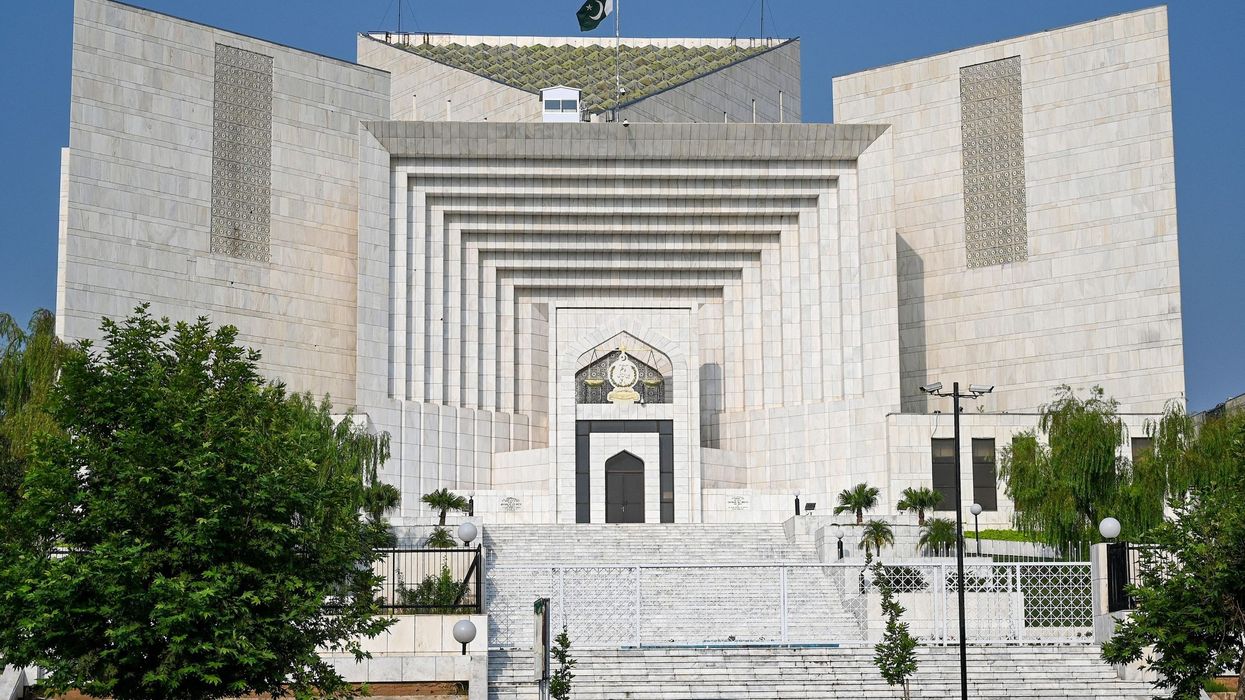

PROCEEDINGS from Pakistan’s Supreme Court were broadcast live on Monday (18) by state television for the first time, giving an unprecedented view into the workings of an institution that has historically had a huge impact on the country’s politics.
The move marks the beginning of the tenure of new Chief Justice Qazi Faez Isa as Pakistan’s top judge. Isa, 64, was sworn in as chief justice last Sunday (17) after he became the most senior judge of the court on the retirement of his predecessor Justice Umar Ata Bandial. Isa’s first move as the top judge was to open proceedings for live broadcast.
“It is a majority consensus decision to telecast live,” Isa said at the start of proceedings shown live by state-run broadcaster Pakistan Television. Previous attempts to broadcast proceedings live had been blocked by the court.
The broadcast was shown uninterrupted by all major Pakistani channels.
Adding to the interest of the proceedings was the nature of the case, which pertains to legislation that curtails the discretion of the chief justice to take up any legal matter directly, commonly known as suo moto action, and his powers to entrust cases to his fellow judges.
The legislation passed by parliament earlier this year had pit the outgoing coalition government of prime minister Shehbaz Sharif with Isa’s predecessor.
Supreme Court judges retire automatically upon reaching the age of 65, and the next most senior judge is elevated as the chief justice. There is no set tenure for a chief justice. Isa’s elevation has garnered nationwide interest given his reputation as a maverick judge and his hard-hitting judgements criticising the role of the country’s powerful military in politics.
The military has ruled Pakistan for over three decades of its 76-year history, and wields enormous influence in politics, including making and breaking civilian governments. The judiciary has historically legalised military rule and, critics say, helped the country’s generals remove elected leaders.
Political parties and analysts claim army generals are trying once again to strengthen their grip over country’s governance under a caretaker government led by prime minister Anwar ul Haq Kakar, who comes from a pro-military party. Isa has given several landmark judgements during his judicial career, including a 2019 ruling that posed scathing questions about the role of the military and its InterServices Intelligence (ISI) spy agency in brokering a deal between Islamists and the then government.
Former prime minister Imran Khan, who was close to the then chief of the ISI Faiz Hameed, attempted to have Isa removed as a judge on charges of financial impropriety in 2018 - a charge that was thrown out in 2019 for want of evidence by his fellow judges. (Reuters)






 Curator Emma Slocombe with ikat robes and arabachi coats in the Peter the Great Room in Blickling Hall Amit Roy
 View of the entrance to Blickling Hall on a rainy autumn dayAmit Roy
 Kente cloth from Ghana in the Long Gallery in Blickling Hall
 Decoration in the Great Hall at Blickling Hall Amit Roy
 Palampore fragment made in coastal south-east India in the Brown Room in Blickling Hall Amit Roy
 Bed valance dating from early 1700s in the Italian Print Room at Blickling Hall Amit Roy
 Indian inspired fabric draped on sofas in the South Drawing Room in Blickling Hall Amit Roy
 Indian inspired fabric draped on sofas in the South Drawing Room with Indian carpet in Blickling Hall Amit Roy
 Karun Thakar has picked out the geometric patterns in the bookcase and the Kente cloth in the Long Gallery in Blickling Hall Amit Roy
 Large tapestry depicting Peter the Great defeating the Swedish army at the Battle of Poltava in 1709 Amit Roy
 ikat robes and arabachi coats in the Peter the Great Room in Blickling Hall Amit Roy
 Baghs and kanthas made by women provide contrast to the men only portraits in the Great Hall at Blickling Hall Amit Roy
 Baghs and kanthas in the entrance Great Hall at Blickling Hall Amit Roy
 Baghs and Kanthas in the Great Hall in harmony with stained glass window at Blickling Hall Amit Roy
 Kimonos reflect Japanese influence in Upper Ante Room in Blickling Hall Amit Roy
 Kimono in Upper Ante Room in Blickling Hall
 A view of the Palace and fort at Agra shows romantic side of India Amit Roy
 Blickling Hall Amit Roy
 Table carpet, European 1670-1680 Amit Roy
 Unfinished 17th century Italian embroidery in the Print Room at Blickling Hall Amit Roy
 Picture of Kashmir shows a romantic view of India Amit Roy
 A panel of Ashburnham bed hangings made in Gujarat for sale in Europe in the Brown Room in Blickling Hall Amit Roy
 Colcha made in the 1600s by women in Bengal for the Portuguese market in the Long Gallery at Blickling Hall Amit Roy




