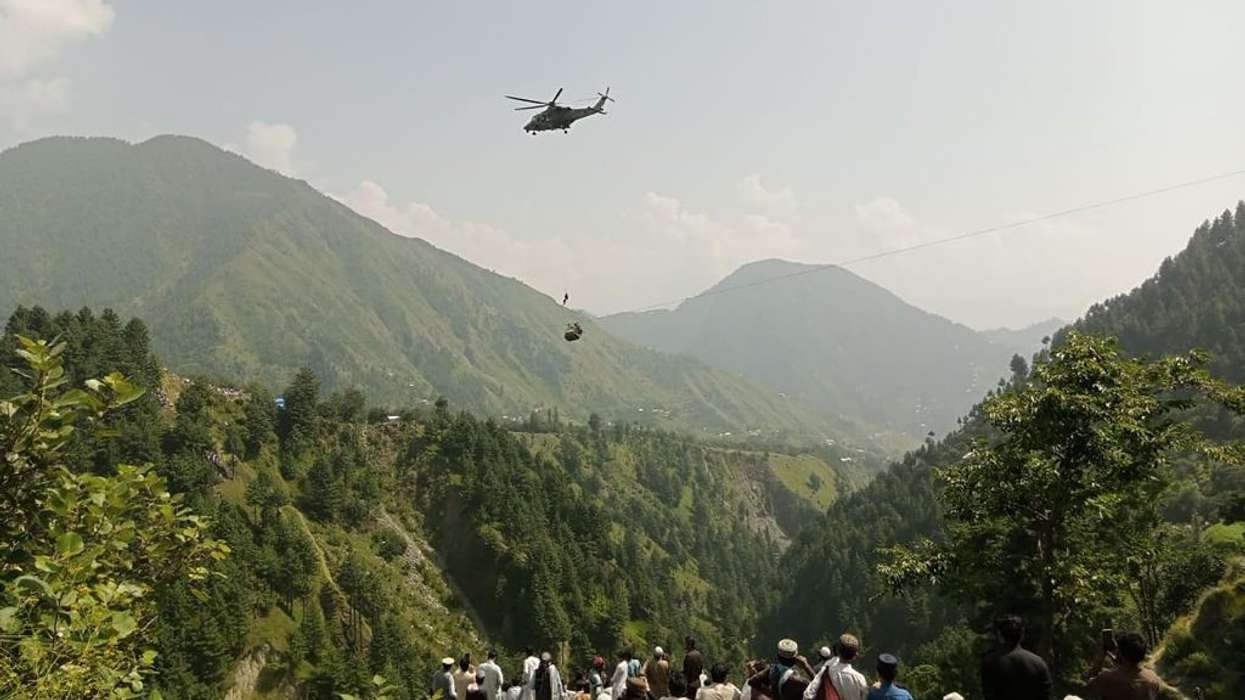
THE owner and operator of a stricken cable car that dangled over a Pakistan ravine for more than 12 hours have been arrested after repeatedly ignoring safety warnings, police said Thursday (24).
Six teenage boys were among eight people left stranded hundreds of feet in the air when two of the three chairlift cables snapped on Tuesday (22), leading to a daring rescue mission that brought them to safety.
"The cables being utilised were of subpar quality, and the machines were also in need of overhauling," Tahir Ayub Khan, a senior police official in northwestern Khyber Pakhtunkhwa province, said.
"The initial notice was issued to the owner in June, followed by a second notification served in August."
He said the owner had received directives to refurbish the machinery, enhance the quality of the chains and obtain a safety certificate from the local administration.
"Both the cable car operator and the owner have been arrested by the police for an investigation into the disaster," Khan said.
Amjad Ali, another police official, confirmed that the arrests were made on Wednesday.
The six children had been on their way to school accompanied by two adults when the chairlift broke down on Tuesday morning midway through its journey above the remote Allai Valley.
"Some of the children were so frustrated and were considering to jump down, but the elder passenger gave us confidence," 15-year-old Rizwan Ullah told AFP on Wednesday.
"When the cable car was twisting, we were terrified and we started reciting the Quran and gave confidence to each other not to jump down."
In a daring rescue operation, military helicopters plucked the first child from the chairlift and brought the student to safety after flying several sorties in the area.
Rescuers then used the cable keeping the gondola from plunging into the valley as a zipline to rescue the seven others stranded late into Tuesday night.
Cable cars that carry passengers - and sometimes even cars - are common across the northern areas of Khyber Pakhtunkhwa province and Gilgit-Baltistan, and are vital in connecting villages and towns in areas where roads cannot be built.
Caretaker prime minister Anwaar-ul-Haq Kakar issued a directive for all chairlifts in mountainous areas to be inspected and for those that are not "safety compliant" to be immediately closed.
In 2017, 10 people were killed when a chairlift cable broke, sending passengers plunging into a ravine in a mountain hamlet near the capital Islamabad.
(AFP)
Pakistan cable car owner arrested after ignoring safety warnings
Eight people left stranded when two of the three chairlift cables snapped were rescued in a daring mission