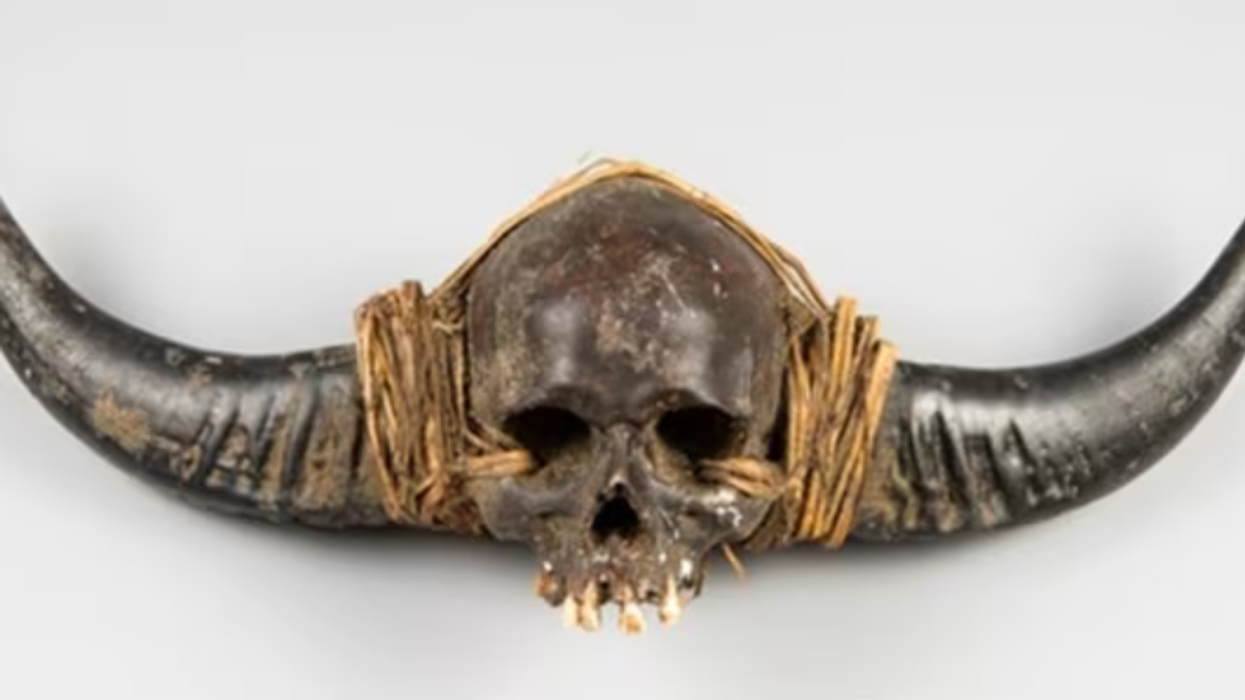

ANGRY Indian politicians, activists and academics have demanded that a 200-year-old skull listed for auction in Britain, alongside at least 25 other remains, to be returned home.
Activists said the 19th century remains of their ancestor represent the colonial violence in India’s eastern Nagaland state.
While the skull was withdrawn from sale last Tuesday (8) after an outcry, Nagaland’s chief minister called for its return. “The human remains of any deceased person belongs to those people and their land,” Neiphiu Rio wrote in a public letter.
Besides the Indian skull, the other remains listed were from Africa, countries elsewhere in Asia, and South America. The private British auction house, Swan Fine Art, near Oxford, had hoped to sell them for around $180,000 (£137,697).
The Naga skull, attached to animal horns, had been offered with a starting bid of £2,100 before its withdrawal.
There was no immediate response from the auctioneers.
Dolly Kikon, a Naga anthropologist, said the sale of any such item was unacceptable.
“Auctioning indigenous human remains in the 21st century shows how descendants of colonisers enjoy impunity to perpetuate racism and colonial violence on communities,” Kikon, a professor at the University of California Santa Cruz, said last Wednesday (9).
“If we have laws to stop the traffic of animals and birds, why don’t governments stop the auction of indigenous human remains that were stolen from the people?” she added.
Kikon is also a member of Recover Restore and Decolonise (RRaD), which works to repatriate the Naga community’s ancestral remains from museums abroad. “The Naga people believe they (the auctioneers) will do the right thing and return our ancestral remains,” she said.
The items, listed alongside antiquarian books and taxidermy animals, have come from private European collections, including from Belgium, Britain, Germany and France.
They include an early 18thcentury “shrunken head” of the Jivaro people – from Ecuador and Peru – that had been owned by Hugh Hefner and displayed in his Playboy mansion, the auction house said.
Together with another Jivaro head, they were expected to sell for as much as £50,000.
Laura Van Broekhoven, director of Oxford’s Pitt Rivers Museum – home to the largest Naga collection in the world – said the sale of such items was “completely unethical”.
Wati Aier, a Baptist priest and leader of the Forum for Naga Reconciliation peace group, appealed to London to return all the skulls to their ancestral lands.
“Throughout the period of British rule, the Naga people were defined as ‘savages’ and ‘headhunters’, which are insulting tropes that continue to be perpetuated today,” he said.
“These human remains symbolise the violence that the British colonial power unleashed on the Nagas.”
Other skulls listed in the Swan Fine Art auction were from Papua New Guinea, Borneo, and Solomon Islands. Ones from Africa orginated from Benin, Congo-Brazzaville, Democratic Republic of Congo and Nigeria.
The two skulls from Congo were balanced on top of each other, which the auctioneers said were “purported to be mother and son”. (AFP)