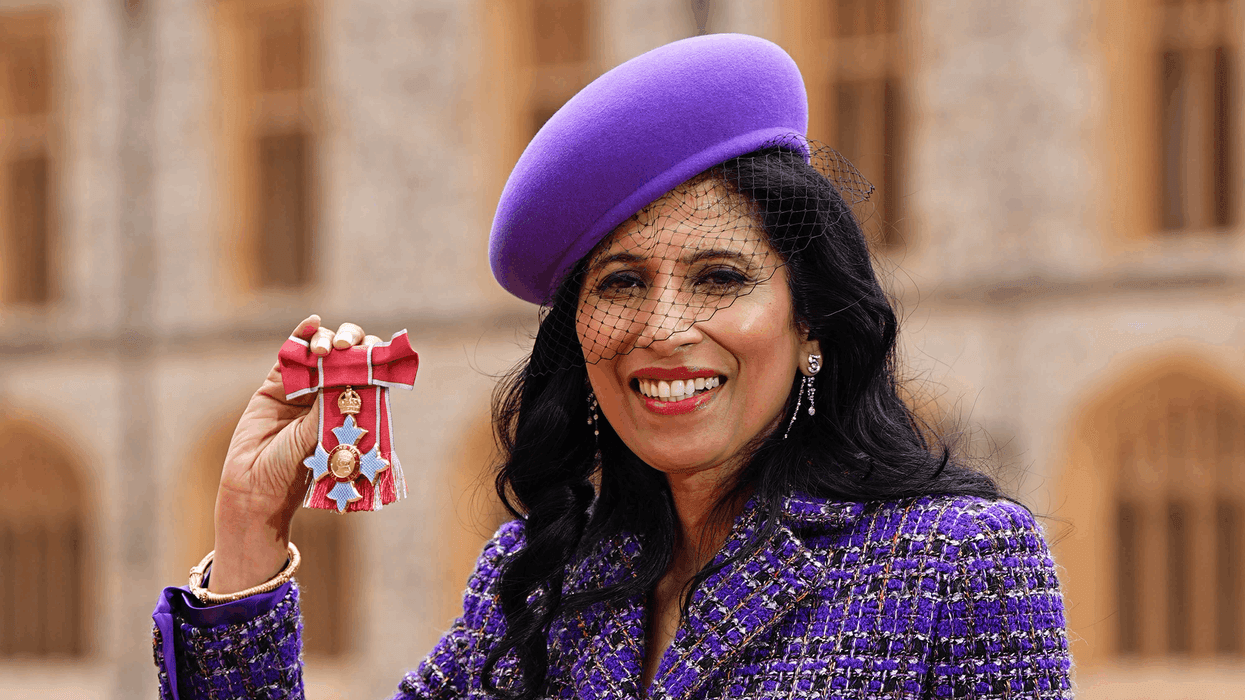

FOUR years ago, when Unilever top executive Leena Nair CBE agreed to take the reins at Chanel, both the polar-opposite worlds of uber-luxury and consumer goods did a double take.
She had never worked in fashion, never managed a creative house, never navigated the rarefied world of haute couture. Yet the Wertheimer family, Chanel's fiercely private owners, bet on someone whose expertise was people, not product. With the passing years, the gamble is being stress-tested in ways few could have anticipated.
The past months have proven particularly demanding for Chanel as well as the global luxury sector.
Chanel reported revenues of $18.7 billion (£15.74bn) for its 2024 fiscal year, down 4.3 per cent at comparable rates, marking the first decline since 2020. Operating profit fell 30 per cent to $4.5bn. The Asia-Pacific region, traditionally a luxury powerhouse, saw sales decline 9.3 per cent, while North America dipped 4.3 per cent.
These figures reflect broader industry headwinds such as economic uncertainty, geopolitical tensions and shifting consumer behavior.
Nair’s response has been counterintuitive: invest more, not less. Capital expenditure surged 43 per cent to $1.75bn in 2024, directed towards real estate acquisitions, manufacturing capabilities and retail expansion.
The company purchased the building housing its Avenue Montaigne flagship in Paris and opened 48 new boutiques globally, with particular emphasis on China, India, and Mexico. Brand support activities remained stable at $2.44bn despite the revenue contraction.
"We set our own course in challenging economic conditions. We could have slowed down the momentum of investment. We've done the opposite," she said, after the fashion house reported the annual results in May 2025.
Under her leadership, Chanel has been progressing on three strategic themes - sustainability, exclusivity, and gender equality.
On sustainability, she oversaw the launch of N°1 de Chanel, a beauty range targeting climate-conscious consumers.
The company committed to net zero carbon emissions by 2040 and has invested in circularity initiatives and upcycled products. Even staff uniforms are now made from upcycled materials.
At the same time, Chanel has doubled down on exclusivity. Nair introduced private, invite-only boutiques to deepen the appeal to ultra-wealthy clients.
One of her most significant moves was appointing Matthieu Blazy as artistic director in late 2024 following Virginie Viard's departure, a creative reset that signals a new chapter for the house's fashion identity.
Earlier this year, she oversaw the launch of a new 2026 chapter of its iconic fine jewellery brand Coco Crush, continuing the evolution of the niche brand created in 2015.
And on equality, she has pushed female representation in Chanel's management from 38 per cent to over 60 per cent.
Nair has also pushed Chanel into tech, including AI investments and tools like Lipscanner, an app that lets users virtually try on lipstick. She has been vocal about ensuring AI reflects diversity, famously highlighting how ChatGPT defaulted to all-male images when asked to depict Chanel's senior leadership.
Perhaps most significant has been her expansion of Fondation Chanel. Under her vision, Fondation Chanel has become one of the largest investors in the UK cultural landscape. Created in 2011 as the philanthropic arm of Chanel, it works with women and girls facing overlapping vulnerabilities such as poverty, gender-based discrimination, displacement or climate risk.
Key initiatives include promoting healthcare advocacy, addressing disparities in gender-based violence and accelerating economic agency and empowerment.
Nair increased funding for Fondation Chanel from £14m to £74m annually, with more recent reports suggesting it has risen further. That represents roughly a five- to six-fold increase since she took the helm, making it one of the largest corporate foundations in the UK.
Reaching more than nine million women and girls worldwide, its impact spans 57 countries through projects such as supporting unmarried women in Korea, helping women plant mangrove trees in India and bolstering affordable care in the US.
Nair also commissioned an independent evaluation of the foundation’s grant-making programmes and governance through Rockefeller Philanthropy Advisors, signalling a shift towards more rigorous, systems-based impact rather than ad hoc giving. The foundation is currently redesigning its digital platform to improve accessibility and application processes.
It is clear that Nair sees the foundation as proof that a luxury house can be commercially powerful and socially consequential, not merely aesthetically inspiring.
Nair’s professional arc began far from haute couture in an Indian town in the state of Maharashtra. Born in 1969 to a Hindu Malayali family, she often found herself pushing against the quiet boundaries placed around girls’ ambition.
In a classroom exercise at the age of nine, when most of her classmates said they hoped to become teachers or homemakers, she declared that she wanted to be the prime minister of India.
Some girls laughed at what sounded to them like an impossible aspiration. But, as she later recalled, she was unwavering, “probably the most determined girl the town had seen”.
Undeterred, Leena went on to pursue engineering at Walchand College of Engineering, one of 18 women in a student body of 3,000 boys. The gender imbalance was stark, but it taught her early lessons in resilience and visibility.
Everything was a negotiation. Studying engineering required convincing her family it would not damage her marriage prospects. Going to XLRI Jamshedpur for her MBA meant a 48-hour train journey to what her family considered “another planet”.
Her father agreed to fund her education on one condition: that she would marry the man he chose before turning 23. She agreed, assuming she would have time to renegotiate later.
Her father, however, held firm. On her 18th birthday, he introduced her to Kumar Nair, a financial services professional. They have now been married for around 30 years.
Soon after her MBA, she joined Hindustan Unilever as a summer intern and became a management trainee in 1992 – a beginning that foreshadowed deep engagement with operational realities across markets.
Across a three-decade career at Unilever, she moved steadily through roles of increasing responsibility – notching up many firsts in the process.
She spent years in operational positions, gaining close insight into the mechanics of mass production and the dynamics of blue-collar workforces before moving into strategic HR roles.
The challenges were immediate. For instance, when she visited factories there was often no women’s toilet because no one had imagined a woman would work there. Her first task was frequently to ensure one was built.
Her first major sales assignment involved selling tea in rural India. It was not glamorous work, but it provided ground-level insight into markets, distribution and consumer behaviour that would later inform her approach to organisational development.
By 2006, she had earned her first significant leadership role as general manager of home and personal care and foods, and head of management development. She led the relocation of Unilever's Foods business from Bangalore to Mumbai and created a capability-building model that became standard across the company.
In 2007, Unilever appointed her executive director and vice president of HR, making her the first woman on the Unilever South Asia Leadership Team.
In 2012, after 20 years in India, she moved to Unilever's London headquarters to serve as global senior vice president for leadership and organization development and global head of diversity and inclusion - a shift from regional leadership to global influence.
The next four years were spent driving employer brand initiatives, creating a world-class leadership centre in Singapore and advancing the diversity agenda across operations.
At the time, she was responsible for the human capital of more than 150,000 people across some 190 countries.
Initiatives under her watch ranged from increasing female representation in management to creating pathways for women returning to the workforce after career breaks.
The numbers were significant.
She increased the percentage of female managers from 38 per cent to 50 per cent, supported a commitment to pay living wages across the supply chain by 2030, and helped achieve a 50:50 gender balance in global leadership and management roles.
The company's ESG credentials became a competitive advantage in talent recruitment and consumer perception.
Transitioning from the FMCG sector to high fashion was a leap in itself. Nair has revealed in social media posts that she took nine months to say yes to Chanel’s offer.
With no fashion background, creative training or experience in luxury goods, it was a high-stakes decision for both Chanel and Nair.
However, the Wertheimer family wanted someone who could build organisational capability, navigate geopolitical complexity and manage a global workforce with the same rigour applied to product development.
They were betting that the future of luxury would be shaped as much by talent management and stakeholder engagement as by creative vision.
Nair officially took the helm in January 2022, becoming the first Indian-origin CEO and the first woman of colour to lead a major global luxury brand.
Her journey to the top of the 115-year-old house was, as she has described it, a “quadruple jump” – from chief human resources officer to CEO, from a publicly listed company to a privately owned one, from an Anglo-Dutch conglomerate to a French heritage brand, and from household staples to luxury fashion.
Chanel was at a delicate moment when she arrived. Karl Lagerfeld had died, Virginie Viard’s creative direction divided opinion, and the brand needed to evolve without alienating its core clientele. She was tasked with extending the label’s long-running success while modernising its structures and storytelling.
Coming from an industry driven by mass production, Nair was struck by the craftsmanship and detail involved in creating a single Chanel bag or garment. Ultra-luxury, she observed, is about rarity, preciousness and building true desirability.
It is little surprise that she spent her first 18 months on a “listening tour”, immersing herself in the business by visiting more than 100 retail locations and 40 manufacturing sites. She met seamstresses in ateliers, sales associates in boutiques and artisans in workshops – the people who make and sell Chanel products.
Beyond Chanel, Nair serves on the board of the Leverhulme Trust, a charitable organisation supporting education and research. She previously served as a non-executive director at BT plc and on the board of the UK government’s Department for Business, Energy and Industrial Strategy.
In recognition of her trailblazing, human-centred leadership and contributions to the retail and consumer sector, she was appointed a Commander of the Order of the British Empire (CBE) by Prince William at Windsor Castle in June 2025.
The honour acknowledged decades of impact across two continents and multiple industries.
Reflecting on the accolade, she wrote on social media: “Honour is a word that can sometimes feel overused, but today it carries profound meaning for me as I received a CBE.
“I share this honour with all the wonderful people who have accompanied my career journey and shaped my values. I am especially thankful to my amazing team at Chanel, to whom I dedicate this award.”
Four years into her tenure, what once seemed an unlikely appointment now looks increasingly deliberate. In an era when luxury is being reshaped by geopolitics, generational shifts and demands for accountability, Chanel’s future may depend as much on disciplined leadership and cultural fluency as on creative brilliance. Nair’s real test is not whether she fits the mould of a traditional fashion chief, but whether she can redefine it – proving that in modern luxury, people, purpose and performance are inseparable.
ENDS