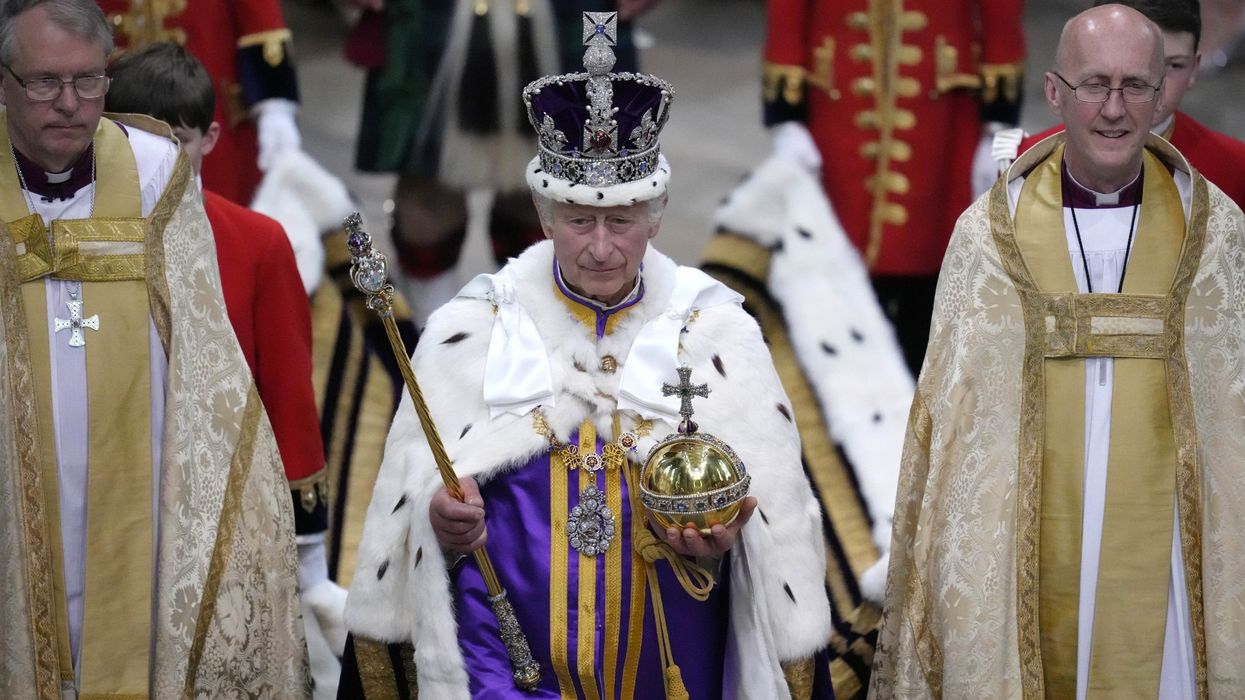

King Charles III was anointed and crowned on Saturday in Britain's biggest ceremonial event for seven decades, a sumptuous display of pageantry dating back 1,000 years.
In front of a congregation of about 100 world leaders and a television audience of millions, the Archbishop of Canterbury, the spiritual leader of the Anglican Church, slowly placed the 360-year-old St Edward's Crown on Charles' head as he sat upon a 14th-century throne in Westminster Abbey.
Gun salutes were fired at the Tower of London and across the capital, the nation, in Gibraltar, Bermuda and on ships at sea.
"God save King Charles. Long live King Charles. May the king live forever," the congregation at the abbey said after a trumpet fanfare.
During the historic and solemn two-hour service, which dates back to the time of William the Conqueror in 1066, Charles' second wife Camilla was also crowned queen.
While rooted in history, the ceremony - televised for only the second time - is also an attempt to present a forward-looking monarchy, with those involved reflecting a more diverse country and all its religions.
With the nation struggling to find its way in the political maelstrom after its exit from the European Union and maintain its standing in a new world order, the monarchy's supporters say the royal family provides an international draw, a vital diplomatic tool and a means of keeping Britain on the world stage.
Saturday's event was on a smaller scale than that staged for Queen Elizabeth in 1953, but still sought to be spectacular, featuring an array of historical regalia from golden orbs and bejewelled swords to a sceptre holding the world's largest colourless cut diamond.
Charles, 74, automatically succeeded his mother as king on her death last September, and the coronation is not essential but regarded as a means to legitimise the monarch in a public way.
After the service, Charles and Camilla, 75, departed in the four-tonne Gold State Coach built for George III, the last king of Britain's American colonies, to ride to Buckingham Palace in a one-mile procession of 4,000 military personnel from 39 nations.
Tens of thousands of people ignored pouring rain to mass in a crowd more than 20 deep in some places to watch what some saw as a moment of history.
Inside the abbey, which was bedecked with flowers and flags, politicians and representatives from Commonwealth nations took their seats alongside charity workers and celebrities, including actors Emma Thompson, Maggie Smith, Judi Dench and US singer Katy Perry.
Charles looked solemn as he swore oaths to govern justly and uphold the Church of England - of which he is the titular head.
He was then hidden from watching eyes by a screen for the most sacred part of the ceremony when he was anointed on his hands, head and breast by Archbishop of Canterbury Justin Welby with holy oil consecrated in Jerusalem.
After being presented with symbolic regalia, Welby placed the St Edward's Crown on his head and the congregation cried out "God save the King".
His eldest son and heir Prince William, 40, then knelt before his father to pledge his loyalty as his "liege man of life and limb", both moments greeted by cheers from crowds outside.
As he left the abbey, Charles wore a silk and ermine robe.
(Reuters)