
INDIA will launch an investigation on Tuesday (18) into a train collision that killed nine people in the state of West Bengal and injured more than 50, a day after a top railway official blamed the incident on driver error.
The death toll was revised down to nine from 15 after Monday's accident, in which a freight train rammed into a passenger train heading for the state capital of Kolkata from the northeastern state of Tripura.
The investigation by India's top railway safety official will start on Tuesday, said Chetan Kumar Shrivastava, general manager of the Northeast Frontier railway, where the accident happened.
"The inquiry will involve eye-witness accounts, scrutiny of official documents and statements from railway officials, regarding signalling and other mandatory safety issues," he added.
On Monday, India's top railway official said the driver of the freight train, who was among the dead, disregarded a signal, leading to the crash with the Kanchanjunga Express, which had halted near a railway station in the district of Darjeeling.
There were 1,400 people aboard, a railway spokesperson said.
But media said an automatic signalling system had not been working from Monday morning, prompting authorities to advise train drivers to proceed slower than usual, in a process known as "paper signals".
India's opposition leaders criticised the railway safety record of prime minister Narendra Modi's government, attributing it to negligence.
The incident came a little over a year after about 288 people were killed in one of India's worst rail crashes in the neighbouring state of Odisha, caused by a signalling error.
State-run Indian Railways, notorious for overcrowding, is the world's fourth largest train network, carrying 13 million people a day, along with nearly 1.5 billion tonnes of freight in 2022.
In remarks to media on Monday, top railway official Jaya Varma Sinha, who chairs India's railway board, called for human error to be redued, adding that an anti-collision system was being set up nationwide.
Partial services resumed on the affected tracks on Tuesday, with some trains diverted and others running slower than usual, railway officials said.
Survivors recall horror
Survivors described on Tuesday their terror when a driver missed a signal and rammed a goods train into a passenger express.
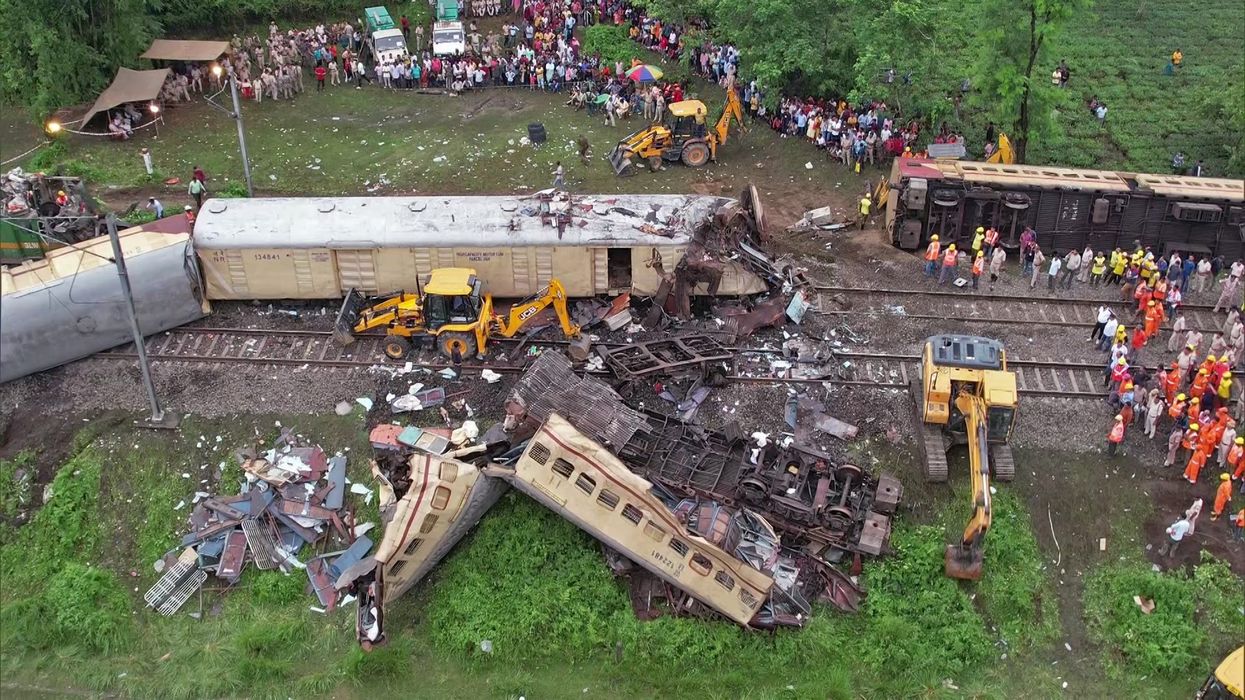
The force of the crash on Monday was so strong that one carriage was initially thrust high into the air, precariously balanced on another.
Heavy goods carriages were flung off the tracks, lying high in tumbled piles.
"I did not feel like I was going to survive," said one passenger, Arti Roy, who lost her belongings when the carriages crumpled, twisted and then flipped off the rails.
Jahangir Alam, 35, who lives near the crash site in the Phansidewa area of Darjeeling district, rushed to offer his help.
He said the sight of the wrecked trains terrified him.
"These accidents that are happening are very dangerous," he said. "Whenever we think about travelling by train, we feel scared inside."
The driver and his co-driver both died in the crash.
Jaya Varma Sinha, chairman of India's Railway Board, said the casualties could have been worse, but a guard wagon and two others carrying post at the back of the passenger train took the brunt of the crash.
India has one of the world's largest rail networks and has seen several disasters over the years, the worst in 1981 when a train derailed while crossing a bridge in Bihar state, killing an estimated 800 people.
In June last year, a three-train collision killed nearly 300 people in Odisha state.
(Agencies)