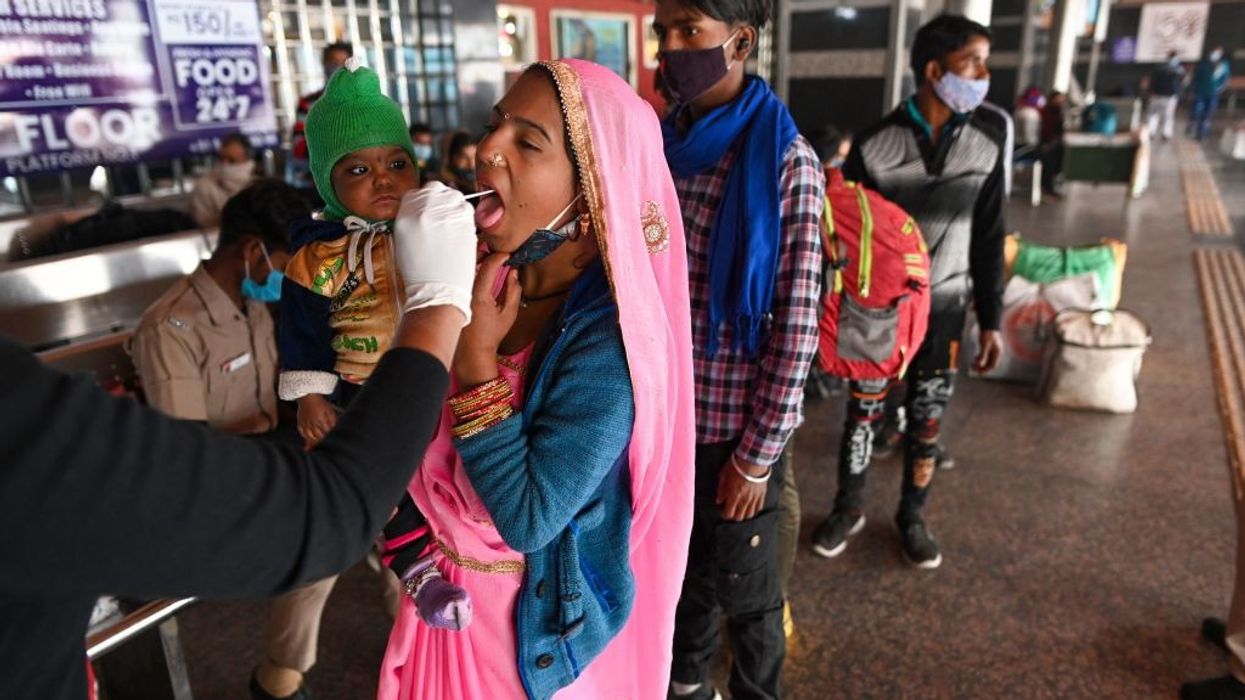

INDIA expects the Omicron variant of coronavirus to cause less severe disease, the health ministry said on Friday (3).
The reasons behind this are vaccinations and high prior exposure to the Delta variant that infected nearly 70 per cent of the population by July.
Junior doctors protested to demand that staff numbers be beefed up, warning of a disastrous situation if the new variant overwhelmed health care facilities, although nearly half of India's 944 million adults have been fully vaccinated.
As many as 84 per cent have received at least one dose, with more than 125 million people due for a second by the end of November, as the government pushes more to get inoculated in the face of Omicron.
"Given the fast pace of vaccination in India and high exposure to Delta variant ... the severity of the disease is anticipated to be low," the ministry said in a statement. "However, scientific evidence is still evolving."
Both of India's first two Omicron patients, reported on Thursday (2), showed mild symptoms, the ministry added.
But concern over the prospect of a third wave of infections has grown after the variant was found in the southern state of Karnataka, in one person with no recent travel history.
The ministry told parliament its immunisation experts were weighing the need for booster doses, after many lawmakers demanded a third shot for healthcare workers and the vulnerable.
It added that discussions on vaccinating the 145 million children aged between 12 and 17 were underway.
New cases have plateaued at about 10,000 in the last few weeks after hospitals and health care facilities were swamped in April and May by a record second surge of infections and deaths unleashed by the Delta variant.
New Covid-19 infections stood at 9,216 on Friday, as some resident doctors kept away from non-critical work to press a demand to add staff by enrolling new post-graduate students.
"We want justice," shouted some students holding a protest at the Dr Ram Manohar Lohia Hospital in the capital, while placards nearby read, "We are human, not robot."
An aide to health minister Mansukh Mandaviya did not immediately respond to a request for comment.
"Healthcare institutions across the nation are running short of adequate workforce of resident doctors," a national grouping of such doctors at dozens of government hospitals told the minister in a letter.
"With the possibility of a future Covid-19 pandemic wave looming large, the situation will be disastrous."
The government has had to delay student admissions over legal disputes on issues such as reserving places for poor applicants.
India has one of the world's worst doctor-to-patient ratios, but prime minister Narendra Modi has said it will turn out more doctors in the next decade or so than during the first 70 years since independence from Britain.
India's tally of Covid-19 infections is 34.62 million, government figures show, with the death toll rising 391 on Friday to 470,115.
(Reuters)



