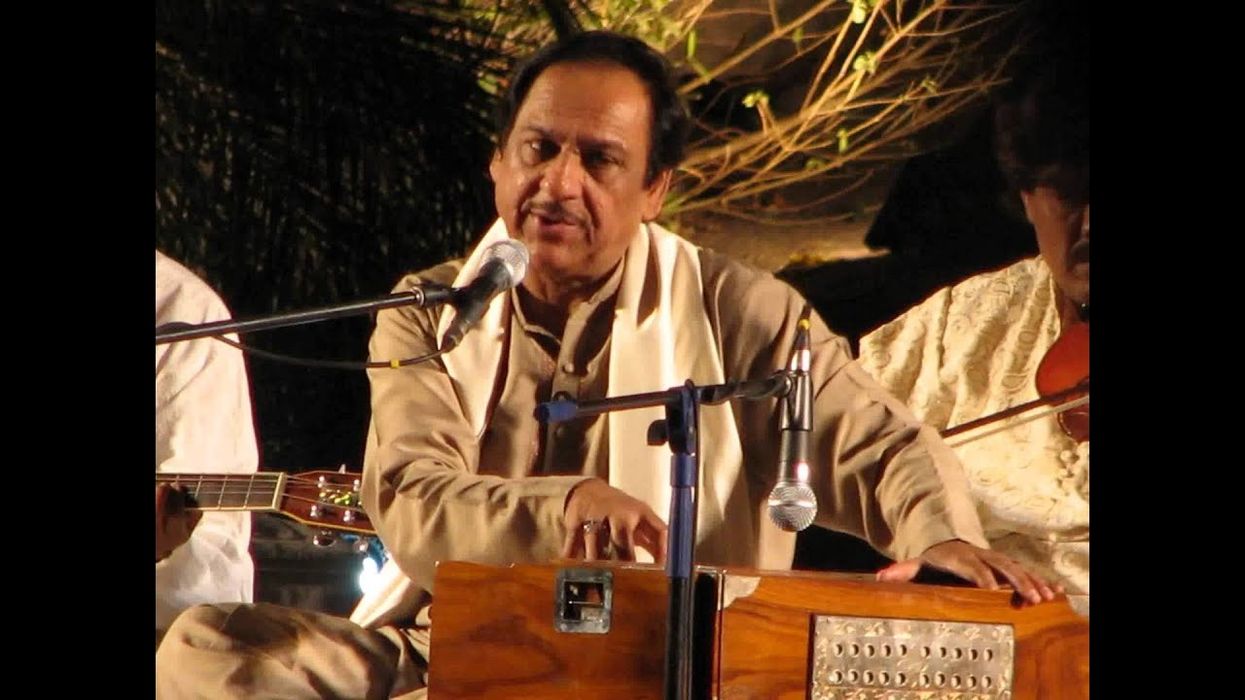

LEGENDARY Pakistani musical maestro Ghulam Ali is widely regarded as one of the greatest ghazal singers in history.
A remarkable career has seen him perform all over the world, release timeless albums and deliver iconic ghazals that have delighted millions across different generations. Born in 1940, he turns a year older this week and celebrates his 81st birthday on December 5.
To mark the occasion, Eastern Eye went back through his treasure trove of interviews and present memorable quotes that help sum up his amazing musical life.
- “I was born in 1941 in Pakistan's Sialkot district. I was six at the time of the Partition. I have foggy memories of people crossing
the border.”
- “Once, when I was six or seven years old, I was humming a song in the class and my master Ebrahim noticed and called me. I was terrified and afraid he would punish me. But he just asked whether I was Daulatbhai's son. My father was also a musician. Then he asked me to sing the song I was humming. I sang the song and my master, also a singer, was very impressed by me.”
- “At the age of eight, my father gave me a raaga and asked me to rehearse it on the harmonium. I worked on it for a month and learnt it. My grandmother was very angry with my father because she felt that he was overstretching a small child like me, but my father explained that my age was the right time to build the base in music.”
- “My name ‘Ghulam’ was given by my father, a great fan of Bade Ghulam Ali Khan Saab. He used to live in Lahore. I had always been listening to Khan Saab, since childhood. My father used to take me to Lahore, 100km away from our village. We used to travel first in a horse and cart, and then take a bus to Lahore.”
- “It was my father’s dream that I become a ghazal singer. He named me after the ghazal legend Bade Ghulam Ali Sahib, under whom I was fortunate enough to train. I have been practising since the age of nine.”
- “I was a good student. Whatever they used to teach, I would retain it. Once I was rehearsing on the terrace, and a person from Radio Pakistan had heard me and was very impressed. I was called down, and he asked me whether I wanted to sing on the radio. In those days, singing on the radio was very prestigious.”
- “I was only 14 years old when I started singing for a children’s programme for Pakistani radio. In six months, I progressed to the topmost level.”
- “I was very young when I started singing at live concerts. Since then, I have devoted my life to music.”
- “My well-wishers and fans are everywhere, including India, Pakistan, Hong Kong, Australia, UK and the US. They never disappoint me and shower love whenever I perform in their country.”
- “I am very happy that I have got an opportunity of taking ghazals to various parts of the world and in that process, I have realised that if you do not dilute your way of presentation, which you have received from your elders, then everyone will praise it. Individuality of any art form stands out.”
- "I've been trying to build a bridge between India and Pakistan in my own way through music. I first came to India in 1980 and never stopped coming since then. I must have been in India a hundred times and feel very comfortable there."
- “Ghazal has its own status. It's not just a genre, it's a thought, an attitude, and way of life. When a ghazal is featured in a film, it acquires exceptional longevity. My ghazal Chupke Chupke, Raat Din in Nikaah is remembered to this day. I have sung many ghazals in films. They’re all loved to this day.”
- “Ninety-five per cent of my songs are self-composed. But if others compose something good, I'm happy singing it. But yes, I’ve become used to singing my own songs.”
- “Ghazal singing is not easy. You have to train a lot in the way you pronounce Urdu words and ensure that you hit the right notes while singing. It takes time and today’s singers are not paying complete attention to it.”
- “My father used to say, always remember your past. If you forget your roots you may become proud, and God does not like people who are proud.”
- “I am also a student. One should always keep on discovering oneself. Life is short. Forget the sorrows and keep on lighting new hopes. The young generation should concentrate on classical music. The audience too should listen to music not only physically, but mentally too.”
- “It is not just a career but my humble service to my people. I am very thankful to my listeners who have not only helped me achieve professional success but also admired me for my contribution across the globe. It all happened with the blessings of my elders and the almighty.”