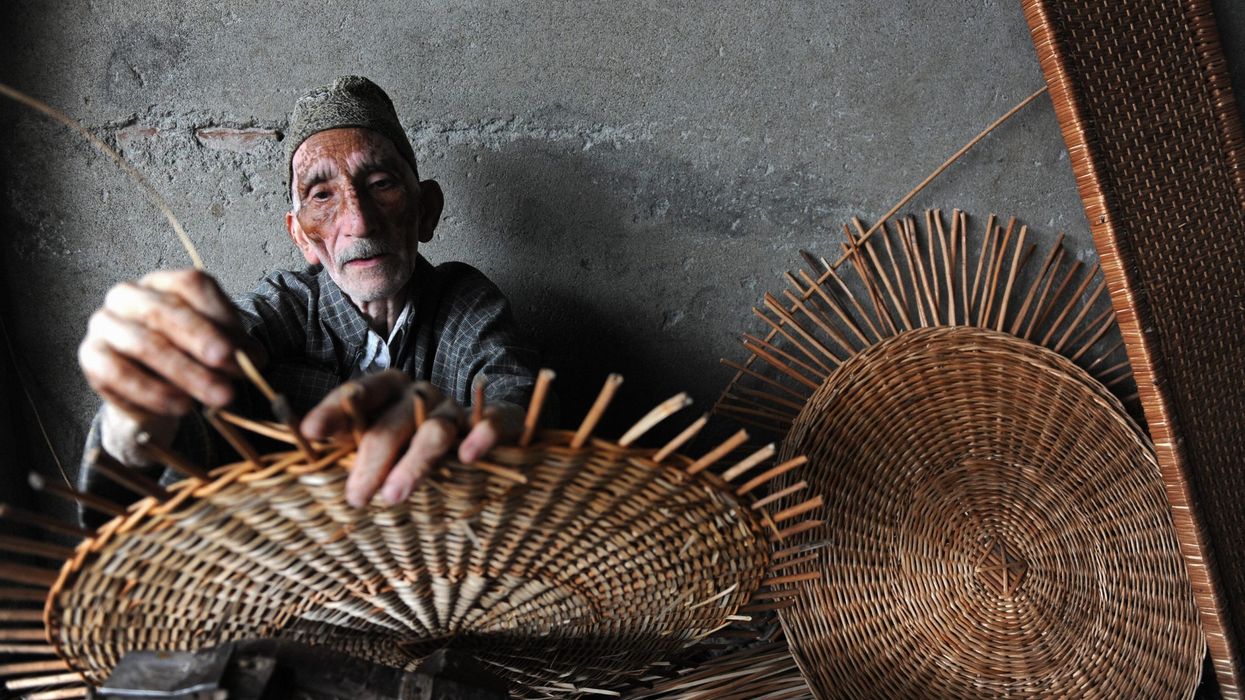

The art of creating intricate wicker products was on the brink of extinction due to diminishing returns and a lack of incentives. However, the Jammu and Kashmir administration intervened in a timely manner, reviving the craft that was originally introduced by the British in the Valley.
Wickerwork is the newest addition to the handicrafts industry in the valley and involves using long, slender branches from willow bushes that grow in the marshy regions of Kashmir to create items such as baskets, trays, chairs, tables, and even beds.
To support the wicker willow artisans, the government has established societies and implemented several measures to strengthen the artisan base through the Handicrafts and Loom policy that was launched in 2020.
"We have registered most of our wicker willow artisans at Ganderbal and Charar-e-Sharif.
"In Ganderbal, we have about 3,000 to 4,000 artisans associated with wicker willow craft and very recently, we made a couple of interventions which include giving awards to the artisans," Director, Handicrafts department, Mahmood Shah told PTI.
As part of the intervention, the cooperative societies have received financial assistance from the government. The policy entails the formation of societies with 10 artisans, who are provided with a financial aid of Rs 1 lakh to enable them to purchase raw materials and essential tools for the production of wicker products.
"We are running the 'Karkhandar scheme' where master craftsmen train students. Both get a stipend as an incentive to ensure that refined skills are transferred from master craftsmen to the young generation.
"We have 15 centres where willow wicker work is taught, not only in elementary centres but advanced centres too … we have ensured that the craft survives," Shah said.
One of the primary challenges to the preservation of wicker art was the younger generation's reluctance to pursue it as a means of livelihood.
Younger generations are reluctant to continue their ancestral profession due to the physical labour involved.
Despite local and outside demand for wicker products, artisans are leaving the trade at an increasing rate.
Maqbool Ahmad, a 40-year veteran willow wicker artisan, stated that the number of families involved in wicker art has dropped from around 300 to less than 100 in his area.
Additionally, Mohammad Shafi, another artisan who has joined the government-run centre, mentioned that the declining wages have also contributed to the decline of the trade.
"Earlier, wages were so low that artisans chose other labour work rather than knitting wicker products. However, after the 2014 financial scheme for the revival of this craft, the designer came from outside to train in developing new and modern designs. We are back to this craft," he said.
"If timely action from the government had not come, this craft was about to die," Shafi added.
The inclusion of wicker art in the World Bank-funded Jhelum Tawi Recovery Project after the 2014 floods breathed new life into the craft, which had been dying out despite its centuries-old presence in Kashmir.
The project included the handicraft and handloom sector, and Abid Mehraj, a cluster development officer, stated that the incorporation of four crafts, including willow wickerwork, was the most effective intervention.
Additionally, a consultant agency from Kolkata was hired in accordance with World Bank guidelines to provide training to the willow wicker artisans.
"Only after one workshop our master artisans had with them, we got orders from outside and leading online websites like 'Amazon' shortlisted our products for sale," Mehraj said.
The intervention by the government has significantly increased the income of the artisans. Prior to this, an artisan would earn a meagre sum of Rs 300 to Rs 400 per day.
"Now, they are earning Rs 1,200 per day and young artisans are also taking interest in this craft," he added.
With inputs from PTI