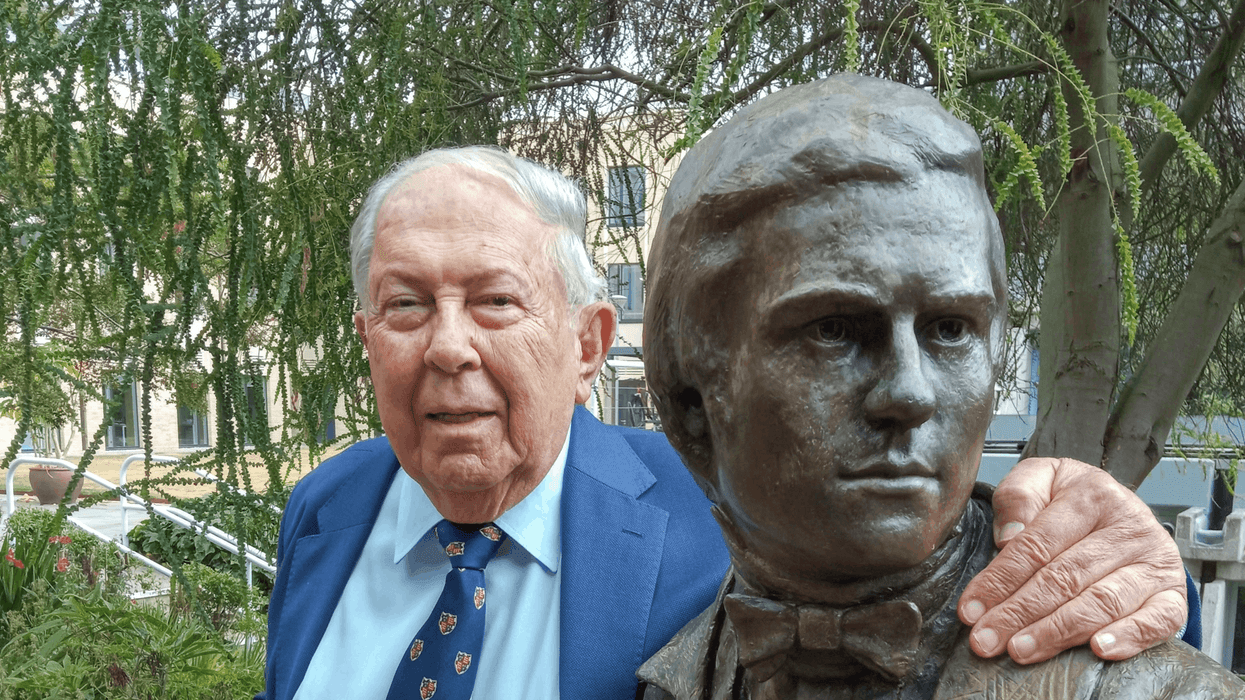

If there is one man who truly deserves a Nobel Peace Prize, it’s not Donald Trump but Dr Yusuf Hamied, long-time chairman of the Indian pharma giant, Cipla.
His friends and admirers across the world did nominate him for a Nobel about 25 years ago in recognition of his campaign to make medicines affordable for the poor and especially his efforts to save AIDs sufferers in Africa.
But the nomination “was cancelled after I was called a ‘pirate’ ”, said Hamied. “What I did was perfectly legal under the laws of India and Africa.”
The “pirate” label unfairly pinned on him by rival western pharma companies, who were furious Hamied was undercutting their exorbitant prices. While they were charging around $20,000 a year for Antiretroviral “AIDS cocktails”, affordable only by the rich, Hamied supplied his made-in-India drugs for “a dollar a day”.
Over 44 million people have died from AIDS-related illnesses worldwide since the start of the epidemic, with the vast majority of these deaths occurring in sub-Saharan Africa. Cambridge University recognised that Hamied’s intervention saved the lives of between 10m and 15m Africans and awarded him an honorary Doctor of Science. Hamied has long believed that pharma has to have a humanitarian aspect and that no one be should be denied medicines.
This year is especially significant for Hamied who will turn 90. He was born in Vilnius, now in Lithuania, on 25 July 1936, the son of an Indian Muslim father, Khwaja Abdul Hamied, and a Lithuanian Jewish mother, Luba Derczanski. It was Hamied’s father who founded Cipla in 1935.
“But it is 90 years since Cipla started making medicines in 1936,” said Hamied, who has homes in England, India and in Spain.
It is partly because of Hamied that India is now considered “the pharma capital of the world”.
Sketching out the arc of his own illustrious career and the evolution of Cipla in an interview, he said: “We are essentially a generic drug company. We have a presence today in over 70 to 80 countries, and export medicines from India. We have manufacturing units in South Africa, in America, in Morocco, and in China also. Products that have made us very popular were for AIDS and malaria. Over the years, Cipla has been a leader in respiratory medicine, medicines for asthma and for chest infections. Recently, we set up lung wellness centres in Delhi and in Bombay (Mumbai). These units check somebody’s lung function. Air pollution in India is getting totally out of hand.”
“We are the number two in India among the pharma companies,” he continued. “We have a turnover of about $3bn worldwide, and our workforce is approximately 30,000. We have a massive research centre in Bombay with over 2,000 people. We have about 30 manufacturing units. A number of them are approved by regulatory authorities from all over the world. We also have 20 charities.”
He stressed: “One has to move forward all the time. In Cipla, we specialise in incremental Innovation. Suppose there’s a drug, and it works on your body for two hours and then gets excreted. And I want the drug to remain in your body for eight hours.”
What is crucial in pharma is the availability of API (active pharmaceutical ingredients).
He explained: “The foundation of the industry is the availability of API. The main thing is, who manufactures the active ingredients that go into the end product? The leading country is China. The second is India. These are the two countries that supply the world with the majority of the active ingredients required in pharmaceuticals. And this is something that I really initiated in a big way in India. And I think that laid the foundation for the development of the Indian indigenous drug industry. The manufacture of the active ingredients helped not only India but the world. That is why India is today regarded as the pharmacy capital of the world.”
Hamied started on the shopfloor at Cipla after studying chemistry at Christ’s College, Cambridge, from 1954-1960, first doing an undergraduate degree, followed by a PhD under the 1957 Nobel Prize winner for chemistry, Lord Alexander Todd.
“When I entered the Indian pharmaceutical industry, manufacture of the active ingredients in India was virtually negligible. We followed the British patent law, the intellectual property laws of 1911, right up to September 1972 when the Indian government changed the laws. Till ’72 India was very much under the control of multinational companies. A very good example is the situation of AIDS in Africa. India supplied 90 per cent of all the AIDS drugs required in Africa from the year 2000 onwards.”
He has been a generous benefactor to Cambridge University and to his alma mater, Christ’s College, where last year he set up the Darwin-Hamied Centre to conduct research “at the intersection of biodiversity, science and demography”.
Charles Darwin, author of On the Origin of Species by Means of Natural Selection, or the Preservation of Favoured Races in the Struggle for Life, was also at Christ’s, from 1828 to 1831. There is a statue of the young Darwin located between Yusuf Hamied Court and the Yusuf Hamied Centre.
Hamied posed the question: “What will happen to the world 50 years from now? What should the world do today to see that the earth’s temperature does not go up by five degrees? Well, one thing is certain. Who is a better person to answer that question than Partha Dasgupta?”
Prof Sir Partha Dasgupta is an eminent Cambridge economist who is the author of the landmark 2021 report, The Economics of Diversity: The Dasgupta Review.
Hamied is also partly funding a new library at Christ’s.
Separately, he is helping to establish the Dasgupta-Hamied Centre at the Judge Business School to examine biodiversity.
He is also supporting Lord Ara Darzi, of Imperial College London, who is heading the Fleming Institute in London to try and find ways of combating Antimicrobial Resistance (AMR), the problem that leads to “superbugs” in hospitals.
Hamied, who keeps in touch with some of the most brilliant medical scientists in the world, revealed: “We are setting up a Fleming Institute in India as well, with the collaboration of the one in England.”
At the moment, he is very concerned that the western world, led by Trump, “has stopped giving donations to Africa for drug purchases for diseases like HIV, malaria and TB. India – and Cipla – can be proud they led to drive to provide AIDs and anti-malarial drugs to Africa. But now Africa is in a very, very tight and difficult situation.”
Hamied’s friends think his Nobel nomination should be revived.
ENDS