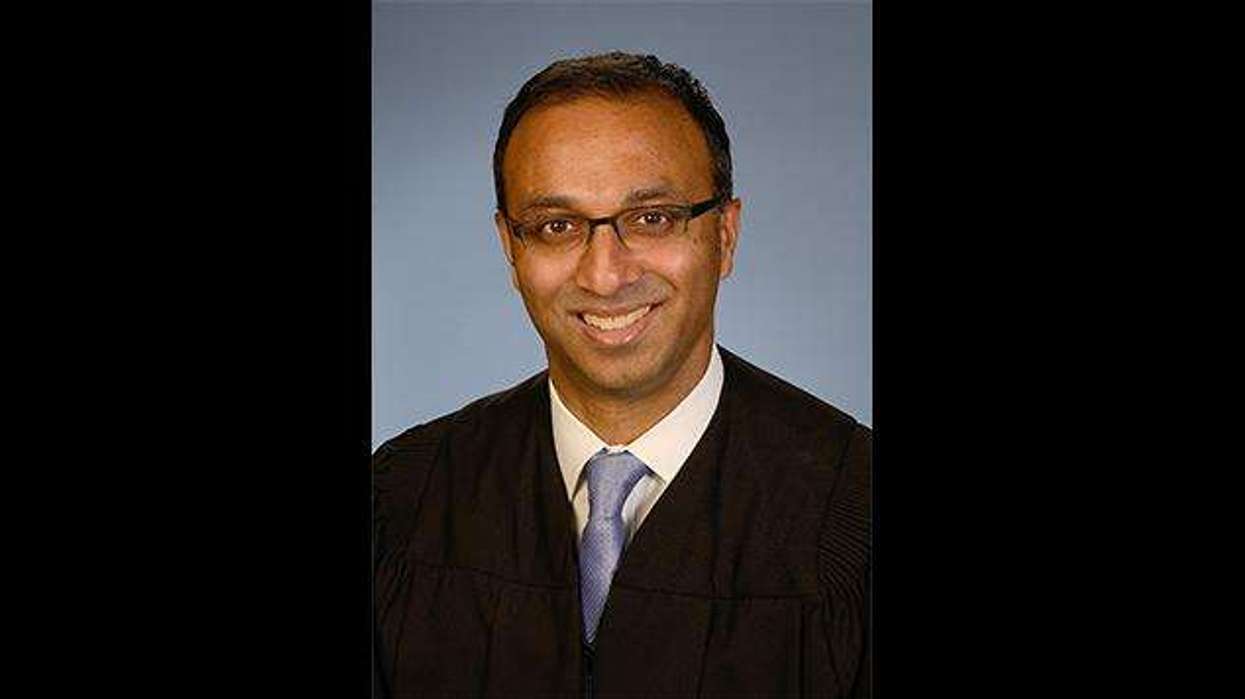

INDIAN-AMERICAN judge Amit Mehta has come into focus after ruling that US president Donald Trump’s speech before the violence at the Capitol on January 6, 2021, was not covered by presidential immunity.
Mehta, a federal judge of the US District Court of the District of Columbia, had in 2022 rejected Trump’s attempt to dismiss three lawsuits that accused him of responsibility for the January 6 attack on the US Capitol.
In August last year, Mehta had also ruled that Google violated anti-trust laws to maintain its position in online search.
Born in Patan in Gujarat in 1971, Mehta was nominated to the US District Court for the District of Columbia in 2014 by then President Barack Obama. He moved to the US at the age of one.
He studied Political Science and Economics at Georgetown University, completing his B.A. in 1993, and later earned his JD from the University of Virginia School of Law in 1997.
After finishing law school, Mehta worked at a law firm in San Francisco and later clerked for Susan Graber of the United States Court of Appeals for the Ninth Circuit. He then worked at a law firm in Washington, DC.
He also served as Director of Facilitating Leadership in Youth, a non-profit organisation focused on after-school activities and mentoring for at-risk youth, according to his profile on the website of the US District Court, District of Columbia.
In his rulings, Mehta has also referred to a personal interest in hip-hop.
On April 1, Judge Mehta said that evidence presented so far in cases brought by police officers and Democratic lawmakers showed that Trump’s speech at the Ellipse on January 6, 2021, was political and not covered by immunity granted to a president’s official acts.
He also said that a call Trump made to Georgia Secretary of State Brad Raffensperger on January 2, 2021, asking him to find 11,780 votes, was political in nature.
“These are the words of an office-seeker imploring a state official to alter the outcome of Georgia's election, not those of an incumbent President acting in his official capacity,” the judge wrote.
While saying that the speech and several other actions appeared to be unofficial, Mehta added that some actions — including directions to Justice Department officials and social media messages prepared during the riot — had enough official character and could not be used against Trump in a trial.
“The court's decision today is not a final pronouncement on immunity for any particular act,” the judge wrote. “President Trump remains free to reassert official-acts immunity as a defence at trial," Mehta said.
On Thursday, another Indian-American lawyer also challenged Trump’s order to end birthright citizenship.
Smita Ghosh, a senior appellate counsel at the Constitutional Accountability Centre, is among a group of lawyers contesting before the US Supreme Court an executive order signed by Trump on the first day of his current term in January.
(With inputs from agencies)