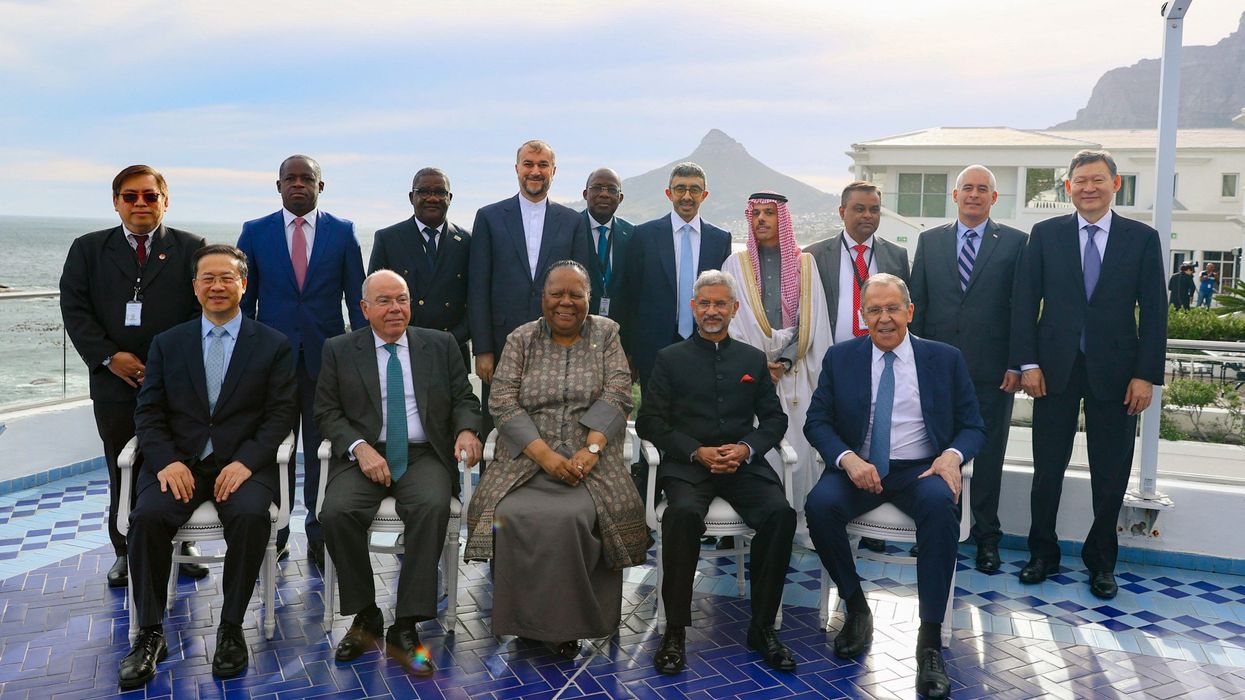

Top diplomats representing BRICS countries expressed openness to welcoming new members into the group during discussions held in South Africa on Thursday (01).
The bloc aims to strengthen its influence in the international arena and seeks a broader representation to amplify its voice.
Foreign ministers from the five-nation grouping of Brazil, Russia, India, China, and South Africa gathered for a two-day conference in Cape Town.
Against the backdrop of the Ukraine war fallout, they collectively called for a "rebalancing" of the global order. The ministers emphasised the need to address and rectify existing imbalances in the international system during their discussions.
"Our gathering must send out a strong message that the world is multipolar, that it is rebalancing and that old ways cannot address new situations," India's Foreign Minister Subrahmanyam Jaishankar said during opening remarks.
"We are a symbol of change and must act accordingly."
As a result of Russia's invasion of Ukraine, Moscow has faced significant isolation on the global platform, leading to its pursuit of closer relationships with China and other nations.
Russian Foreign Minister Sergei Lavrov disclosed that "more than a dozen" countries, including Saudi Arabia, have shown interest in joining BRICS, and the group is presently determining its approach to these potential new members.
The matter was discussed with Saudi Arabia's top diplomat, Prince Faisal bin Farhan Al Saud, who was present in Cape Town, Lavrov said.
China's Vice Foreign Minister Ma Zhaoxu struck a more conciliatory tone, expressing Beijing's welcoming stance towards prospective applicants.
"We expect more countries to join our big family," Ma told a press conference.
Preceding the heads of state summit scheduled for August, talks were held, posing challenges for host country South Africa due to the potential attendance of Russian President Vladimir Putin.
Putin is the subject of an arrest warrant issued by the International Criminal Court (ICC) over allegations of unlawful deportation of Ukrainian children. As a member of the ICC, Pretoria (South Africa's administrative capital) with its close diplomatic relations with Moscow, would be obliged to arrest Putin should he step foot in the country.
South African Foreign Minister Naledi Pandor restated on Thursday that President Putin, like all other leaders, has received an invitation to the upcoming event. She further mentioned that the government is currently examining its "legal options" considering the situation.
"It is difficult to see that South Africa, which has such a strong stand on children's rights, is shaking the hand of a person who is part of these systemic war crimes against Ukrainian children," Dzvinka Kachur, 41, a member of the Ukrainian association of South Africa told AFP.
Pretoria, amidst accusations of tilting towards the Kremlin despite its claim to maintain neutrality in the Ukraine war, has consistently advocated for BRICS to serve as a counterbalance to the prevailing Western-dominated international order.
In line with this objective, fifteen foreign ministries from Africa and the global south have been invited to participate in the second day of talks on Friday (02), aiming to foster dialogue and collaboration among these regions.
(AFP)