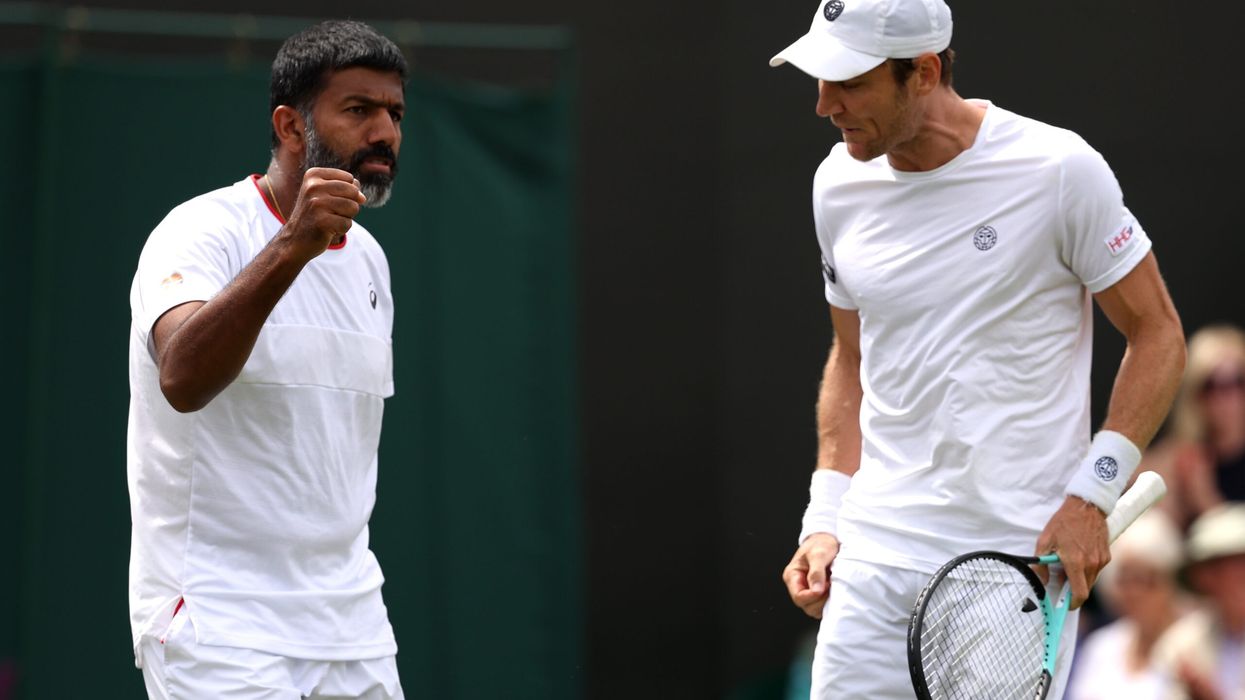

India’s Rohan Bopanna and his Australian partner Matthew Ebden advanced to the second round of the Wimbledon men’s doubles event with a win over Robin Haas and Sander Arends.
Bopanna and Ebden defeated their Dutch opponents 7-5, 6-4 in a rain-interrupted match on Wednesday, finishing in one hour and 11 minutes.
The second seeds, who are the current Australian Open champions, will face Germany’s Hendrik Jebens and Constantin Frantzen in the next round.
The Indo-Australian pair had reached the semi-finals of the season’s third Grand Slam last year.
Earlier on Wednesday, India’s Sumit Nagal and his Serbian partner Dusan Lajovic were eliminated in the first round by Spaniards Pedro Martinez and Jaume Munar.
Martinez and Munar won 6-2, 6-2 in one hour and seven minutes.
India will have further representation in the men’s doubles first round through N Sriram Balaji and Yuki Bhambri on Thursday. Balaji, partnering Britain’s Luke Johnson, will face fourth seeds Mate Pavic of Serbia and Marcelo Arevalo of El Salvador. Bhambri and France’s Albano Olivetti will take on the Kazakh duo of Alexander Bublik and Alexander Shevchenko.
(With PTI inputs)